Sixty-eight resume objective examples sit below, sorted into seven banks by career stage and situation, and every one of them is built from the same three slots: role, evidence, payoff. Change one slot per application and you have a fresh objective in about ninety seconds.
The banks are ordered by how early you are in a career, because that is what decides whether you should write an objective at all. Entry-level and career-change applicants get the most out of one. If your last title already matches the title in the posting, skip to bank #4 — you probably want a summary instead, and there is a bank of those too.
Two things every published example list leaves out are in here. The evidence on whether an objective earns interviews at all, and how the line survives an applicant tracking system before a recruiter ever sees it. Hard-skill terms copied verbatim from a posting match at roughly 60% against ATS keyword filters, against about 28% for soft-skill phrasing [8]. That single fact rewrites most of the objectives you have already sent.
| Bank | Who it is for | Objective or summary |
|---|---|---|
| 1. Entry-level | No paid history in the field | Objective |
| 2. Recent graduate | Degree in hand, fresher pool | Objective |
| 3. Career change | Pivoting fields with transferable proof | Objective |
| 4. Experienced | Title matches the posting | Summary, with three exceptions |
| 5. Industry-specific | Healthcare, IT, finance, creative, service | Either |
| 6. Situations | Relocation, gaps, return to work, terms | Objective |
| 7. High-volume | Applying to 20+ postings a week | Objective, one base line |
What a resume objective is (and the one line that decides if you need one)
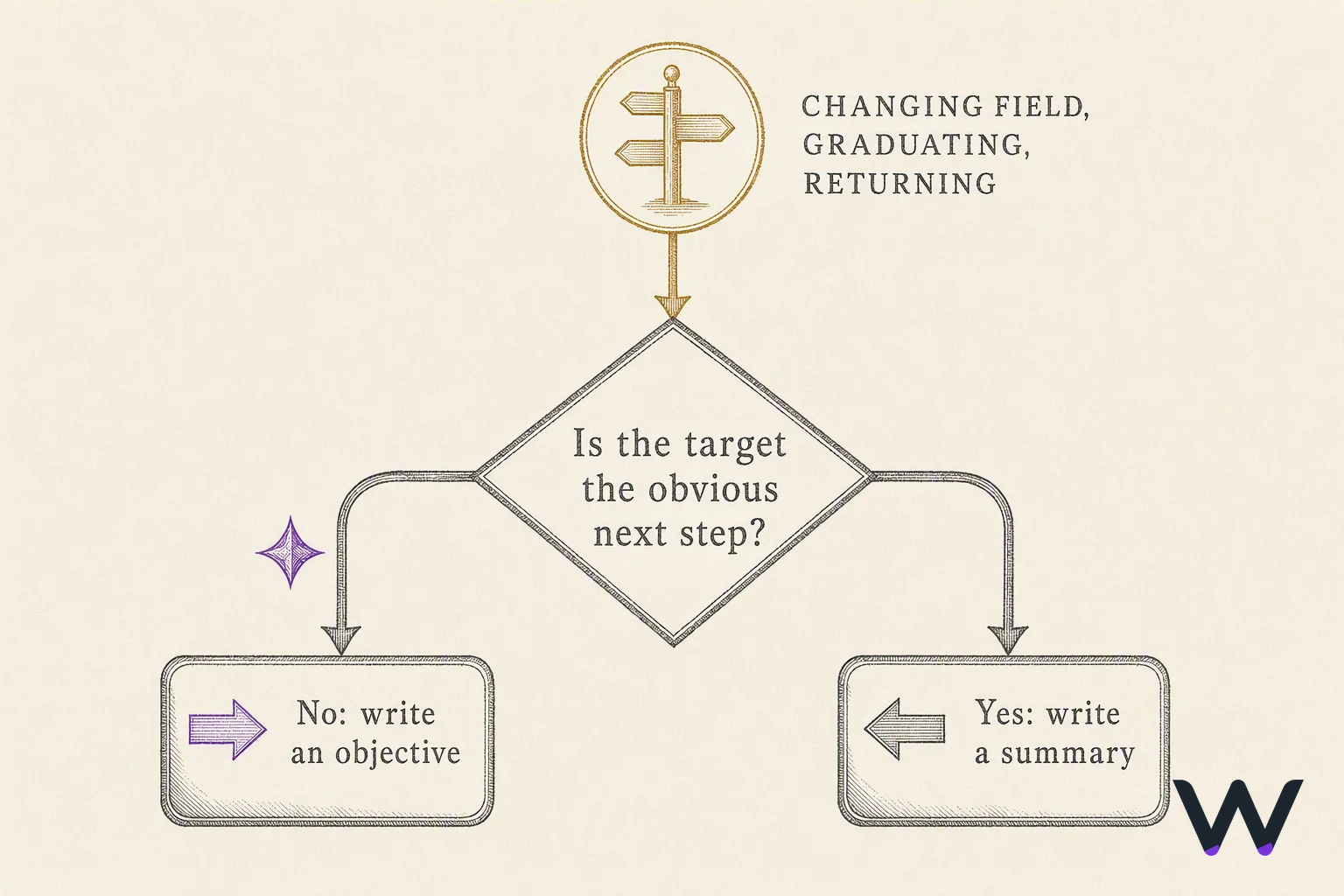
The objective is one or two lines sitting above everything else on the page, and its job is to tell an employer which role you want and why you applied, rather than what you have already achieved [1]. A summary occupies that same slot and does the opposite: a brief snapshot of your skills and accomplishments, written to hold a recruiter's attention long enough that they read the rest [1].
The line that decides between them is short. If the job you are applying for is not the obvious next step from the job on your last resume line, write an objective. If it is, write a summary and let your accomplishments do the arguing. Career changers, new graduates, people returning after a gap, and anyone relocating need the objective, because the rest of the resume does not explain the direction on its own.
An example of an objective statement, with the direction doing the work: "Paralegal of six years moving into compliance, seeking a compliance analyst role where contract review and audit-trail discipline transfer directly." Compare it to the version that gets skipped: "Hoping to find a rewarding opportunity at a growth-oriented company that will let me use my skills." One names a target and a reason. The other names nothing.
Placement is fixed and not worth agonizing over. A resume is the record of your work history, skills, and education that an employer screens before deciding whether to interview you, and the objective sits directly under your contact block, above work experience, in two lines or fewer. Label it "Objective" or leave it unlabeled. Recruiters read the position, not the header.
My position: most people applying to the title they already hold should delete the objective entirely and use a summary. The objective earns its space when it resolves a question the reader would otherwise answer badly on their own, and "why is this person applying here?" is that question. Everyone else is spending their most-read two lines restating what the next section already proves.
✨ Build a Resume That Gets Interviews
AI analyzes 24 ATS criteria · Tailors your resume to each job · Free forever
Build My Resume Free →★ 4.7/5 on Reviews.io
Do resume objectives actually get interviews? What the hiring data shows
Just 7% of U.S. candidates believe the hiring market favors them, per the Greenhouse 2025 Workforce & Hiring Report [2]. In the same report, 80% of U.S. workers said they feel insecure in their current roles, and 45% of Gen Z candidates said standing out to employers is harder than ever [2]. That is the market your two lines land in. More applicants per posting, more of them qualified.
Here is what the evidence does not show. No public controlled study isolates resumes with an objective against otherwise identical resumes without one and reports the difference in interview rate. Every ranking page on this keyword implies that number exists. It does not, and saying so plainly beats dressing up a recruiter-attention statistic as proof of something it never measured.
So treat the objective as a targeting device, not a scoring one. It cannot make a weak match look strong, and a hiring manager who wanted a Salesforce administrator will not be talked into a career changer by a sentence. What it can do is stop the reader from misfiling you: from reading "restaurant manager" and closing the file before reaching the operations coursework three inches down.
One more finding from the Greenhouse report is worth carrying into how you write yours. 72% of candidates report that the job they applied for turned out to be different from what was advertised [2]. Mirror the posting's exact job title, because that is what the screener searches for. Do not mirror its wish list, because the wish list is frequently fiction.
Good objectives for a resume share three traits: they name the exact title from the posting, they carry one piece of evidence that is checkable, and they say what the employer gets. Bad ones ask for growth opportunities. "Seeking a challenging role where I can develop my skills" tells a reader you want something from them and nothing about what arrives if they say yes.
What would change this view: a split test run across a few thousand applications inside one ATS, same resume, objective toggled on and off, measured on callback rate by seniority. Until someone publishes that, the honest claim is narrow. An objective helps when your resume needs an explanation. Rewrite yours for the three roles you applied to last week and see whether each version could only have been sent to that one posting.
The 3-part formula every example below follows
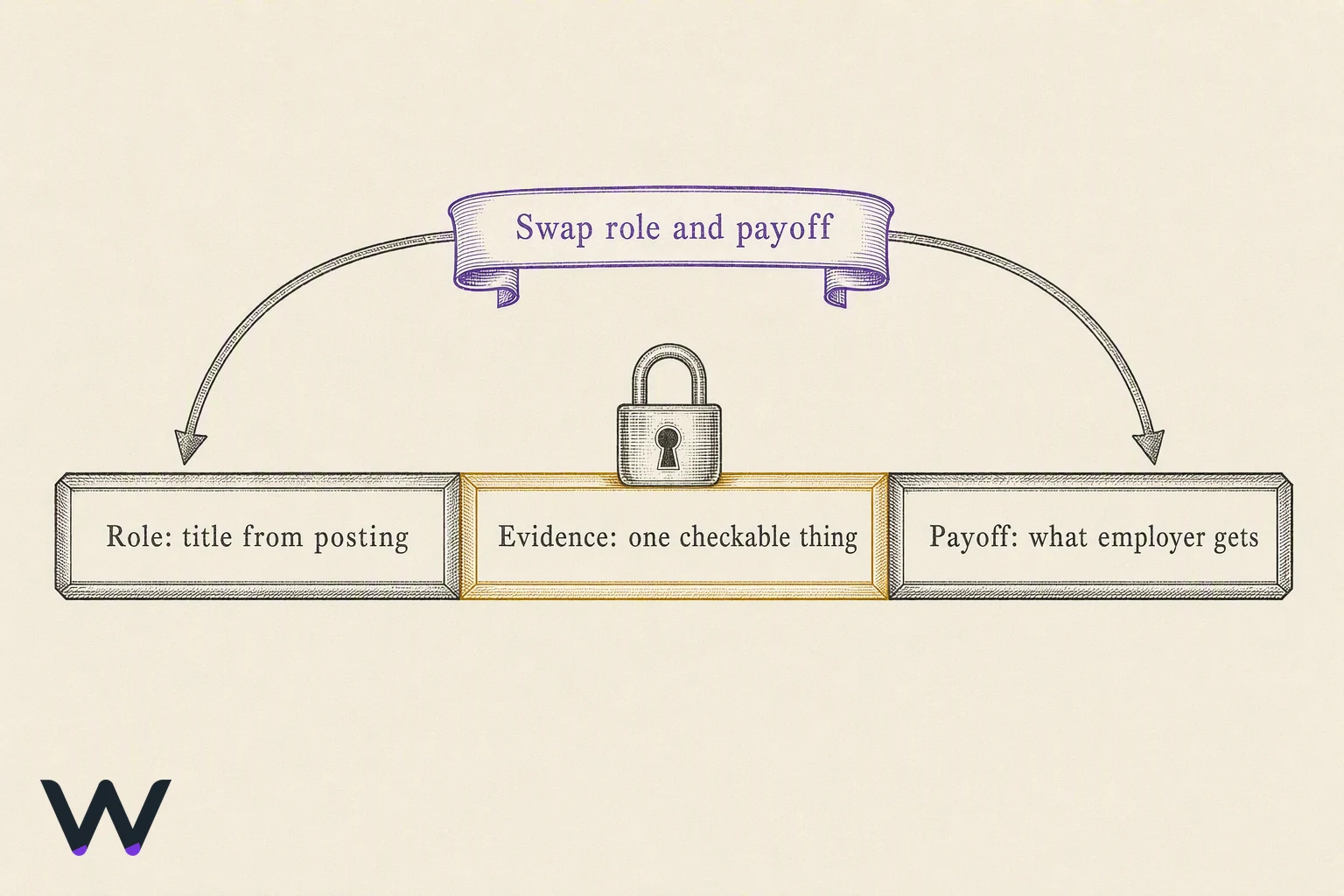
Every example in the banks below is built from the same three slots, in the same order: role, evidence, payoff. Learn the order once and you can write a fresh objective per application in about ninety seconds, because only one slot changes.
The slots, in the order they belong on the page:
- Role. Copy the job title verbatim from the posting, plus your own current or intended identity.
- Evidence. One checkable thing you have done: a named tool, a certification, a scope, a result.
- Payoff. What the employer gets, phrased in their terms, not "opportunity to grow".
- Swap slot. Role and payoff change per application. Evidence usually does not.
- Length. Two lines maximum on the printed page, one sentence preferred.
- Cut. Any adjective that survives being deleted without changing the meaning.
Assembled, it reads: "Bookkeeper certified in QuickBooks Online seeking the Staff Accountant role at Ramp, bringing month-end close experience to a team scaling its billing operations." Role, evidence, payoff. Nothing decorative.
A strong objective is one that could not have been sent to any other posting. That is the entire test, and it is stricter than it sounds. Take your draft, swap in a different company name and a different job title, and if the sentence still works untouched, it is generic and the reader will treat it as such. Weak drafts fail on the payoff slot first, almost always by talking about what the applicant wants.
Lead the evidence slot with a verb or a credential rather than a feeling. "Trained on Epic scheduling" beats "passionate about healthcare". Where you have a quantifiable metric — shift volume, caseload, ticket count, budget size — put it in the evidence slot and nowhere else, because the payoff slot is the employer's, not yours. Keep the metric honest and roundable. An unverifiable figure in the first two lines poisons the rest of the page.
One habit worth building: keep the evidence slot written down once, in a note, and rewrite only the role and payoff each time you apply.
1. Entry-level and zero-experience objectives
No paid history in the field is a positioning problem, not a disqualification. The evidence slot does not require a salary behind it; it requires something checkable. Coursework, part-time shifts, volunteer hours, a capstone project, and a school leadership role all qualify, and all of them beat an empty claim about being a fast learner. Use the lines below as swap-ins, changing the role and payoff slots per posting.
For new graduates and students, where coursework carries the evidence:
- Degree to analyst: "Statistics graduate seeking a Junior Analyst role, bringing SQL coursework and a capstone forecast built in Python."
- Degree to marketing: "Communications graduate seeking a Marketing Coordinator role, with Google Analytics certification and a semester managing a campus newsletter."
- Internship to full-time: "Summer engineering intern seeking a full-time Associate Engineer role, having shipped test fixtures used by the production line."
For applicants whose only paid work sits outside the target field:
- Retail to customer success: "Retail associate trained on Shopify POS seeking a Customer Success Associate role, resolving refund disputes at the counter."
- Food service to operations: "Line cook fluent in Toast POS and inventory counts seeking a Warehouse Operations role on the night shift."
- Rideshare to logistics: "Rideshare driver with route planning and rating discipline seeking a Delivery Dispatch role at a regional carrier."
For volunteer and high school evidence, which is undersold constantly:
- Volunteer build to trades: "Habitat for Humanity site volunteer seeking a Carpentry Apprenticeship, with tool safety training and crew scheduling experience."
- Club leadership to admin: "Student government treasurer who ran the club budget in Google Sheets, seeking an Office Administrator role."
- High school to hospitality: "High school graduate with ServSafe certification seeking a Host role at a full-service restaurant."
Two words to delete from every draft in this bank: "entry-level" and "despite". Calling yourself entry-level tells the screener something the rest of the page already says, and it spends your best line on your weakest fact. "Despite having no experience in the field" is worse. It hands the reader the objection before they have raised it themselves, and hiring managers are not obligated to argue you out of your own framing.
Take the strongest transferable skill you actually have, name the system or certification behind it, and write it once. Then change only the job title per application.
2. Recent graduate and fresher objectives
A recent graduate's degree is not the differentiator, because everyone in a fresher pool has one. The detail inside it is: the capstone dataset, the lab technique, the thesis method, the student-org budget you actually ran. Lead with that detail, name the target role in the posting's own words, and stop there. Two clauses, one sentence.
Use these swap-ins when your most recent dated line is a graduation and your work history is coursework, internships, or campus roles. Replace the capitalized slots.
- "Computer science graduate whose capstone shipped a working API for a campus food pantry, applying for the Junior Developer opening at COMPANY."
- "Accounting graduate and former treasurer of a student chapter, seeking the Staff Accountant role where reconciliation accuracy is the first listed duty."
- "Nursing graduate with clinical rotations in med-surg and pediatrics, targeting the New Graduate Residency at HOSPITAL."
- "Marketing graduate who ran the paid social budget for a student-run agency and cut cost per signup, applying for the Marketing Coordinator role at COMPANY."
- "Mechanical engineering graduate with a senior design project on thermal testing, seeking the Manufacturing Engineer position at COMPANY."
- "Psychology graduate with a thesis on survey design and a semester of statistical coding, applying for the Research Assistant opening at LAB."
Each of those names something a recruiter can check. "Eager to apply my strong academic foundation" names nothing, and a hiring coordinator moving through a stack of fresher applications reads it as blank space. Fill the evidence slot with the smallest true specific you have.
When to drop the graduation year
Keep the graduation year while it is the newest dated item on the page. It explains a thin work history instead of hiding one, and for fresher job applications it is the timeline the reader is looking for. Drop it the moment a full-time role outranks it in recency, and drop it for good once enough years have passed that the date reads as an age marker rather than a milestone. Freshers keep it. Anyone with a decade of work behind them does not.
3. Career change and pivot objectives
A career change objective has one job: connect the old field to the new target with proof that survives the jump. The proof matters more than the apology, and the hiring data supports leading with it. Educational background slid from the fourth most important hiring factor among HR professionals in 2021 to sixth by 2025, ranked below relevant work experience and demonstrated skills [3]. Among HR professionals, 82% say critical-thinking skills are acceptable to employers when gained through a non-degree route [3].
That gives career changes a shape. Name the old field once, name the transferable evidence, name the new role. Three slots, one sentence, no autobiography.
- "Six years in restaurant management, including scheduling and P&L for two locations, moving into Operations Coordinator work at COMPANY."
- "Classroom teacher moving into instructional design, with a certificate program completed and three self-built course modules now in use at SCHOOL."
- "Pharmacy technician transitioning to clinical data entry, with inventory auditing experience and a completed medical terminology course."
- "Retail district trainer moving into corporate Learning and Development, having onboarded staff across eleven stores."
- "Journalist moving into content marketing, with a portfolio of published explainers and a year of managing an editorial calendar."
Two phrasings undo all of that work, and both are common enough that recruiters read them as a category. The first is "seeking to transition into a new field where I can learn and grow," which asks the employer to fund your education. The second is any version of "looking to break into" the industry, because the verb concedes you are standing outside the door. Rewrite both around what you already do that the new role needs.
Skip the change narrative entirely if your transferable proof is thin and your old field is unrelated. In that case the objective slot is better spent on a specific certification, a completed course, or a portfolio project, and the story goes in the cover letter where there is room for it. Career direction clarity is the whole point of the line. A reader who finishes your objective and still cannot name the job you want has been given a paragraph about you instead of a claim about the role.
4. Experienced and senior-level objectives
Most experienced applicants should write a summary, not an objective. The summary wins when your last title matches the target title, because the reader wants scope and results, not intent. An objective wins in exactly three situations: you are relocating and the address on the resume contradicts the posting, you are pivoting into an adjacent function, or you are re-entering after a gap. All three raise a question in the reader's first five seconds. The objective answers it before the question hardens into a rejection.
Senior lines carry numbers the way junior lines carry coursework. Years, headcount, budget, territory, revenue scope. Spell out the figures that are yours, and put the target role at the end so the sentence lands on the job.
- "Operations director with eleven years in third-party logistics, relocating to Denver in the spring and seeking a regional operations role covering multi-site fulfillment."
- "Engineering manager who has run a fourteen-person platform team and a seven-figure tooling budget, moving into a Director of Engineering role with hiring ownership."
- "Finance lead returning after a two-year caregiving break, previously owning a forty-million-dollar annual plan, targeting an FP&A manager position."
- "Sales manager with nine years in medical devices and a territory covering four states, seeking a national accounts role at a device manufacturer."
- "HR business partner supporting a three-hundred-person division, moving from generalist work into a Compensation Manager seat."
Cut the adjectives that senior resumes accumulate. "Seasoned," "results-driven," and "proven track record" are the three that survive longest and pay least, because every competing applicant at your level writes them too. Scope numbers do the same job and cannot be copied.
One caution on the re-entry line. Name the gap in the objective only if the dates make it obvious anyway, then move immediately to the scope you carried before it. A gap explained in six words reads as confidence. The same gap explained in three sentences reads as a defense, and it pushes your strongest quantifiable metrics below the fold.
5. Industry-specific objectives: healthcare, IT, finance, creative, customer service
Industry norms decide what goes in your first clause, and the convention differs more by field than by seniority. Lead priorities split cleanly: business resumes should lead with metrics and leadership, creative resumes with a portfolio, STEM resumes with skills and projects, and nonprofit resumes with service and impact [4]. The pattern holds down into individual job families. Read the posting's first three requirement bullets and mirror whichever of those four things they name.
- Healthcare and nursing roles. Credential first, setting second. "Registered Nurse licensed in Ohio with Basic Life Support certification and two years of med-surg experience, seeking a night-shift position on a telemetry unit." Dental assistance follows the same rule with the radiology certification in the same slot.
- IT and engineering roles. Stack first, scale second. "Backend developer working in Python and Go on Amazon Web Services, seeking a platform engineering role on a team running containerized services." Name the tools the posting names, spelled the way the posting spells them, because the Applicant Tracking System matches strings and not synonyms.
- Finance and accounting. Metric first. "Certified Public Accountant closing a month-end cycle for a mid-market manufacturer, seeking a senior accountant role with consolidation ownership." Portfolio size, close timelines, and audit scope belong here.
- Creative and design. Portfolio first, medium second. "Brand designer with a portfolio of packaging and identity work for consumer goods clients, seeking an in-house design role." A link beats an adjective every time in this field.
- Customer service and support. Volume and channel first. "Support specialist handling live chat and email queues for a subscription product, seeking a senior support role with escalation ownership."
- Teaching positions. Certification and grade band first. "State-certified secondary math teacher with experience in inclusion co-teaching, seeking a high school algebra position."
- HR roles. Function first. "HR generalist running onboarding and benefits administration for a growing services firm, seeking a People Operations role."
Specialized niches follow the field they sit closest to. Clinical research borrows the healthcare pattern, data engineering borrows the IT pattern, and development officers at nonprofits lead with impact rather than budget. When two conventions could apply, pick the one the posting's own language uses. Your objective is a match test, and matching the field's vocabulary is the cheapest way to pass it.
6. Situation objectives: relocation, employment gaps, return to work, salary and location terms
Relocation, gaps, return-to-work, and the money question all get solved the same way: name the fact once, in neutral words, then spend the rest of the line on what you bring. Most job seekers over-explain the situation and under-explain the value. Flip that ratio.
Gaps are the least remarkable thing on your resume. An analysis of over 27 million U.S. resumes covering 2020 to 2025 found more than 50% of workers had at least a one-month employment gap, and 58% carry a gap of six months or longer [5]. You are in the majority. Write it like a fact, not a confession.
Swap the bracketed variables and use the line that matches your case:
- Relocating, date certain: "Marketing coordinator relocating to Austin in March 2026, bringing three years of paid social management, seeking a full-time role with Bright Cellars' demand generation team."
- Relocating, open timeline: "Registered nurse licensed in Ohio and Pennsylvania, available to relocate within four weeks of an offer, seeking a med-surg position at Allegheny Health Network."
- Return to work after caregiving: "Financial analyst returning to full-time work after two years of family caregiving, with FP&A and Excel modeling experience across two audit cycles, seeking an analyst role at Baird."
- Gap spent studying: "Operations specialist who completed the Google Project Management Certificate during a 2025 career break, seeking a logistics coordinator role at Flexport."
- Career changer with a gap: "Former restaurant general manager retraining in data analytics, with SQL and Tableau coursework finished in 2026, seeking a junior analyst position at Chewy."
- Layoff: "Customer success manager, most recently at Twilio through a 2025 reduction in force, seeking a CS role covering mid-market SaaS accounts."
Two things do not belong in the objective. Salary expectations are the first: an objective that opens with a number reads as a negotiation before an introduction, and screening guidance treats it as a red flag. Put your figure in the application form field where it is asked for, and nowhere else. Location terms are the second, with one exception — write "relocating to Austin" only when you have committed to the move, because "open to relocation" is the phrase that gets read as "will need a package."
Explaining why the gap happened is also not the objective's job. One neutral clause, then move. The interview is where the story goes, and by then you have already cleared the screen.
7. High-volume applying: one base line, three variables you swap per posting
Over 98% of Fortune 500 companies rely on ATS software to screen incoming resumes [6], which is why a high-volume applicant cannot send one identical objective to forty postings and expect a keyword match. But rewriting from scratch forty times is how people burn out by Thursday. The routine that survives both problems keeps one base sentence and changes three named variables.
Write your base line once:
"[ROLE TITLE] with [EVIDENCE] seeking [POSITION] at [COMPANY]."
Three variables move per application. Everything else stays.
| Variable | Where you pull it | What you change it to | Time per application |
|---|---|---|---|
| Role title | Job posting headline, verbatim | "Marketing Coordinator" not "marketing pro" | 10 seconds |
| Evidence phrase | First 3 requirement bullets | The skill they list first, in their words | 40 seconds |
| Target line | Posting title plus company name | "a demand generation role at Warby Parker" | 10 seconds |
One minute per application. That is the whole budget.
The mirroring rule is narrow: copy the noun phrases, not the sentences. A posting that says "manage paid social campaigns across Meta and TikTok" gives you "paid social campaign management across Meta and TikTok" — same nouns, your grammar. Copying a full sentence from the posting reads as lazy to a human and buys nothing extra from the parser, which is matching terms, not prose.
Pull your evidence phrase from the requirements section, never the "About us" section. Company culture language is where applicants waste their best sentence. A posting that opens with "we're a fast-growing team that values curiosity" is telling you nothing you can put in an objective; the bullet six lines down that says "3+ years in HubSpot" is the one that decides the match.
Cap the customization there. Beyond three variables you are rewriting, and rewriting at volume is what makes people give up at application eleven. Build a text file with your base line and a running list of role titles you have applied to. Paste, swap three, send.
Resume summary examples for when the objective is the wrong tool
Swap the objective for a summary once you have roughly three years of relevant experience. The line is not seniority, it is whether your history is more persuasive than your intent. An objective argues forward: what you want and why you fit. A summary argues backward: what you have already done, with the proof attached.
The conversion is mechanical. Take any objective above, cut the "seeking" clause entirely, and promote the evidence into first position with a number attached.
- Objective: "Marketing coordinator with three years of paid social management seeking a demand generation role at Warby Parker."
- Summary: "Marketing coordinator with three years running paid social across Meta and TikTok, managing a $40,000 monthly budget and cutting cost per acquisition by a fifth."
- Objective: "Registered nurse seeking a med-surg position at Allegheny Health Network."
- Summary: "Med-surg registered nurse, five years across two Level I trauma centers, precepting new graduates through their first six months on the floor."
Four rules separate a summary from a bloated objective:
- Open with your title and years, never with an adjective. "Detail-oriented professional" is the phrase every screener has stopped reading.
- Put a number in the second clause. Budget, headcount, volume, percentage, tenure — any one of them.
- Drop "seeking" and drop the company name. A summary that names the employer has reverted to an objective.
- Hold it to two or three lines. A four-line summary is a cover letter that wandered into the wrong section.
Keep the objective if you are changing fields, returning after a break, or applying to your first job after graduating. In all three cases the forward-looking sentence is doing real work, because the backward-looking one would raise the question you are trying to answer. Everyone else: rewrite it as a summary this week and stop asking for the job in a slot that is meant to prove you can do it.
Resume skills examples to drop into the evidence slot
Almost 70% of employers hiring recent college graduates now use skills-based hiring, up from about 65% the prior year in NACE's 2026 Job Outlook survey [7]. The middle slot of the formula is where that gets decided. Name two skills, one hard and one soft, and give the hard one a unit.
| Field | Hard skill phrasing | Soft skill phrasing |
|---|---|---|
| Marketing | "paid social management across Meta and TikTok" | "cross-functional briefing with design and sales" |
| Software | "Python and PostgreSQL, three shipped internal tools" | "code review across a six-person team" |
| Nursing | "med-surg and telemetry, 24-bed unit" | "family communication during discharge planning" |
| Finance | "financial modeling in Excel and Power BI" | "audit-cycle stakeholder reporting" |
| Retail management | "inventory forecasting for a $2M annual store" | "hiring and scheduling for 18 hourly staff" |
| Teaching | "differentiated instruction, grades 6 through 8" | "parent conferencing across 120 students" |
| Customer support | "Zendesk and Intercom, 60-ticket daily queue" | "escalation handling for enterprise accounts" |
Soft skills fail when they float. "Strong communicator" names nothing a hiring manager can picture, while "escalation handling for enterprise accounts" names a situation, an audience, and a stake. Attach every soft skill to the context it happens in. That single edit does more for the sentence than adding a third skill.
Pull your hard skill from the posting's requirements, and pull the tool names verbatim — Zendesk stays Zendesk, not "ticketing software." Pull the soft skill from whatever the posting's requirement bullets describe as collaboration, ownership, or communication, then rewrite it in your own nouns.
Two skills is the ceiling for one objective sentence. Three turns the line into a list and the reader stops parsing at the second comma. The rest of your skills belong in the skills section, where the parser reads them just as well.
Making the objective survive the ATS
Applicant tracking systems score resumes before a recruiter opens one, and only applications clearing the threshold get routed to a human [9]. That makes the objective a parsing problem first and a writing problem second. Hard-skill and technical terms copied verbatim from the job posting match at roughly 60% against ATS keyword filters, against about 28% for soft-skill phrasing [8]. So "Salesforce administration and SQL reporting" outranks "strong communicator and team player" on the same line.
Six formatting changes decide whether the top block reaches the parser intact:
- Keep the objective in the body text. Pitt's career center advises putting no content in headers or footers, because parsers lose or scramble that text before it reaches the objective [8].
- Strip images and mid-line columns from the top third. The same guidance is blunt: "Avoid using images, complex designs, and mid-line columns" [8].
- Label it with a plain heading. "Objective" or "Career Objective" — not "About Me", "My Why", or a graphic banner with the word set in a logo font.
- Copy hard skills verbatim. If the posting says "accounts payable", write accounts payable, not AP and not payables management.
- Name the exact job title from the posting. Title strings are the highest-weight match in most keyword filters, and an abbreviation breaks the match.
- Save as .docx or a text-based PDF. A PDF exported as a flattened image parses as a blank page.
Keyword integration has a ceiling, and it arrives fast. Three or four exact terms from the posting is the working range for a two-line objective; past that the line reads like a tag cloud to the recruiter who does open it. Write it for the parser, then read it aloud to check a person still recognizes a sentence.
One more formatting rule that costs nothing: one column, one font, left-aligned, 10-12pt. Boring parses.
What not to put in a resume objective
Six phrasings make an objective read as filler, and most published example lists are built out of them. Delete these on sight.
- "Seeking a challenging role that lets me grow." Every applicant wants growth. The line describes what you want from the employer, when the objective's job is your value proposition to them.
- "Hard-working, detail-oriented team player." Adjectives a hiring manager cannot verify and every competing resume also claims. Trade them for a task you performed and a number attached to it.
- The company's mission statement, quoted back. "Passionate about your commitment to sustainable innovation" tells a recruiter you read the About page. It tells them nothing else.
- Salary, hours, or remote-work terms. Career goals about compensation belong in the offer conversation, not in line one of a resume.
- "Looking to transition into a new field." Naming the field you are leaving frames you by what you lack. Name the target role and the transferable skill instead.
- Anything longer than three lines. Resume objective writing that spills to four lines has become a summary wearing the wrong label, and it pushes your experience below the fold.
A cheap test: cover the company name and read the objective. If it could go to any employer in the country unchanged, it is filler, and a recruiter who reads 200 of these a week clocks it in under two seconds.
Cut it or fix it. A resume with no objective beats a resume with a generic one, because the generic one spends prime real estate saying nothing.
✨ Build a Resume That Gets Interviews
AI analyzes 24 ATS criteria · Tailors your resume to each job · Free forever
Build My Resume Free →★ 4.7/5 on Reviews.io
How often to rewrite your objective over a career
Rewrite on events, not on a calendar reminder you will snooze. Four events change what the objective should say: a title change, a new certification, a new tool you now use daily, and a shift in what postings in your field are asking for. Recruit Rockstars CEO Jeff Hyman recommends refreshing a resume every quarter whether or not you are job hunting, plus an immediate update after any promotion, new certification, or newly mastered skill [10]. The quarterly pass is maintenance. The event-driven rewrite is the one that changes the words.
The market-shift trigger is the one people miss. Pull ten current postings for your target title twice a year and read the skills lines. When a tool you never see starts appearing in six of ten, your objective is behind the market, and career advancement objectives written two years ago name software the hiring manager has already replaced.
Personalization stays per-application. The stage-specific template you pick — entry-level, career change, senior — changes maybe three times in a career. The job title and the two hard skills inside it change every time you hit send.
Set a quarterly reminder. Do the rewrite when the event happens.
Frequently asked questions
Do resume cover letter examples work the same way as objective examples?
No. Resume cover letter examples run 150 to 300 words and build an argument across paragraphs, while an objective is one sentence that has to survive a six-second scan and an ATS parse first. Borrow the cover letter's specifics — the metric, the tool, the target role — and compress them. The letter persuades a human. The objective earns the human.
Where does the objective go on the resume?
Directly under your name and contact block, above experience, under a plain heading such as "Objective" or "Summary" in body text. Keep it out of headers, footers, text boxes, and mid-line columns, because Pitt's career center warns that ATS parsers lose or scramble content placed there [8], and over 98% of Fortune 500 companies screened resumes with ATS software as of 2025 [6].
What are good objectives for a resume?
Good resume objectives name the exact job title from the posting, one hard skill written in the posting's own words, and one number you can defend in an interview. Hard-skill terms lifted verbatim from a posting match at roughly 60% versus about 28% for soft-skill phrases [8]. So "Salesforce administrator" beats "detail-oriented team player." Every time.
What is an example of an objective statement?
An objective statement pairs the target role with proof: "Warehouse associate with a forklift certification and more than a year of pick-rate work, applying for the Shift Lead opening." An objective tells an employer your intentions and why you applied rather than cataloguing achievements [1]. That framing is why it works for career changers and stalls for senior candidates.
What is a strong objective?
A strong career objective resume line is specific enough that it could not be pasted into a second application without edits. Weak ones describe the writer; strong ones describe the fit. Given that almost 70% of employers hiring recent graduates now use skills-based hiring [7], the strongest version leads with a demonstrated skill and drops the request for a challenging role entirely.
What not to put in a resume objective?
Leave out salary expectations, the word "seeking," any adjective about your work ethic, and the employer's name misspelled from a previous application. Skip soft-skill strings too — they match at about 28% against posting keywords [8]. Also cut anything you cannot evidence in the experience section eight lines below. An unsupported claim reads as noise.
References
- Resumes and Cover Letters | Career Design Center | USU — usu.edu
- Fighting bias, bots and burnout: Global job market trends from the Greenhouse 2025 Workforce & Hiring Report — greenhouse.com
- The Skills-First Movement: Redefining How Organizations Hire and Grow — shrm.org
- UNC Resume Guide for Students — unc.edu
- Survey Shows Career Gaps Rising: This Job Interview Strategy Can Help — forbes.com
- ATS and Guide to Resumes in 2025 — charlotte.edu
- Majority of Employers Use Skills-Based Hiring — harvard.edu
- Resume and CV Writing Tips – Applicant Tracking Systems (ATS) — pitt.edu
- Craft Your Resume with AI in Mind — shrm.org
- Most Professionals Aren't Updating Their Resume Often Enough — Here's How Frequently You Should Make Changes — yahoo.com

Build a Resume That Gets Interviews
- ✓AI scores your resume on 24 ATS criteria
- ✓Tailors it to each job with one click
- ✓Unlimited resumes — free forever