
Last updated: 2026-08-31
Nine verb banks below, grouped by the bullet situation you are staring at rather than by Management/Communication/Financial buckets. Every verb on this page sits inside a finished bullet. A verb list you have to translate yourself is the list you close at 11pm. Banks are ordered by how often the situation shows up across a week of applications, so bank 1 is the bullet with a number in it.
Start there. If nothing on your page carries a number yet, jump to bank 2: leadership verbs for bullets with no direct reports repair an entry-level resume faster than any adjective swap. Whether you search action verbs for resume or actions verbs for resume, the fault is the same one — a verb that describes the job description instead of what changed because you did the job. Bank 8 is the delete list, and it is the fastest 10 minutes on this page.
The 9 verb banks at a glance
Each bank below is named for the bullet it repairs, sized so you can see how much choice you actually have, and led by the verb that does the most work in that situation.
| # | Bank | Verbs | Lead verb | The bullet it belongs in | Fix it when |
|---|---|---|---|---|---|
| 1 | Quantified impact | 14 | Increased | The bullet that already has a number in it | The verb is vaguer than the metric beside it |
| 2 | Leadership without reports | 12 | Coordinated | Influence over people who did not report to you | You led something and can't say "managed" |
| 3 | Build and ship | 14 | Shipped | Anywhere you wrote "Implemented" | Nobody can tell what came out the other end |
| 4 | Process and efficiency | 8 | Cut | Cost, time, or error rate, with the unit attached | The bullet says "streamlined" and stops |
| 5 | Analysis and research | 8 | Segmented | Confidential work you cannot name the client for | An NDA is eating the whole bullet |
| 6 | Posting-matched phrasing | 8 | Resolved | Bullets rewritten in your target posting's own words | Your words and the requisition's do not overlap |
| 7 | Resume power statements | 3 slots | Negotiated | Verb + identifiable task + purpose, method, or result | The bullet names a duty, not a change |
| 8 | Weak verbs to delete | 4 | — | "Responsible for" and its three relatives | The bullet opens with a phrase, not a verb |
| 9 | Swap-in verbs for tailoring | 6 | Onboarded | One bullet, 30 postings, two edits each | You are rewriting the whole resume per job |
Twenty verbs, one breath, if you need a starting shortlist before you read the banks: Increased, Cut, Reduced, Shipped, Rebuilt, Automated, Coordinated, Convened, Negotiated, Resolved, Documented, Trained, Onboarded, Launched, Migrated, Audited, Forecast, Consolidated, Recovered, Scoped.
Weak resume action statements are rarely weak words. They are unattached ones — a verb with no object, no unit, and no outcome behind it.
✨ Build a Resume That Gets Interviews
AI analyzes 24 ATS criteria · Tailors your resume to each job · Free forever
Build My Resume Free →★ 4.7/5 on Reviews.io
1. Quantified impact verbs (when the bullet has a number)
Hiring managers are the bottleneck on numbered bullets: 76% say AI-written resumes make it harder to understand what a candidate actually accomplished [1]. A verb that outruns its number is how you land in that pile. Claim the action you took, no more:
- Increased — you owned the lever that moved it.
- Cut — cost, time, or hours, never quality.
- Shipped — the thing exists and has a date.
- Recovered — the number fell first, then you fixed it.
- Consolidated — two systems became one and you can name both.
- Grew — a population, not a percentage in isolation.
- Doubled — only when the baseline is stated too.
- Delivered — a committed scope, on a committed date.
- Exceeded — a target somebody else set, quoted.
- Sustained — the number held across a stated stretch of time.
- Converted — an input population became an output one.
- Retained — churn you kept from happening, with the cohort named.
- Saved — currency and period attached.
- Raised — funds, scores, or capacity, with the instrument named.
Same bullet, only the verb changed:
- Before: "Helped improve renewal rate to [X]%." After: "Recovered renewal rate to [X]%."
- Before: "Was responsible for faster month-end close." After: "Cut month-end close by [X]%."
- Before: "Worked on the vendor migration." After: "Migrated [X] accounts to Netsuite."
The pattern is the same in all three. The weak version claims proximity to a result; the strong version claims a specific action against it. Proximity is what a hiring manager cannot verify in an interview, so it reads as filler.
2. Leadership verbs for resume bullets with no direct reports
Leadership verbs work at entry level when they name influence you actually exercised rather than a headcount you never had. Managing sideways is ordinary work, not a stretch claim: leaders reach a point where they must mobilize people who are not their direct reports [2]. Twelve that survive a recruiter's read:
- Coordinated — you set the schedule others worked to.
- Convened — you called the meeting and it produced a decision.
- Onboarded — a named new hire got productive on your instructions.
- Mentored — one person, named skill, stated stretch of time.
- Unblocked — you removed the dependency somebody else was stuck behind.
- Championed — you argued for the change and it shipped.
- Aligned — two parties wanted different things and stopped.
- Facilitated — only with a named decision as the output.
- Escalated — you judged the threshold correctly and named the path.
- Persuaded — a decision changed and you can name whose.
- Trained — a group, a curriculum, a measurable after-state.
- Represented — you spoke for a team in a room it wasn't in.
Use "Led" only when you can name who followed and for how long. Otherwise use Coordinated and keep the interview.
What separates a real influence bullet from a padded one is whether a second person could confirm it. "Convened the weekly release review across three teams" has witnesses. "Provided leadership on release quality" has none, and an interviewer will find that out in one question.
3. Build and ship verbs (the 'implemented' bank)
"Implemented" is the most-copied verb on any résumé, and copied verbs are exactly what an inconsistent read misses: recruiters picked the stronger of two candidates correctly only 55% of the time, and two evaluators disagreed by an average of 41 percentage points [3]. Ambiguity costs you twice — once when a reader skims past it, and again when a second reader scores the same bullet differently. Fourteen replacements, ordered from vaguest to most specific about what came out the other end:
- Developed — the code, curriculum, or model existed after you and not before.
- Built — you made the thing itself, not the plan for it.
- Shipped — it reached users on a date.
- Launched — first public availability, with a market attached.
- Deployed — pushed to a live environment you name.
- Rolled out — staged release across teams or regions.
- Automated — a manual step stopped being manual.
- Migrated — moved a system from a named A to a named B.
- Integrated — two named systems now talk.
- Rebuilt — a working version existed and you replaced it.
- Prototyped — deliberately throwaway, and say so.
- Piloted — limited population, fixed window, measured.
- Standardized — one way replaced several.
- Instrumented — you added the measurement, not the feature.
Pick the verb that survives the follow-up question "what shipped, and when?" If two of these fit equally well, take the one further down the list. The more specific verb narrows what an interviewer can ask, and you already know the answer.
4. Process and efficiency verbs (cost, time, error rate)
Efficiency verbs pair with a saving, never a launch. "Streamlined onboarding" tells a hiring manager nothing. "Cut onboarding from 9 steps to 4" tells them the unit, the before, and the after. Attach a unit to each of these or delete the bullet:
- Reduced — cost, headcount hours, ticket volume. Name the currency.
- Cut — the blunt one. Best with time.
- Eliminated — the step is gone entirely, not shortened.
- Consolidated — several tools, vendors, or reports became one.
- Streamlined — only with a step count on both sides.
- Optimized — name the metric optimized against, or drop the verb.
- Modernized — a named legacy system, replaced by a named current one.
- Accelerated — cycle time, with days.
No unit, no verb. Rewrite the bullet as a "Built and shipped" line instead.
Three units cover almost every efficiency bullet ever written: a currency, a count of steps, and a stretch of time. If your bullet resists all three, the work was probably a build rather than a saving, and it belongs in bank 3.
5. Analysis and research verbs for work you can't show
Confidential analysis is describable without leaking anything. Name the method and the decision it fed, and leave the client, the figures, and the product unnamed. "Analyzed data to support business decisions" is a vibe. "Segmented 4 years of churn records to rank three retention hypotheses for the exec team" is a method plus an audience, with no proprietary detail in it. Verbs that carry a method:
- Modeled — you built something predictive with named inputs.
- Segmented — a population, split on a stated rule.
- Benchmarked — measured against a comparison you can name.
- Diagnosed — found the cause, not the symptom.
- Audited — checked against a standard.
- Forecast — a number, a horizon, an error you owned.
- Reconciled — two sources disagreed and stopped.
- Synthesized — many inputs, one recommendation.
Say what the analysis decided. That is the part no NDA covers.
Three things are almost always safe to state even under a strict agreement: the method you used, the size of the dataset in rounded terms, and the audience the output went to. What stays out is the client name, the raw figures, and any product not yet public. A bullet built from the first three reads as substantive. A bullet that redacts all six reads as if you did nothing.
6. Communication and service verbs matched to the phrasing postings actually use
Use the verbs your target postings already use. That is the honest answer to which verbs belong on a resume. Open five live listings for the role, copy the verbs out of the "Responsibilities" block, and write your bullets in those words.
Two things justify that instruction. First, a recruiter reading fast is pattern-matching against the requisition in front of them, not against a verb list, and career-office vocabulary like "liaised" and "facilitated" rarely appears in the requisition itself. Second, that reading is measurably noisy: two evaluators scoring the same real resumes disagreed with each other by an average of 41 percentage points [3]. Shared vocabulary is the cheapest way to narrow that spread in your favour. Eight verbs that show up in postings for support, success, and coordinator roles:
- Resolved — a ticket, a dispute, a bug, with volume attached.
- Escalated — you knew the threshold and the path.
- Onboarded — customers or hires, counted.
- Briefed — upward communication to a named audience.
- Documented — a runbook, a policy, a help center.
- Presented — to a room, with a size.
- Negotiated — terms changed in your favor.
- Coordinated — across named teams, not "cross-functionally".
Tailor the top three bullets to each posting's verbs. Leave the rest fixed.
Copy the posting's verb, not its whole sentence. Lifting a full responsibility line back into your resume describes the job you are applying for rather than the one you did, which is the exact failure the rest of this page is built to prevent.
7. Resume power statements: the verb + metric + method formula
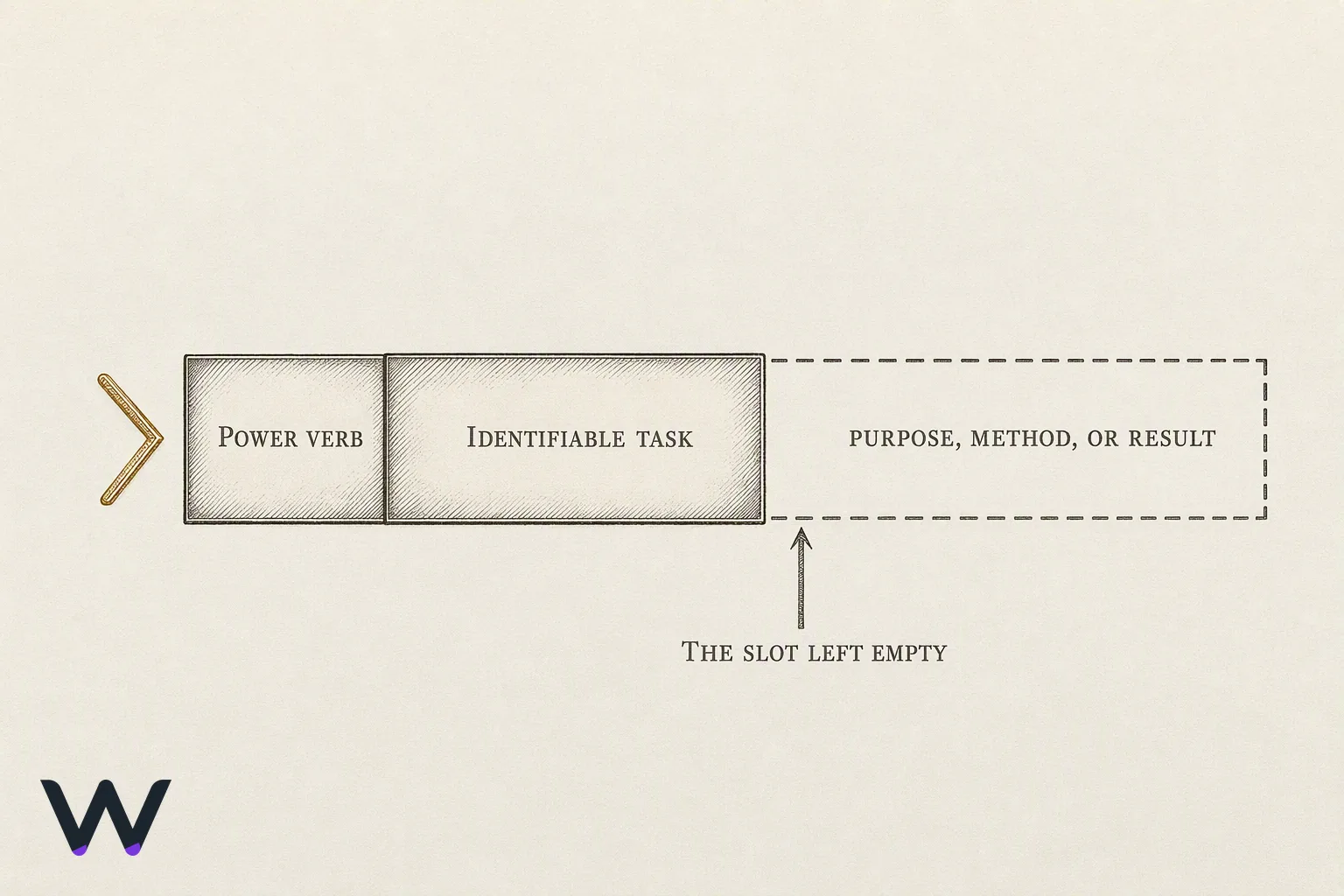
A resume power statement fills three slots in order: a power verb naming the skill, the identifiable task, and the purpose, method, or result behind it. That exact three-part shape is what Purdue University's Center for Career Opportunities teaches, backed by a bank of 82 power verbs across 6 functional-skill categories [4]. Responsibilities describe the job description. Resume action statements describe what changed because you did the job.
The three slots, and what fails in each:
| Slot | What goes in it | How it fails |
|---|---|---|
| Power verb | One past-tense action naming a skill | A phrase ("responsible for") instead of a verb |
| Identifiable task | The specific thing, named | A category ("various projects") instead of a thing |
| Purpose, method, or result | Why, how, or what changed | The slot is left empty and the bullet stops |
Same template, two very different roles:
- Warehouse: Reorganized pick paths across 4 aisles, cutting average order pick time by a third.
- Marketing: Rebuilt the weekly email calendar around send-time testing, lifting open rate two points.
Both bullets fill all three slots, and neither needs a metric in the second slot to work — the result slot carries it. Write the verb last if it helps. Get the task and the result down first, then pick the verb that names the skill a hiring manager is scanning for.
8. Weak verbs to delete on sight
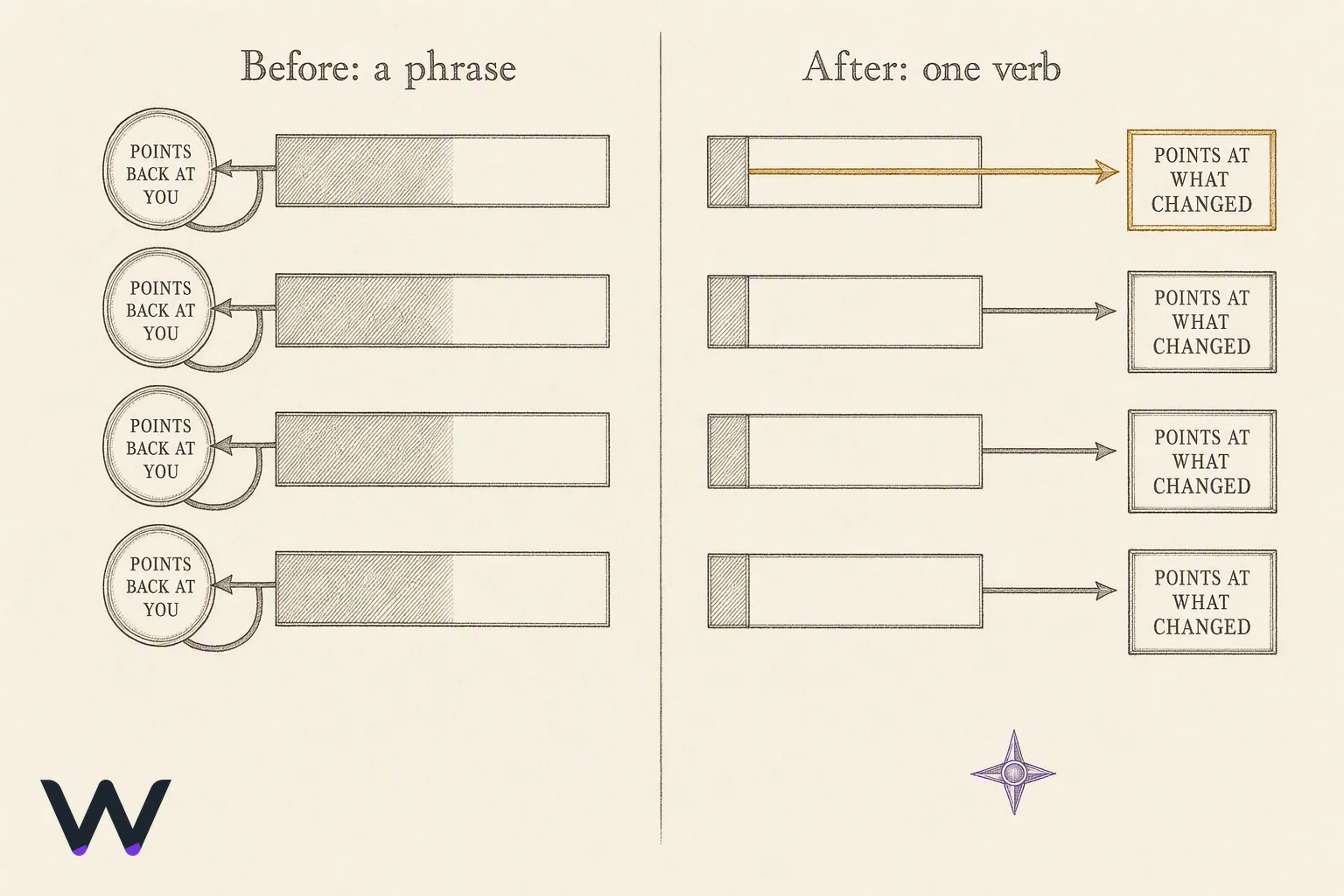
Passive language instead of action words is the No. 3 most common resume mistake seen by Harvard's Mignone Center for Career Success [5]. Four phrases carry it, and every one has a same-length replacement.
| Delete on sight | Write instead | Why the swap works |
|---|---|---|
| Responsible for | Managed, Owned, Ran | Names the scope of ownership, not the assignment |
| Helped with | Coordinated, Supported | Says what your help consisted of |
| Worked on | Built, Shipped, Rewrote | Says what existed afterwards |
| Assisted | Trained, Advised, Handled | Names the service you performed |
All four share one flaw: they describe your relationship to the work rather than the work. That is why swapping them costs no length. The specific verb was always available, and the vague phrase was doing the job of hiding that you had not chosen one.
Five skills worth the space: the tool you use daily, a measurable process skill, one language or system, one people skill shown in a bullet, and one certification. Skills sections list nouns. Bullets prove them.
Past tense for finished work, present for the current job. Keep it that simple.
✨ Build a Resume That Gets Interviews
AI analyzes 24 ATS criteria · Tailors your resume to each job · Free forever
Build My Resume Free →★ 4.7/5 on Reviews.io
9. Swap-in verbs for tailoring one bullet to 30 postings
Write one strong bullet per job, then change only two things per posting: the verb and the object noun. A posting asking for "escalation management" gets "Resolved 40+ escalations a week"; the same bullet for a posting asking for "customer onboarding" becomes "Onboarded 40+ accounts a week." Two edits, roughly 30 seconds, no rewrite.
Six verbs worth keeping in the rotation, because each has a common posting phrase behind it:
- Onboarded — postings asking for activation, ramp, or implementation.
- Resolved — escalation management, incident handling, case work.
- Coordinated — program support, scheduling, cross-team delivery.
- Documented — enablement, knowledge base, process documentation.
- Migrated — platform moves, consolidation, system transitions.
- Automated — operational efficiency, tooling, process improvement.
Tailoring stops paying at the top bullet of your two most recent roles. Below that, a reader skimming a page in seconds is unlikely to reach your edits at all — and given how much two evaluators of the same resume can disagree [3], the return on rewriting bullet nine is close to zero. Cap it there.
Build a swap table before you start applying: three columns, one per bullet, listing the verb variants you will rotate. Then apply, and leave the resume alone.
Frequently asked questions
How does this list compare to the Harvard action verbs for resume list?
Category lists and situation banks answer different questions, and the mapping between them is close to one-to-one. The best-known category scheme groups its verb bank into 9 categories — Leadership, Communication, Technical and six more — rather than the single 185-entry alphabetical list common on career-advice sites [5]. The nine banks above sort by bullet situation instead:
- Leadership -> the leadership-signals bank, plus the influence-without-authority bank for the reports you never had
- Communication -> the posting-matched phrasing bank, where the verb changes per job ad
- Financial and Quantitative -> the quantified-impact bank
- Technical -> the deployment bank, split by what shipped
- Research and Teaching -> the process and enablement banks
Category lists answer "what kind of job was this." Situation banks answer "what does this bullet need." Different question.
What is a stronger synonym for "implemented" on a resume?
Name the action instead. Deployed, piloted, rolled out, migrated, instrumented, standardized — each one tells a recruiter the scope, the risk, and roughly the timeline. "Implemented Salesforce" could mean a two-week pilot or an 18-month migration; "Migrated 400 seats off Salesforce" cannot mean both. That precision matters more now that 76% of hiring managers say AI-written resumes make it harder to see what a candidate actually accomplished [1].
How many action verbs do you actually need?
Fewer than the 185-verb lists suggest. A well-regarded university career office ships just 82 verbs across 6 categories, and its graduates place fine [4]. A resume holds 15 to 25 bullets, and repeating a verb across two jobs is invisible to a reader who spends seconds per page. Twenty verbs you can defend in an interview beat 185 you scrolled past.
Which verbs should go in a resume, and which skills?
Lead every bullet with a past-tense verb that names one completed action, then attach the number. Skip the verb entirely for skills: list the tool, the certification, the language, the platform. Recruiter judgement is noisier than most applicants assume. One analysis of real resume evaluations found evaluators picked the stronger candidate 55% of the time, barely better than a coin flip [3]. Make the strong bullet impossible to miss.
References
- What Hiring Managers Want Now That AI Can Write Resumes — forbes.com
- 5 Ways to Wield Influence When You Lack Authority — hbr.org
- Are recruiters better than a coin flip at judging resumes? Here's the data. — interviewing.io
- Power Verbs & Functional Skills for your Resume — purdue.edu
- Harvard College Guide to Creating a Strong Resume – Harvard FAS | Mignone Center for Career Success — harvard.edu

Build a Resume That Gets Interviews
- ✓AI scores your resume on 24 ATS criteria
- ✓Tailors it to each job with one click
- ✓Unlimited resumes — free forever