By the Wobo Data Team. Last updated: November 3, 2026. Data validated October 25, 2026.
On the large-employer Workday career sites Wobo tracks, 58.0% of US job postings were taken down by day 30, so the median posting stays up about 25 days (postings published May 1 - Oct 20, 2026). This Q3 2026 job market report starts with that window, then covers pay disclosure after Virginia's new law, re-posted jobs, remote and hybrid work, and job requirements. Every figure comes from Wobo's crawl of public company career sites.
Key findings
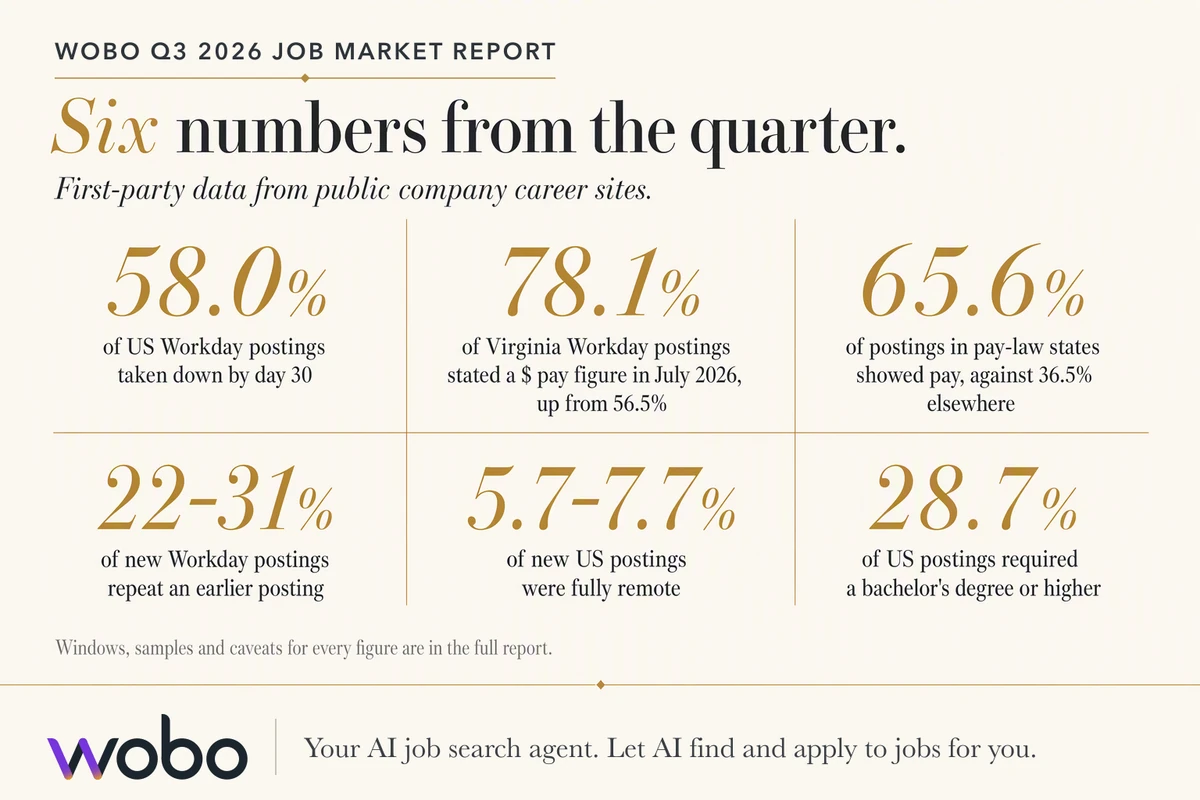
- 58.0% of US job postings on large-employer Workday career sites (published May 1 - Oct 20, 2026) were taken down by day 30; the median posting stays up about 25 days.
- 28.6% of the postings still open on US Workday career sites on October 23, 2026 had been first published 60 or more days earlier.
- 78.1% of Virginia Workday postings stated a dollar pay figure in July 2026, the month the state's pay-transparency law took effect, up from 56.5% in June.
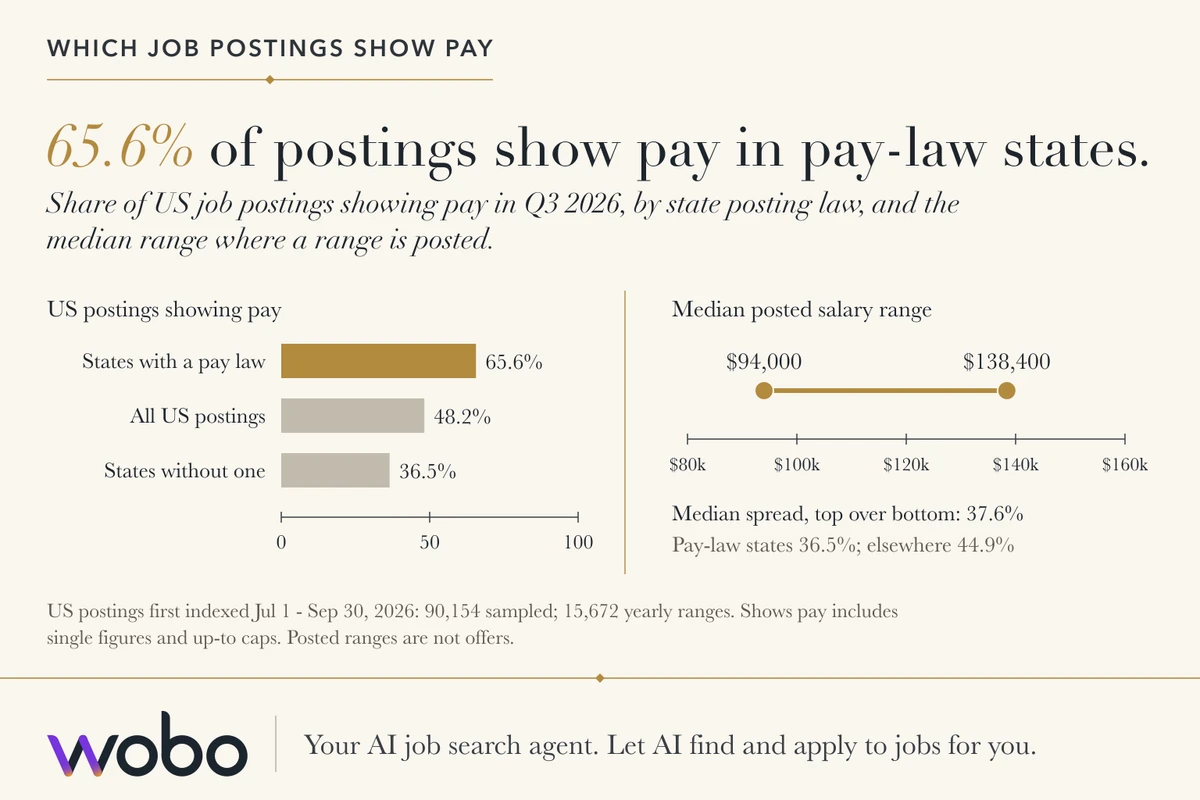
- 65.6% of US postings in states with a pay-range posting law showed pay in Q3 2026, against 36.5% in states without one.
- $94,000 to $138,400 was the median posted US salary range in Q3 2026, from the median minimum to the median maximum.
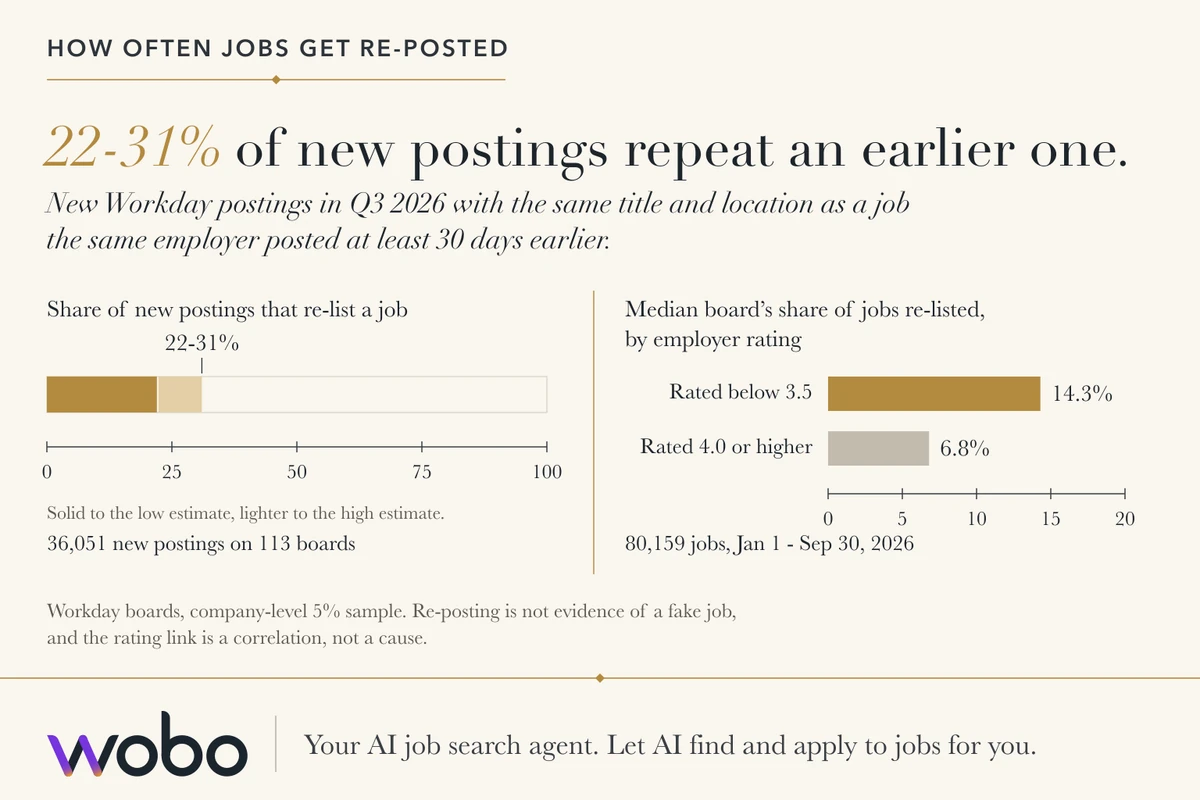
- 22-31% of new Workday postings in Q3 2026 repeated a job the same employer had posted at least 30 days earlier.
- 47.5% of new US postings in Q3 2026 came from the largest 1% of the employers posting on the career sites Wobo tracks.
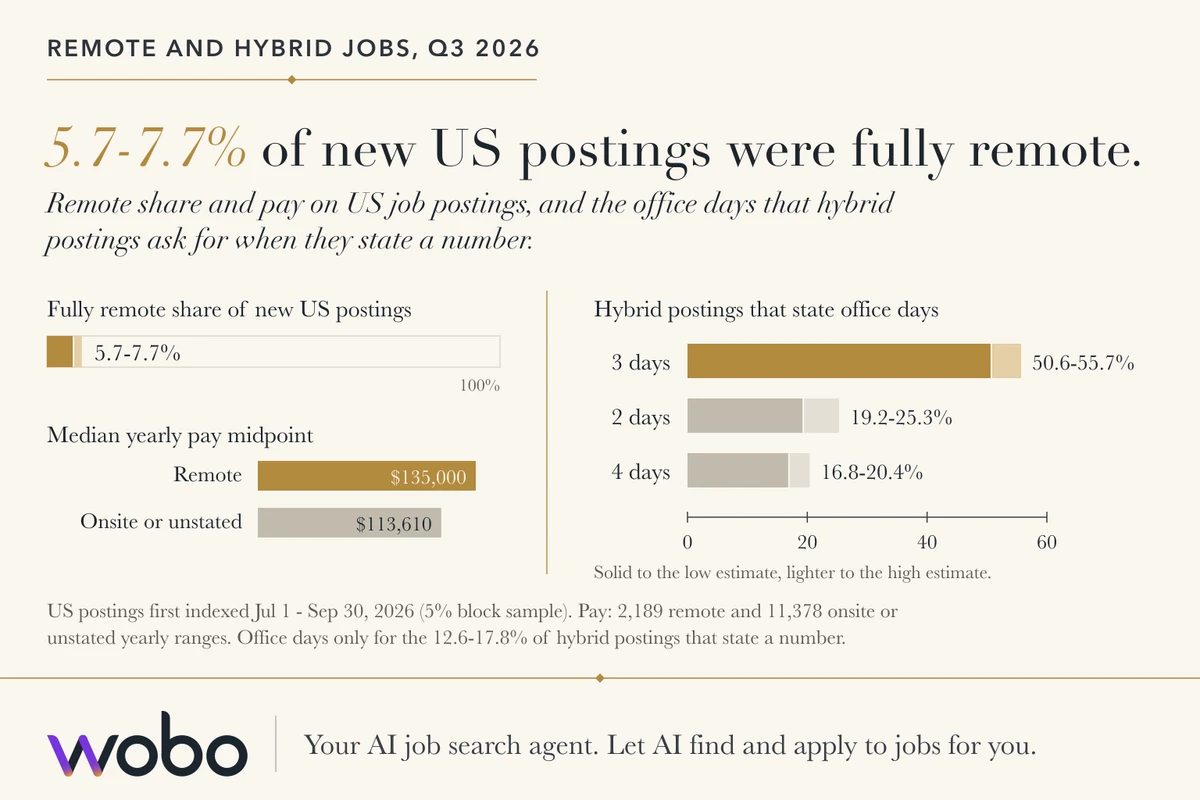
- 5.7-7.7% of new US job postings in Q3 2026 were fully remote.
- 50.6-55.7% of US hybrid postings in Q3 2026 that state office days ask for 3 days a week.
- $135,000 was the median yearly pay midpoint on remote US postings in Q3 2026, against $113,610 for onsite or unstated ones.
- 28.7% of US postings in Q3 2026 required a bachelor's degree or higher.
- 8.8% of US postings titled entry-level or junior in Q3 2026 asked for 3 or more years of experience.
- 0.7% of US postings first indexed in Q3 2026 say the employer sponsors visas.
- 2.75% of non-tech Workday postings worldwide listed an AI skill in October 2026, up from 1.32% in January.
How to cite this report: Wobo, "Q3 2026 Job Market Report," November 3, 2026, https://www.wobo.ai/blog/job-market-report-q3-2026/
🚀 Stop Applying Manually
AI scans the job market 24/7, finds matching roles, and applies with tailored content
Automate My Job Search →★ 4.7/5 on Reviews.io
Methodology: how the data was collected
Wobo's crawl of public company career sites covers the major applicant tracking systems (ATSs), including Workday, Greenhouse, Lever and Ashby. Wobo checks the career sites it tracks every day and deactivates a posting when the employer takes it down, so every posting carries a current open or closed status. One record is one job posting, parsed for pay, experience, degree, skills and workplace type. Most figures use a fixed-seed 5% block sample of postings first indexed Jul 1 - Sep 30, 2026: 91,766 sampled US postings, about 1.8M estimated.
Time trends use Workday alone, the only ATS crawled continuously since January 2026, and each finding states its own window and sample. Every query on October 23 and 25, 2026 returned aggregates only and suppressed any group under 50 records. No employer is named.
A validation pass on October 25, 2026 checked 490 postings against employers' live career pages and added model-free text checks for the trend figures.
| Data | Source | Sample | Window | Main limit |
|---|---|---|---|---|
| Job postings | Public career sites on the major ATSs | 5% block sample; 91,766 US postings | First indexed Jul 1 - Sep 30, 2026 | Tracked sites only, not the whole US market |
| Posting lifespan | Workday career sites | 7,199 sampled US postings | Published May 1 - Oct 20, 2026; status as of Oct 23, 2026 | Taken down is not hired |
| Virginia pay | Fixed panel of about 400 Workday boards | Full count; 8,435 (Jun) and 9,530 (Jul) postings | First indexed Jun 1 - Oct 22, 2026 | Workday boards only |
| Re-posted jobs | Workday career sites | 36,051 new postings on 113 boards (company-level 5% sample) | Jul 1 - Sep 30, 2026, against the same boards since Jan 1, 2026 | Exact title and location match, so the count is conservative |
| AI skills | Workday career sites, all countries | 11,445-29,022 non-tech postings a month | First indexed Jan 1 - Oct 22, 2026 | Skills extracted by a language model, so lower bounds |
Most Workday job postings come down within a month
On large-employer Workday career sites, 31.0% of US job postings are taken down by day 14 and 58.0% by day 30, so the median posting stays up about 25 days. The estimate covers 7,199 sampled US Workday postings published May 1 - Oct 20, 2026, with status as of Oct 23, 2026. Apply inside the first two weeks. By day 30, more of these postings are gone than open.
A posting counts as taken down once the employer removes it from its own career site. The curve reads each posting's open or closed status on October 23, 2026 by its age: of the postings published a given number of days earlier, the share already taken down, assuming the May to October cohorts behave alike. In the October 25 check against employers' live career pages, 151 of 159 closed postings aged 3-30 days were confirmed gone, as were 108 of 109 older ones; counting the few still live as open puts day 14 at about 29.5%.
Taken down is not hired: a posting can be filled, paused, cancelled or replaced. Only Workday is shown, because it is the one ATS whose publish dates cover closed postings as well as open ones.
To stay inside that window without checking career sites yourself, use Wobo's AI job search agent. Wobo scans company career pages every day, ranks new roles by fit with your profile and drops a posting once the employer takes it down.
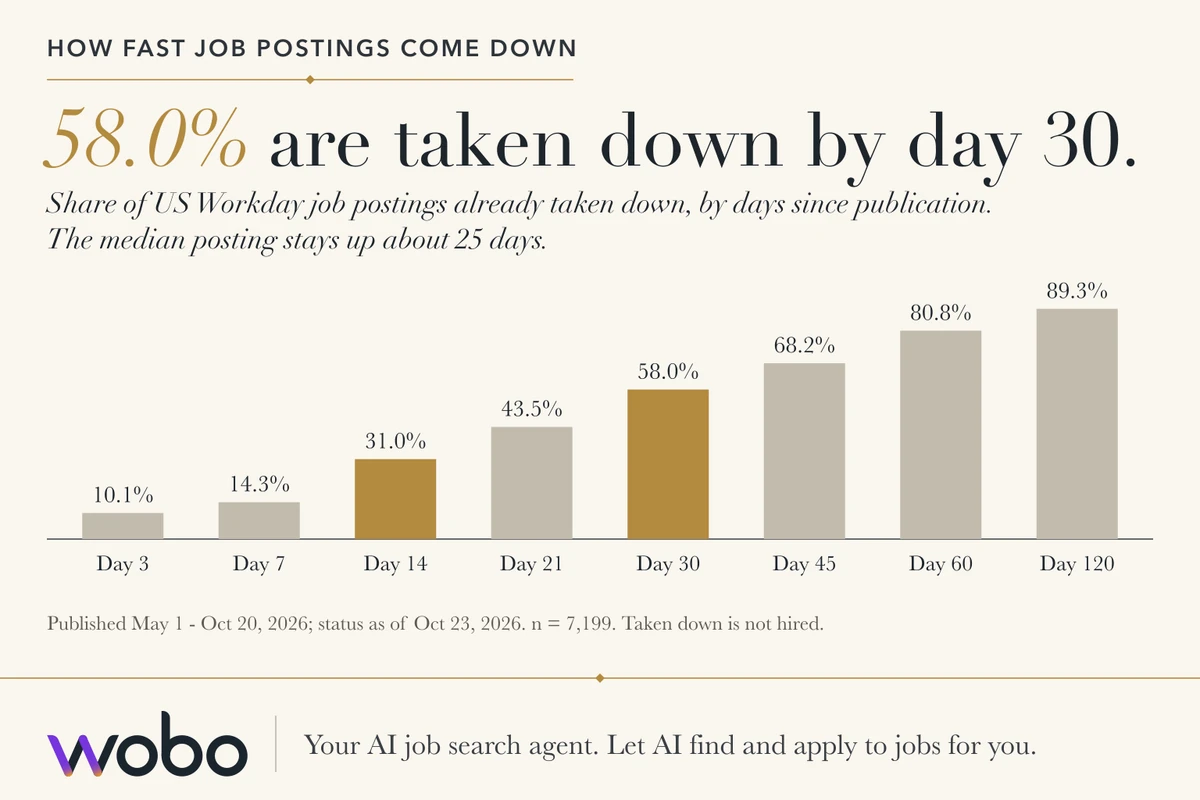
The table lists the same curve as the chart, by age of the posting.
| Days since publication | US Workday postings taken down |
|---|---|
| Day 3 | 10.1% |
| Day 7 | 14.3% |
| Day 14 | 31.0% |
| Day 21 | 43.5% |
| Day 30 | 58.0% |
| Day 45 | 68.2% |
| Day 60 | 80.8% |
| Day 120 | 89.3% |
Remote postings move fastest early. Fully remote US Workday postings were 43.1% taken down at about two weeks, against 20.8-26.1% of onsite or unstated postings; the gap narrows to about 5 points at one month and is gone by two months. The two-week figure comes from 2,596 sampled US Workday postings (a 10% block sample) published May 1 - Oct 20, 2026, with status as of Oct 25, 2026. Remote postings come down almost twice as fast only in those first weeks.
Workplace type here uses the structured label: the ATS's own remote field, the location, a title token or a #LI tag. Taken down is not hired here either, and the data cannot show why remote postings come down sooner. For a remote role, apply in week one. Wobo's auto-apply can do that for you, submitting to matched roles above a fit score you set.
Old open postings are mostly still live. On October 23, 2026, 28.6% of the postings still open on US Workday career sites had been first published 60 or more days earlier, and 150 of 151 such postings checked by HTTP were still live on the employer's own site. The snapshot draws on 24,917 sampled open US postings from the ATSs Wobo crawls, SmartRecruiters excluded. The Workday figure, about 3 in 10, is the most reliable of the ATS figures; Lever's runs higher because its date field can predate publication.
Old does not mean fake. Evergreen, continuous-hiring and hard-to-fill roles stay open for months. Apply to a 60-day-old posting if it fits, then spend your follow-up time on newer ones.
Virginia's pay law moved job postings within a month
On the Workday career sites Wobo tracks, the share of Virginia job postings whose text states a dollar pay figure rose from 56.5% in June 2026 to 78.1% in July 2026, the month Virginia's pay-transparency law took effect, while states without a posting law stayed at 46-49% of postings showing pay. One month did it.
Virginia's SB 215 and HB 636, identical bills signed by Governor Abigail Spanberger, require covered employers to state the wage, salary or pay range in public and internal job postings from July 1, 2026 [1][2]. The window covers postings first indexed Jun 1 - Oct 22, 2026, and the counts are full counts of Virginia postings on a fixed panel of about 400 Workday boards: 8,435 in June and 9,530 in July, with no single board above 15% of a month's postings. The no-law comparison uses the parsed pay field on a 1-in-20 sample.
The July jump holds under both measures: from June to July, the parsed pay field went from 60.3% to 73.0% and the text measure from 56.5% to 78.1%. Wobo's extraction model was updated on Sep 4, 2026, so the later trend uses the text measure, which plateaued at about 84% while the parsed figure kept rising. The data comes from Workday boards only, the one ATS crawled continuously over the window.
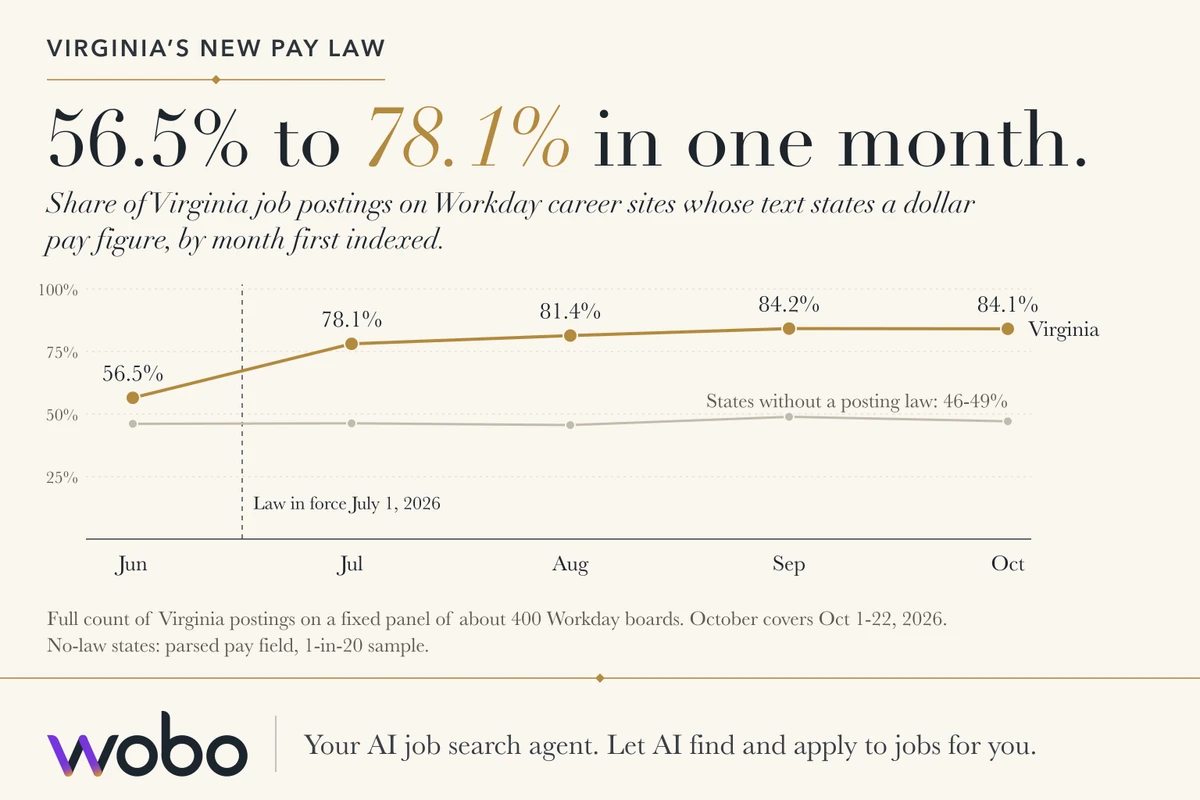
The table compares Virginia with states without a posting law, month by month. The two columns use different measures: posting text for Virginia and the parsed pay field for no-law states.
| Month first indexed, 2026 | Virginia postings stating a dollar figure | No-law states showing pay |
|---|---|---|
| June | 56.5% | 46.1% |
| July | 78.1% | 46.3% |
| August | 81.4% | 45.6% |
| September | 84.2% | 48.9% |
| Oct 1-22 | 84.1% | 47.1% |
Pay disclosure splits along state law. In Q3 2026, 65.6% of US job postings in states with a pay-range posting law showed pay, against 36.5% in states without one; nationally, 48.2% of postings showed any base pay figure. The base is 90,154 sampled US postings first indexed Jul 1 - Sep 30, 2026 (a 5% block sample, about 1.8M estimated), and it describes the employer career sites Wobo tracks, not the whole US job market. The split is not all the law's doing: law states include California, New York and Washington, which have more white-collar employers.
Law states here are the 13 jurisdictions with a posting law in force all quarter: California, Colorado, Washington, New York, Hawaii, DC, Maryland, Illinois, Minnesota, New Jersey, Vermont, Massachusetts and Virginia. Maine (in force from July 29, 2026) and Rhode Island are excluded from both groups, and Connecticut, whose requirement starts October 1, 2026, counts as no-law for Q3 [3]. "Shows pay" includes single figures and "up to" caps; 37.7% of postings show a full range.
Posted ranges are wide where they exist. In Q3 2026 the median posted US salary range ran from $94,000 to $138,400 (the median minimum and the median maximum), the typical range's top sat 37.6% above its bottom (the median spread), and 7.7% of posted ranges had a top at least double their bottom. The base is 15,672 sampled yearly US ranges first indexed Jul 1 - Sep 30, 2026. Ranges are narrower in pay-law states, at a 36.5% median spread against 44.9% elsewhere.
Posted ranges are not offers or actual pay, and the postings that show pay are a selected subset. Still, treat a posted range as the employer's stated budget for the role: with a median spread of 37.6%, an ask at the midpoint or above stays inside it, and the salary negotiation scripts cover the wording.
A job posting count is not a count of open jobs
Of the employers that posted new US jobs on the career sites Wobo tracks in Q3 2026, the largest 1% published 47.5% of those postings. The figure is a full count of about 1.83M new US postings first indexed Jul 1 - Sep 30, 2026, and half of them came from 1.2% of those employers. A posting count is not a hire count: big employers often post one requisition per location. Read a headline posting total as postings, not openings.
Many new postings repeat an earlier one. 22-31% of the new Workday job postings published in Q3 2026 repeat a job with the same title and location that the same employer had posted at least 30 days earlier. The sample is 36,051 new Workday postings first indexed Jul 1 - Sep 30, 2026 on 113 boards (a company-level 5% sample), compared against the same boards since Jan 1, 2026. Matching needs an exact title and location, so a retitled re-post is missed and the count is conservative.
A re-posted job is not evidence of a fake job. A re-listing can be continuous hiring, a refresh or a stalled search, and the data cannot tell those apart. Greenhouse and Lever are excluded from the headline because a few boards dominate them. If a role you applied to reappears, apply to the new posting: it costs minutes and reaches whatever pipeline is live now.
Employer ratings line up with re-posting. Employers rated below 3.5 re-list the same job 1.5-2 times as often as employers rated 4.0 or higher: the median Workday board re-lists 14.3% of its jobs at low-rated employers against 6.8% at 4.0+ employers. The base is 80,159 Workday jobs on 113 boards first indexed Jan 1 - Sep 30, 2026 (a company-level 5% sample).
Correlation, not cause. Low-rated employers skew to high-turnover industries where continuous re-hiring is normal, and the ratings come from the employer profile stored with each board, whose date and source are not independently verified.
Remote jobs are scarce, and stated hybrid schedules center on three days
Fully remote roles were 5.7-7.7% of new US job postings in Q3 2026. The base is 91,766 sampled US postings first indexed Jul 1 - Sep 30, 2026, and the range runs from the structured label, a lower bound, to the first-published label, which over-counts. A remote-only search competes for a small slice of postings. Add hybrid roles within commuting distance before adding volume.
Wobo's automated job applications run on criteria you set once: job title, location, salary range and remote preference. You can review every match before Wobo applies.
Among hybrid US postings that state an in-office requirement, 3 days a week is the most common at 50.6-55.7%, ahead of 2 days at 19.2-25.3% and 4 days at 16.8-20.4%. Only 12.6-17.8% of hybrid postings state a number at all, so 82-87% leave it out. The counts are 316-785 hybrid postings that state office days, across three populations of US postings first indexed Jul 1 - Sep 30, 2026 (5% block sample), found by a regex that matches a number near office wording.
Ask the office-days question at the first call. Most postings will not answer it for you.
Remote pays more outside tech. Remote US postings advertised a median yearly pay midpoint of $135,000 in Q3 2026, against $113,610 for onsite or unstated postings; within a role, the remote premium was +48% in sales, +4% in software engineering and -2% in Data & AI. The sample is 2,189 remote and 11,378 onsite or unstated yearly ranges under the structured workplace label, and only postings that show pay are counted.
Composition is the biggest caveat: remote sales roles are mostly SaaS account executives, while onsite sales includes retail and field roles. For software engineers, remote is a working arrangement, not a raise.
Fewer than 3 in 10 postings require a bachelor's degree, and AI skills are spreading
28.7% of US job postings in Q3 2026 required a bachelor's degree or higher, 38.2% stated no education requirement, and in software engineering 57.0% required a bachelor's or higher. The base is 90,154 sampled US postings first indexed Jul 1 - Sep 30, 2026. "None stated" is not "no degree needed": the posting gave no minimum, and education is parsed by a language model that does not separate "or equivalent experience" clauses.
Apply when the degree line is missing. A posting that names no minimum has not ruled you out. Software engineers can set the 57.0% against the senior-to-junior gap in Wobo's software hiring report.
The entry-level job that wants years of experience exists, but it is not the norm. 8.8% of US job postings titled entry-level or junior in Q3 2026 asked for 3 or more years of experience, 17.8% asked for 2 or more, and the median stated requirement was 1 year. The base is 2,843 sampled entry-level-titled US postings, 1,669 of which state a year requirement. The definition is narrow, since many entry-level jobs carry titles like "Associate", and years parsed by a language model may count "preferred" as required, which would overstate the share.
Read a years requirement as a target, not a gate, and let the resume answer it. Wobo tailors your resume to each role it applies to, and its free ATS resume checker scores a resume across 24+ criteria before you send it.
Few postings say they sponsor visas. 0.7% of US job postings first indexed in Q3 2026 say the employer sponsors visas, from 90,160 sampled postings. The figure is a lower bound read from posting text, and most postings say nothing either way, so a silent posting has not ruled sponsorship out. Save your sponsorship status in your Wobo profile: Wobo fills out each application form and answers screening questions from that profile.
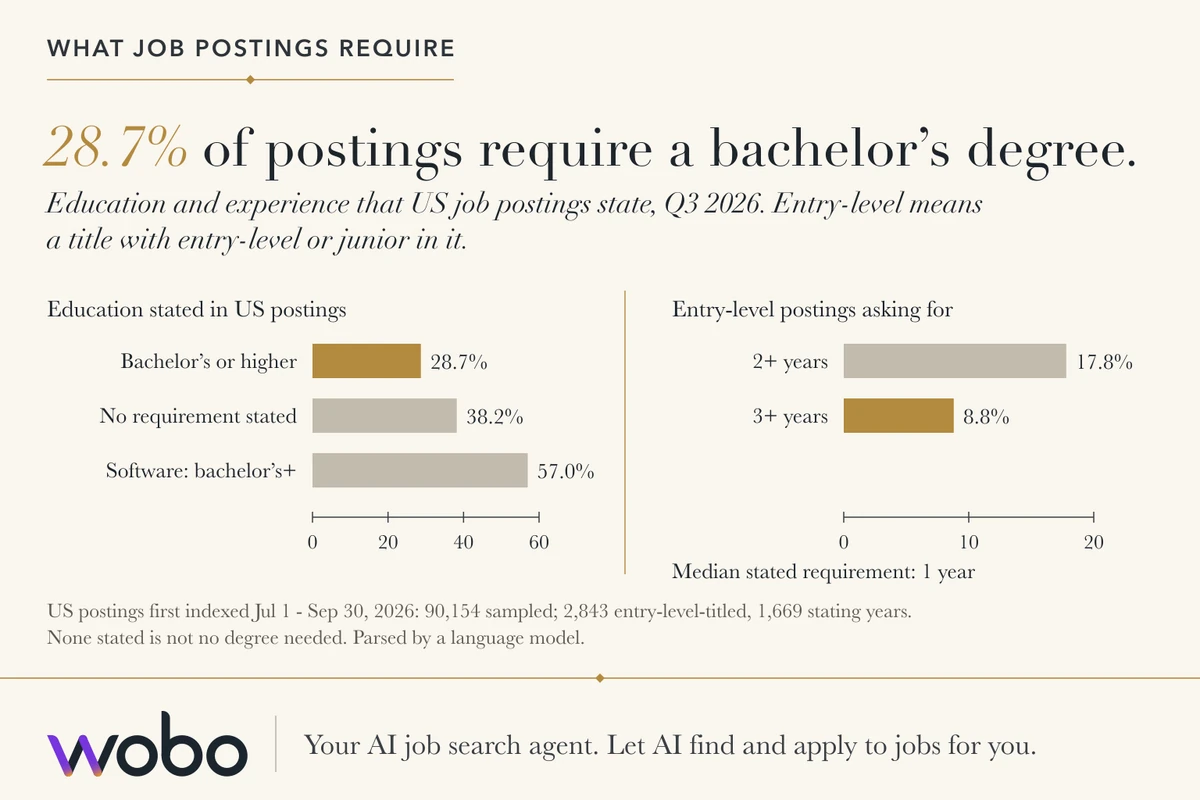
The table sets the requirement figures for US postings side by side, each with its own base.
| What the posting states | Share | Base (first indexed Jul 1 - Sep 30, 2026) |
|---|---|---|
| Bachelor's degree or higher | 28.7% | 90,154 US postings |
| No education requirement | 38.2% | 90,154 US postings |
| Bachelor's or higher, software engineering | 57.0% | Software engineering postings in the same sample |
| 3 or more years, entry-level or junior title | 8.8% | 2,843 entry-level-titled US postings |
| 2 or more years, entry-level or junior title | 17.8% | 2,843 entry-level-titled US postings |
| Employer sponsors visas | 0.7% | 90,160 US postings |
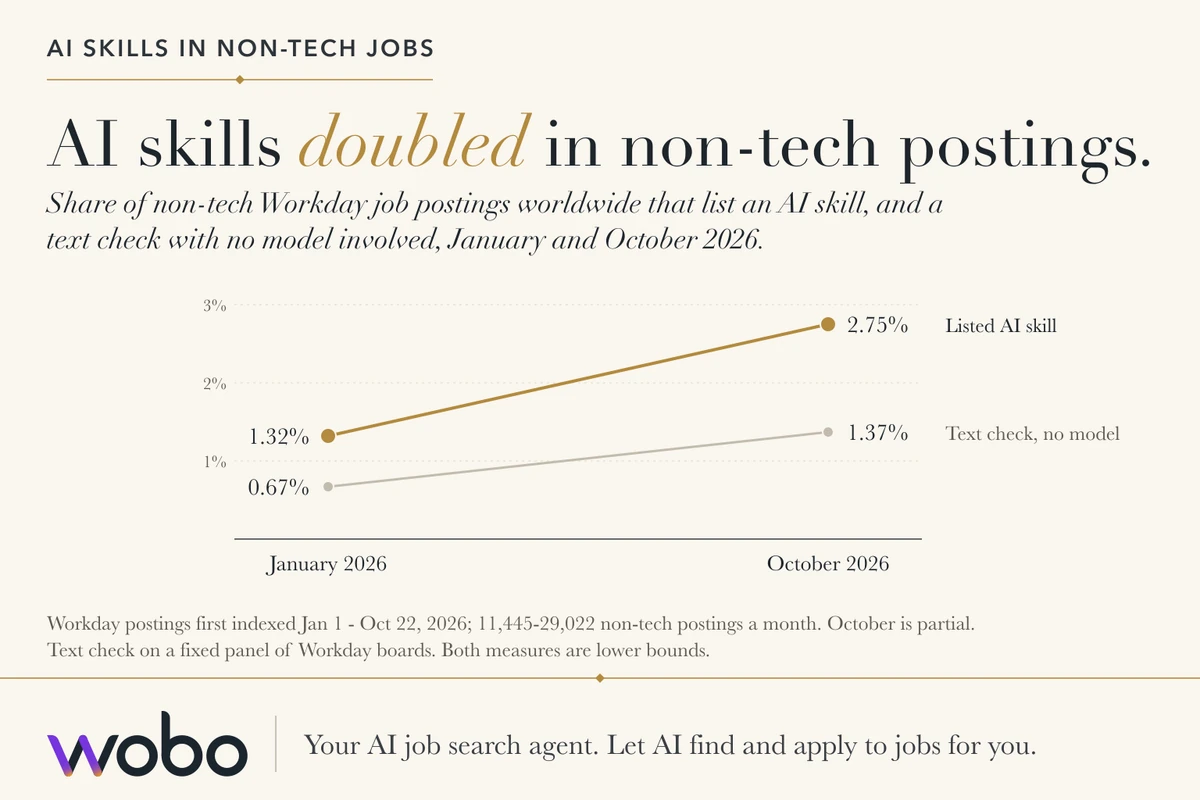
AI is reaching non-tech job descriptions. The share of non-tech Workday job postings worldwide that list an AI skill rose from 1.32% in January 2026 to 2.75% in October 2026, and a text check with no model involved, run on a fixed panel of Workday boards, also doubled, from 0.67% to 1.37%. The monthly samples hold 11,445-29,022 non-tech postings first indexed Jan 1 - Oct 22, 2026, and October is a partial month.
Skills are lists extracted by a language model, so these are lower bounds, and AI skills are still a small minority of postings; Workday boards also skew to large employers. For non-tech applicants, that rate suggests an AI skill is still rare among stated requirements, so a named tool on a resume reads as extra rather than as a missing box. A guide to which skills to put on a resume shows how to match them to a posting's own wording.
What this data cannot show
- The whole US job market. Every figure describes the employer career sites Wobo tracks on the major ATSs, where Workday's large employers weigh heavily. Jobs posted outside those sites are not counted.
- Why a posting came down. A posting taken down may have been filled, paused, cancelled or replaced, and the lifespan curve reads each posting's status by age on October 23, 2026.
- Hires, offers or actual pay. A posting count is not a hire count, and a posted range is not an offer.
- Why a job was re-posted. A re-listing can be continuous hiring, a refresh or a stalled search, and posting data cannot tell those apart.
- Requirements a posting leaves out. Degree, experience and skill figures come from what postings state, parsed by a language model; a missing line is not a waived requirement.
🚀 Stop Applying Manually
AI scans the job market 24/7, finds matching roles, and applies with tailored content
Automate My Job Search →★ 4.7/5 on Reviews.io
About Wobo, the publisher of this report
Wobo is an AI job search agent that finds jobs and applies to them for you. The Q3 2026 figures in this report come from the same daily crawl of company career pages that feeds it, and each step below acts on what the data shows.
- Finds. Wobo scans thousands of company career pages every day, going to employers' own sites instead of job boards.
- Matches. Wobo compares your profile with each job description on skills, experience and seniority, and gives the role a fit score.
- Fills out. Wobo completes the application form and answers screening questions in your voice.
- Tailors. Wobo adapts your resume to the role, and the AI Resume Builder creates one if you have none yet.
- Writes. Wobo writes a cover letter for each job; the AI Cover Letter Generator does the same on its own.
- Applies. Wobo submits directly to the company, automatically or after your review, and shows every answer it gave in a tracking dashboard.
How Wobo works walks through the setup, step by step.
Frequently asked questions
How long do job postings stay up?
On large-employer Workday career sites, the median US job posting stays up about 25 days. Of the postings published May 1 - Oct 20, 2026, 31.0% were taken down by day 14 and 58.0% by day 30, with status read on October 23, 2026. A posting taken down may have been filled, paused, cancelled or replaced.
What does it mean if a job is no longer posted?
A job that is no longer posted has been taken down by the employer, and the posting does not say why: the role may be filled, paused, cancelled or replaced by a new posting, so removal is not proof of a hire. On Workday career sites, 22-31% of new Q3 2026 postings repeated an earlier job, so a role that disappears can come back.
Why do companies repost jobs?
Companies repost jobs for continuous hiring, to refresh a listing or because a search stalled, and posting data cannot tell those apart. On Workday career sites, 22-31% of new postings in Q3 2026 repeated a job the same employer had posted at least 30 days earlier. Employers rated below 3.5 re-listed 1.5-2 times as often as those rated 4.0 or higher.
Do most jobs require a college degree?
Most US job postings on the career sites Wobo tracks do not require a bachelor's degree. In Q3 2026, 28.7% of 90,154 sampled US postings required a bachelor's degree or higher and 38.2% stated no education requirement, which is not the same as saying no degree is needed. Software engineering sits higher: 57.0% of its postings required a bachelor's or higher.
Is remote work going away in 2026?
Remote work is not gone in 2026, but fully remote roles are scarce: they were 5.7-7.7% of new US job postings in Q3 2026 on the career sites Wobo tracks. Hybrid is the common middle ground, and among hybrid postings that state office days, 3 days a week is the most common requirement at 50.6-55.7%.
What to do with these numbers. Apply in the first two weeks, check for a pay range before you fill in a form, and ask about office days at the first call. The Q4 2026 edition will follow on the same method in early 2027.
References
- SB 215, 2026 Regular Session, Virginia General Assembly (companion bill HB 636). lis.virginia.gov
- Virginia Law Will Require Pay Transparency, Restrict Employers from Seeking Wage History, Morgan Lewis, May 5, 2026. morganlewis.com
- Show Me the Money (or the Wage Range): New State Pay Transparency Laws, Cooley, July 6, 2026. cooley.com

Stop Applying Manually
- ✓AI scans the job market for you 24/7
- ✓Applies with tailored content on company sites
- ✓You focus on interviews, we handle applications