Last updated: 2026-10-16
Six good cover letter examples follow, each a complete before-and-after letter for entry-level, first-job, no-direct-experience, career-change or mid-career applicants. All six share one structure: a trigger sentence, a highlight paragraph and a CTA line. The letters run from shortest to longest, because time decides how many applications you send this week. Start with the Three-Sentence Email Letter if a posting asks you to email a recruiter. One trigger, one highlight, one ask. Career changers should skip to the full-length letters, where the No-Direct-Experience Letter matches each job requirement to one line of past work. Polish alone may not set a letter apart. After one job platform added an AI cover-letter assistant, the letters improved but employers stopped relying on them, according to a working paper by economists Jingyi Cui, Gabriel Dias and Justin Ye [2].
Cover letter examples compared by length and use case
Every entry is a complete sample cover letter for job application use, not a fragment. Each one is built on the same "trigger sentence, highlight paragraph, CTA line" structure, and each one shows a single technique you can copy into your next letter.
| Example | Length | Who it fits | Send as | Technique it shows |
|---|---|---|---|---|
| Short email letter | Shortest | Applicants asked to email a recruiter directly | Email body | Subject line that names the role and the applicant |
| Entry-level | Short | Graduates with internships or coursework | Attachment | Highlight paragraph built on one project |
| First job | Short to medium | Applicants with little or no paid work history | Attachment | Transferable skills from school, volunteering or part-time work |
| No direct experience | Medium | Applicants moving into an adjacent role | Attachment | Matching the job post's own nouns |
| Career change | Medium to long | Applicants switching industries | Attachment | One line that explains the pivot |
| Mid-career | Longest | Applicants with a record of measurable results | Attachment | CTA line that proposes a next step |
What does a cover letter look like in 2026?
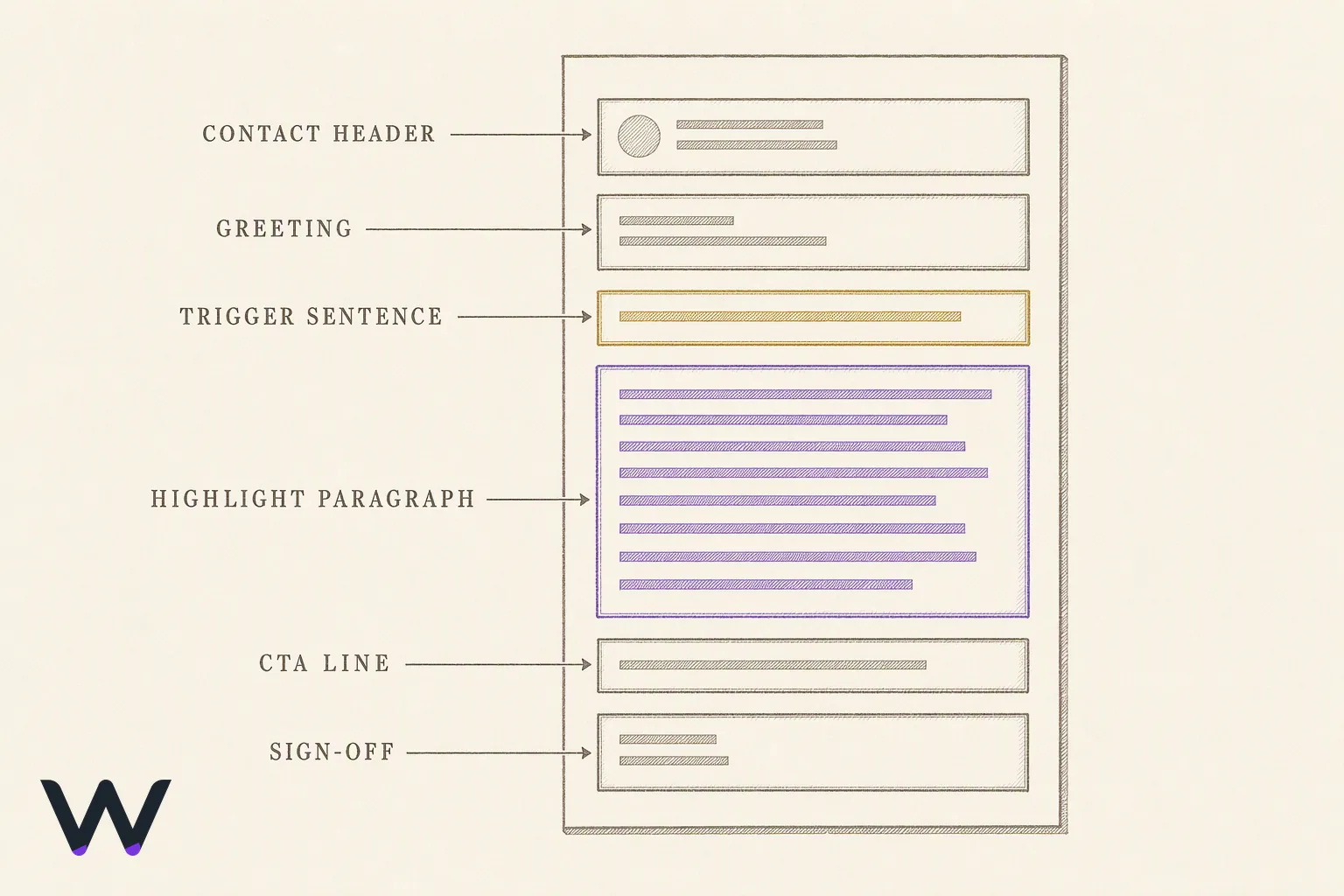
The format we recommend is a single page: three or four short paragraphs under a contact-information header. The letter goes with your resume and uses evidence your resume can only list. Write it for one employer and one role, because an effective letter is written for the individual job and company rather than reused across applications [1]. The header holds your name, phone, email and the date, followed by a greeting such as "Dear Hiring Manager".
Keep the format plain: one page, a standard font, normal margins and a formal tone. Then make every paragraph do one job, and cut any sentence that only repeats your resume.
File type deserves a minute before you hit send. Use whatever format the employer's portal or job post asks for. If it names none, follow the same rules you use for your resume. Our explainer on how an ATS reads a resume covers the parsing side, and the same logic applies to your cover letter.
Every example below uses this skeleton:
- Contact-information header: name, phone, email, date, then the employer's name.
- Greeting: a named person if you can find one, "Dear Hiring Manager" if you can't.
- Trigger sentence: one specific fact about the employer, tied to your strongest match.
- Highlight paragraph: one achievement, with what you did and what changed.
- CTA line: one sentence that asks for the interview or proposes a call.
- Sign-off: "Sincerely" or "Best regards," followed by your full name.
If you want a longer breakdown of what each body paragraph should contain, start with our guide to cover letter purpose and format.
How to start a cover letter with five minutes of company research
To start a cover letter, name one specific thing about the employer and connect it to your best qualification in the same sentence. A letter that could go to any company fails the basic test of being written for this job and this employer [1]. The opening paragraph is where the reader can tell which kind of letter they're holding. A generic first line gives it away immediately.
Enthusiasm belongs in the letter too, which SHRM calls "the perfect place to show passion for your career" [1], but it only works when it points at a fact. The rewrites below are hypothetical teaching examples, with brackets marking where your research goes:
| Weak opening | Rewritten trigger sentence |
|---|---|
| "This letter is my application for the Marketing Coordinator position." | "Your job post asks for someone who can run [named tool] campaigns, and that was my whole internship at [company]." |
| "I have always admired your company." | "[Company]'s launch of [product] is the reason I'm applying: I spent last year supporting customers on a similar product." |
| "I believe I'd suit this role perfectly." | "After [company]'s [funding round or expansion], your team will need [skill from the post], which I have done at [employer]." |
The five-minute research checklist
- Job description, two minutes: copy the two skill phrases the post repeats most, word for word.
- Company news, two minutes: search the company name plus "launch" or "funding" and keep the most recent result.
- LinkedIn, one minute: look up the hiring manager's name and title for your greeting.
- Write the trigger sentence: one news item or job-post phrase, joined to your strongest match.
Stop once the timer runs out. An opener built on one fact beats one built on five you skimmed.
Short cover letter examples for high-volume applications
1. The Three-Sentence Email Letter
The Three-Sentence Email Letter goes straight into the body of an email, with no attached cover letter. It has one trigger sentence, one highlight sentence and one CTA line. Use it when the posting says to email a recruiter, or when you're writing to a person at a small company that has no applicant portal.
Before (weak):
Subject: Application To whom it may concern, I'm interested in the position I saw online. I work hard and learn fast. My resume is attached. Thanks.
After (a template, not a real applicant; fill in the brackets):
Subject: [Job Title] application, [Your Name] Hi [Hiring Manager Name], Trigger: Your listing for a [Job Title] asks for someone who can [top requirement from the posting], which is what I did every week at [Current or Last Employer]. Highlight: There I [one result, with a number if you have one]. CTA: Could we set up a short call this week? My resume is attached. [Your Name] | [Phone] | [LinkedIn URL]
Length: about seventy words, not counting the labels.
In a short email letter, the subject line does the salutation's job by giving the role and your name before the email is opened. The weak version gets both wrong. "To whom it may concern" shows you didn't look for a name, and "Application" doesn't say which job. Address a named person whenever you can find one.
Take it if the posting asks for an emailed application. Skip it if the employer uses a portal with its own cover letter field, because three sentences there look like you skipped a step.
2. The Entry-Level Graduate Letter
For a first-time job application, put your education where experience would normally go. Name one course, project or internship that matches a requirement in the listing, say what you produced, and finish by asking for an interview. The Entry-Level Graduate Letter is for recent graduates applying to an internship or a first job.
Before (weak):
Dear Sir or Madam, I just finished my [Field] degree and I am looking for my first job. I don't have much experience, but I am eager to learn and I think I'd fit in well at your company. Hopefully I will hear back.
After (a template, not a real applicant):
Dear [Hiring Manager Name], Trigger: [Company]'s [Internship or Job Title] posting asks for [skill from listing], and I spent my final semester at [University] doing exactly that in [Course or Capstone Project]. Highlight: For that project I [what you built, analyzed or ran], working with [tool named in the listing] and presenting the results to [a client, a panel or a professor]. During my internship at [Organization], I also [one concrete task and its outcome]. Both gave me practice in [second requirement from the listing]. CTA: I'd welcome an interview to walk you through the project. I'm available [days or dates] and can share samples beforehand. Sincerely, [Your Name]
Length: about a hundred words.
"Eager to learn" says nothing the reader can check, while a named capstone gives them a deliverable to ask about. Never apologize for experience you don't have. The line "I don't have much experience" hands the reader a reason to reject you.
Take it if at least one project or course matches the listing. Skip it if you already have relevant paid work. In that case, lead with the work.
3. The First-Job Letter
The First-Job Letter is for applicants who have never held a paid job, or only a short part-time or seasonal one, and are applying for a first role such as retail, hospitality or office support. Its highlight paragraph is built from transferable skills you used at school, as a volunteer or in a part-time job. Each one names where it came from, so the reader can picture the setting.
Before (weak):
Dear Hiring Manager, I want to apply for the [Job Title] job. I have never had a job before, but I am a hard worker and a fast learner. I am reliable and good with people. I hope you will give me a chance.
After (a template, not a real applicant):
Dear [Hiring Manager Name], Trigger: Your [Job Title] posting asks for someone who is [first requirement from the listing, such as "dependable on weekend shifts"] and [second requirement, such as "comfortable handling cash"], and I've done both before. Highlight: For [number] months I volunteered every [day] at [organization], where I [task that matches the first requirement, such as opening on time and signing in other volunteers]. At [school], I was treasurer of [club], so I [task that matches the second requirement, such as counting and recording fundraiser money]. [If you have one: During my part-time or seasonal job at [employer], I [task that matches a third requirement, such as serving customers at the counter].] CTA: I'd welcome an interview, and I can start [date]. I'm available [days and hours], including [weekends or evenings if the listing asks for them]. Sincerely, [Your Name]
Length: about a hundred and twenty words.
The weak version opens with what's missing and then lists traits the reader can't check. Unpaid work counts when it involved the same tasks the listing names, such as showing up on schedule, handling money or dealing with the public. Name the organization and how long you were there, so the reader has something specific to ask about. If the listing mentions shifts, put your availability in the CTA line so the reader doesn't have to ask.
Take it if you can match at least two listing requirements to school, volunteer or part-time tasks. Skip it if you have a degree project or internship that matches the listing. Use the Entry-Level Graduate Letter instead.
The slowest part of sending these letters in volume is rewriting the trigger and highlight for every posting. Wobo's free AI Cover Letter Generator drafts a letter from the job listing you paste in and the experience stored in your Wobo Persona, and it works the listing's required skills into the text. You have to sign up and fill in the Persona before it will write anything. Before you send each draft, check that it has a trigger, a highlight and a CTA.
Full-length examples of cover letters for career changes and experience gaps
4. The No-Direct-Experience Letter
The No-Direct-Experience Letter takes each requirement in the job description and matches it to something you've done, one line per requirement. It suits applicants whose past work never had the job's title but involved the same tasks. The example below is a hypothetical composite: a retail shift lead applying for a customer success role.
Before (weak):
Dear Hiring Manager, Although I don't have direct experience in customer success, I believe my skills are transferable. I am a people person, I stay calm under pressure, and I am passionate about helping customers. It would be exciting to grow with your team.
After (hypothetical composite):
Dear [Hiring Manager Name], Trigger: Your [Job Title] listing names three needs: handling escalations, tracking accounts and training new users. I've handled all three on a sales floor at [Retailer]. Highlight: Here's how each maps to your listing: - Handling escalations: as shift lead at [Retailer], I took the complaints other staff couldn't resolve, [how many a week]. - Tracking accounts: I kept the [special-order or loyalty] log for [number] repeat customers and closed out every open order before it went overdue. - Training new users: I onboarded [number] new hires on the [point-of-sale system], using a checklist I wrote. None of it was called customer success, but the work is the same. CTA: I'd like to show how that translates to your customers. Are you free for a call [days]? Regards, [Your Name]
Length: about a hundred and thirty words.
Reusing the listing's own wording lets the reader check each claim in seconds. The weak version claims "transferable" skills and never names one. Cut "people person" from every letter, because it can't be checked.
Take it if you can match at least three listing requirements to real tasks. Skip it if you can only match one. Apply for a role closer to what you've done instead.
5. The Career-Change Letter
The Career-Change Letter explains the switch in one sentence and then spends the highlight paragraph showing that your skills carry over. It is for people moving into a new field who have a concrete reason for the move. The example below is a hypothetical composite of a teacher moving into instructional design.
Before (weak):
Dear Hiring Manager, After many years in teaching, I have decided it is time for a change. I have always been interested in instructional design, and I recently completed an online course. Teaching has given me many skills, including communication, organization and creativity. Please consider me despite my nontraditional background.
After (hypothetical composite):
Dear [Hiring Manager Name], Trigger: [Company]'s [Instructional Designer] role asks for someone who can turn subject expertise into courses learners finish, and that's the work I've done for [number] years as a [subject] teacher at [School]. Switch: I'm moving into instructional design because the part of teaching I was best at was building the curriculum, not delivering it. Highlight: At [School] I redesigned the [course name] unit around [method or tool], and [result: pass rate, completion or adoption by other teachers]. I built the materials in [authoring tool from the listing], wrote the assessments and revised them from student feedback each term. Those are the three steps your posting lists: design, build, iterate. [Number] other teachers now use it. CTA: I'd value a conversation about the role. I can bring the redesigned unit as a portfolio sample and walk you through each revision. I'm available [days]. Sincerely, [Your Name]
Length: about a hundred and forty-five words.
The weak version spends half its length apologizing. A switch sentence that gives a reason reads as a decision, and storytelling here means exactly that one sentence. Once the letter is done, the resume should open with the same pivot statement. Our resume tips for high-volume job seekers cover how to lead a career-change resume that way.
Take it if you can name the specific part of your old job that matches the new one. Skip it if the only thing connecting the two fields is a course you finished.
6. The Mid-Career Achievement Letter
The Mid-Career Achievement Letter puts two measured results in the middle paragraph and ends with a direct request for an interview. It is for experienced professionals applying to senior or lateral roles where results matter more than duties. The example below is a hypothetical composite of an operations manager.
Before (weak):
Dear Hiring Manager, As an experienced operations manager, I have a strong history of success. I have managed teams, improved processes, and delivered results across multiple projects. I am results-driven and do well in fast-paced settings. My resume provides further details of my accomplishments. I appreciate you considering my application.
After (hypothetical composite; use only your real figures):
Dear [Hiring Manager Name], Trigger: [Company] just announced [expansion, launch or initiative from its news page], and the [Operations Manager] role you posted is the one that has to make it run. I've led that kind of buildout at [Current Employer]. Highlight: For the past [number] years I've run a team of [number] across [sites or functions]. That team handled [volume: orders, tickets or shipments] a [week or month]. Two results bear directly on your listing: - I cut [process, such as order-to-delivery time] from [before figure] to [after figure] by [what you changed]. - I reduced [cost line] by [percentage or amount] over [timeframe] without cutting headcount. Both came from the same habit: [one sentence on how you work, such as a weekly review of the slowest step]. Closing paragraph: I'd like to interview for this role and walk you through how I'd approach [initiative] in my first [timeframe]. I'm available [days and times], and I can send the before-and-after reports ahead of the conversation. Best regards, [Your Name]
Length: about a hundred and sixty-five words.
"Strong history of success" is your resume compressed into adjectives. A before figure next to an after figure lets the reader see the change for themselves. The closing paragraph asks for the interview by name and offers something to look at.
Take it if you have two results you could defend in an interview. Skip the metrics if your figures are confidential. Use the scope you were responsible for, such as team size or budget, instead.
Tailoring one letter to 20 applications without it reading as AI-written
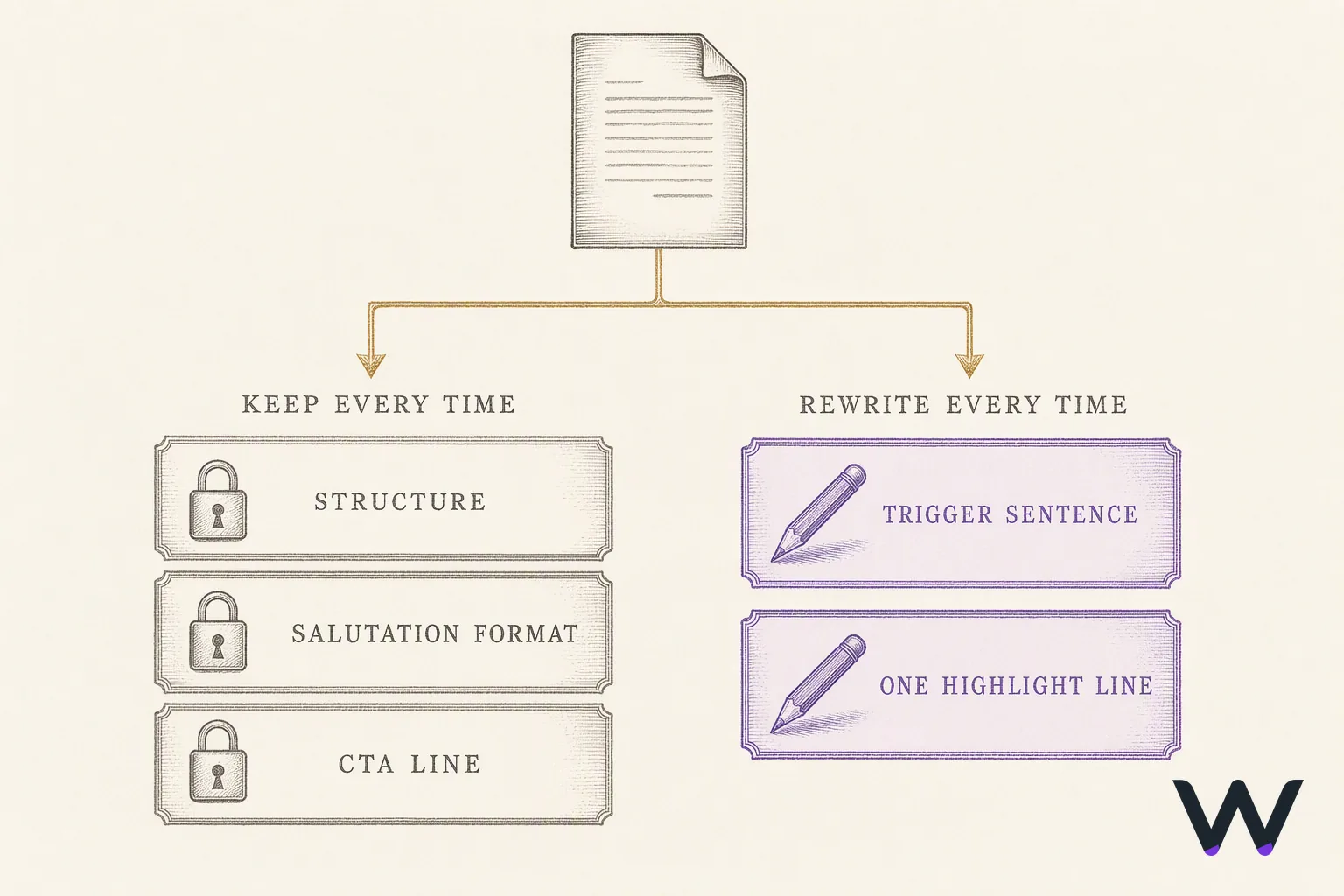
For every application, rewrite the trigger sentence and one highlight line. Keep the structure, the salutation format and the CTA. Limit your edits to those parts, because polished generic text may not stand out. On one job platform that added an AI cover-letter assistant, letter quality rose while "employers stopped relying on cover letters in their hiring decisions" [2]. The evidence is a working paper by economists Jingyi Cui, Gabriel Dias and Justin Ye, available here only through Fortune's March 2026 summary [2]. The summary doesn't name the platform, the country or the sample size, so read it as one platform's result, not a rule for every employer.
Cover letters may disappear from hiring altogether in the near future, Wharton economist Judd Kessler predicts [2]. That is one economist's prediction, not a measurement. The trigger sentence is where you show you read this particular posting, and a drafting tool needs you to supply that detail.
Three mistakes sink a letter fast:
- Wrong company name. It is usually left over from your last application. Search the letter for the previous employer's name before you send it.
- Resume in paragraph form. The highlight should tell the story behind one resume line, not repeat every line.
- "To whom it may concern." Look up the name of the person hiring for the role, or write "Dear [Team] hiring team" if you can't.
Frequently asked questions
What should a cover letter include?
A cover letter should include a contact header, a salutation that names a person, a trigger sentence tied to this employer, a highlight paragraph with your strongest proof, and a closing line that asks for an interview. Write each letter for the individual job and company rather than reusing it across applications [1].
How do you end a cover letter?
End a cover letter with one sentence that asks for a concrete next step, such as a short call or an interview. Then sign off with "Sincerely" or "Best regards" above your typed name. If your closing statement only thanks the reader, you have left the next move to a stranger.
How do you address a cover letter?
Address a cover letter to the hiring manager by name. The job post or the company's LinkedIn page often lists one. If you can't find a name, write "Dear Marketing Hiring Team" and swap in the team you would join. Avoid "To whom it may concern". That phrase makes the letter read like a form letter.
What is a cover letter for a job application?
A cover letter for a job application is a single page sent alongside your resume. It explains why you fit this role at this company and asks for an interview. Its value is the chance to tie your passion for the work to a specific achievement rather than restating the resume, as SHRM frames it [1].
How does a cover letter differ from a resume?
A cover letter differs from a resume in purpose. The resume records your history, and the cover letter argues why one part of that history matters to this employer. The resume is a list, while the cover letter is prose written to a person. The letter is also where personal passion meets a specific achievement, the framing SHRM uses to separate it from the resume [1].
Should a cover letter have bullet points?
A cover letter can have bullet points, but use them sparingly. A few bullets inside the highlight paragraph work when each one names a result. Keep the trigger sentence and closing line in prose. A cover letter made mostly of bullets reads like a second resume.
References
- How to Write a Great HR Cover Letter — shrm.org
- 'AI killed the cover letter.' This Wharton economist says the hiring ritual's days are numbered — fortune.com

Build your next application with Wobo.
- ✓Free AI resume builder with unlimited PDF downloads
- ✓Resume, cover-letter and application tools in one workspace
- ✓Choose jobs yourself or automate with paid Autopilot