Last updated: 2026-10-01
The skills worth listing are the ones the posting names, in the posting's own vocabulary, eight to twelve of them, re-sorted for every application you send. A requirement reading "Salesforce administration" misses a skills line that says "CRM tooling." Same competence. Different string. Two public sources anchor the method below. O*NET, the U.S. Department of Labor's occupational database, keeps skills separate from abilities and from knowledge [1]. The National Association of Colleges and Employers (NACE), in its Job Outlook 2026 Spring Update, surveyed 185 respondents and found 85% looking for evidence of teamwork on a college candidate's resume rather than the word itself [2]. Everything beyond those two findings is a recommendation drawn from how postings and parsers are built, and it is labelled that way wherever it appears. Below: what the parser reads, how to mine the requirements block, the eight-to-twelve count, a five-role table of listable tools, and the rows to delete.
What counts as a skill on a resume (and what the parser sees)
A resume skill is a learned capability a hiring team can verify: software you operate, methods you run, languages you speak. O*NET, the U.S. Department of Labor's occupational database, keeps skills separate from "abilities," which are innate capacities, and from "knowledge," which is subject matter. It then splits skills themselves into basic and cross-functional ones [1]. That taxonomy exists to classify occupations, not to advise job seekers, and its page carries no publication date. Take the categories from it, not a hiring claim.
The split is still worth borrowing, because your reader makes a cruder version of it. Hard skills are the nameable ones: Excel, Python, QuickBooks, Spanish, medical billing. Soft skills describe the way you work with people and time: written communication, stakeholder management, scheduling under deadline. Traits are neither. "Hard-working," "detail-oriented," and "team player" describe nobody in particular, match no requirement in the posting, and cost you a line each. Cut them.
Your resume gets read twice, and the two readers want different things. Software reads first, looking for strings it was told to find. A person reads second, skimming to judge whether those strings are plausible given your job titles. The skills section is the only block on the page built for both passes, which is why it earns a rewrite per application instead of a copy-paste.
Why the skills section decides your interview rate in 2026
Most online applications at an employer large enough to run an Applicant Tracking System pass a keyword screen before a person opens the file. Treat that as the planning assumption behind this method rather than a measured rate, because we have no published figure to cite for it. The parser does not weigh your skills. It matches them. A requirement that reads "Salesforce administration" matches a skills line saying Salesforce administration and misses one saying CRM tooling. Same competence. Different string.
Then a human takes over, and the file gets a scan rather than a read: job titles, employer names, and the skills block, in roughly that order, hunting for a reason to keep going. A skills list long enough to need two columns emphasizes nothing, because everything in it is equally weighted.
That is the argument for selection over quantity. Every skill you add beyond what the posting asked for dilutes the ones that would have earned the interview. An obviously padded list is easy to spot, too, because padding costs a candidate nothing.
For high-volume applicants the arithmetic is operational. Send 40 applications a month with one generic skills block and you are betting that 40 postings asked for the same things in the same words. They did not. Rewriting eight to twelve lines per application takes a couple of minutes, and those are better-spent minutes than another pass over your summary or your bullet verbs. Treat the skills block as the part of your ATS resume that changes every time, and the rest of the document as the part that mostly stays put.
Pull your skill list from the job description, not a top-10 article
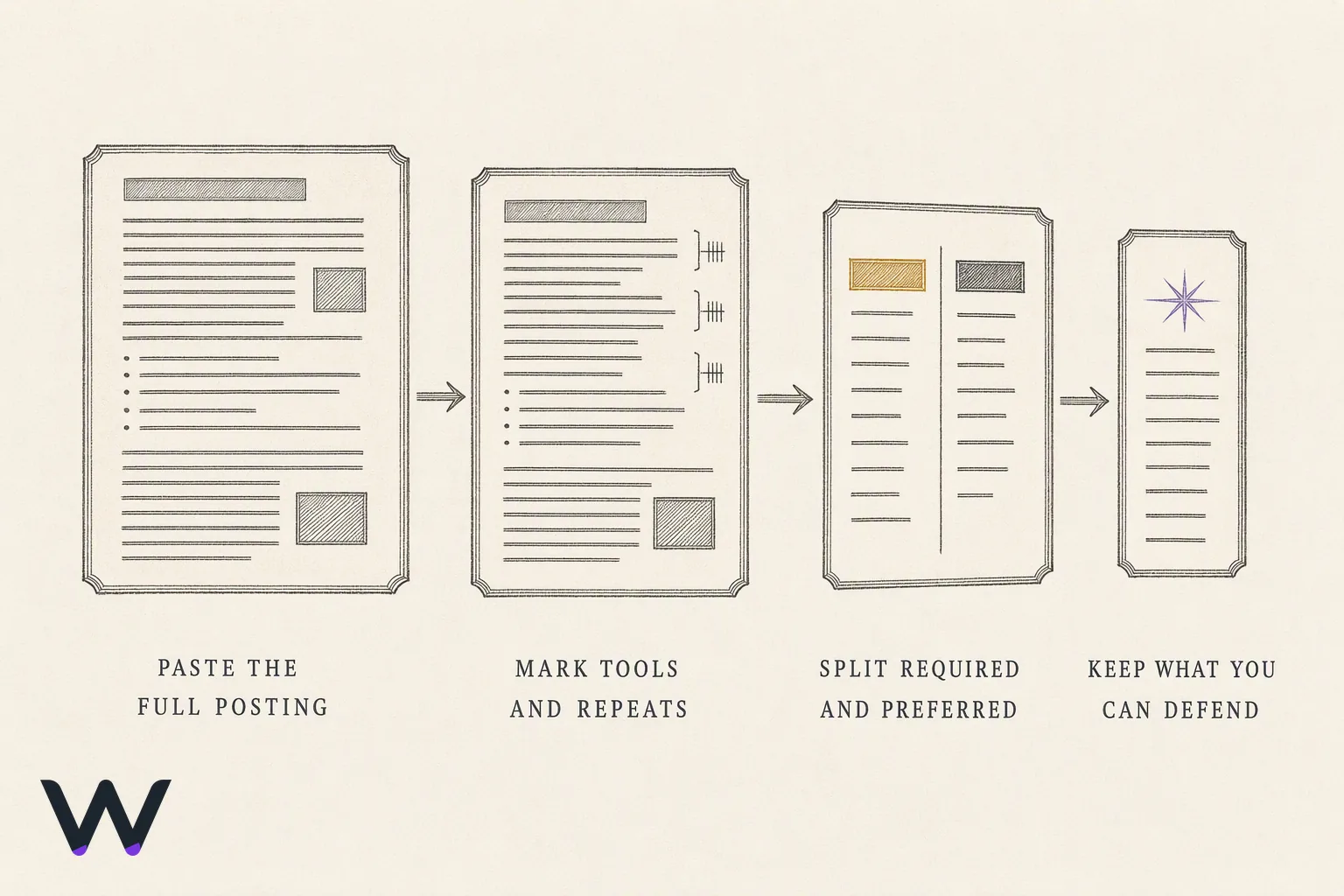
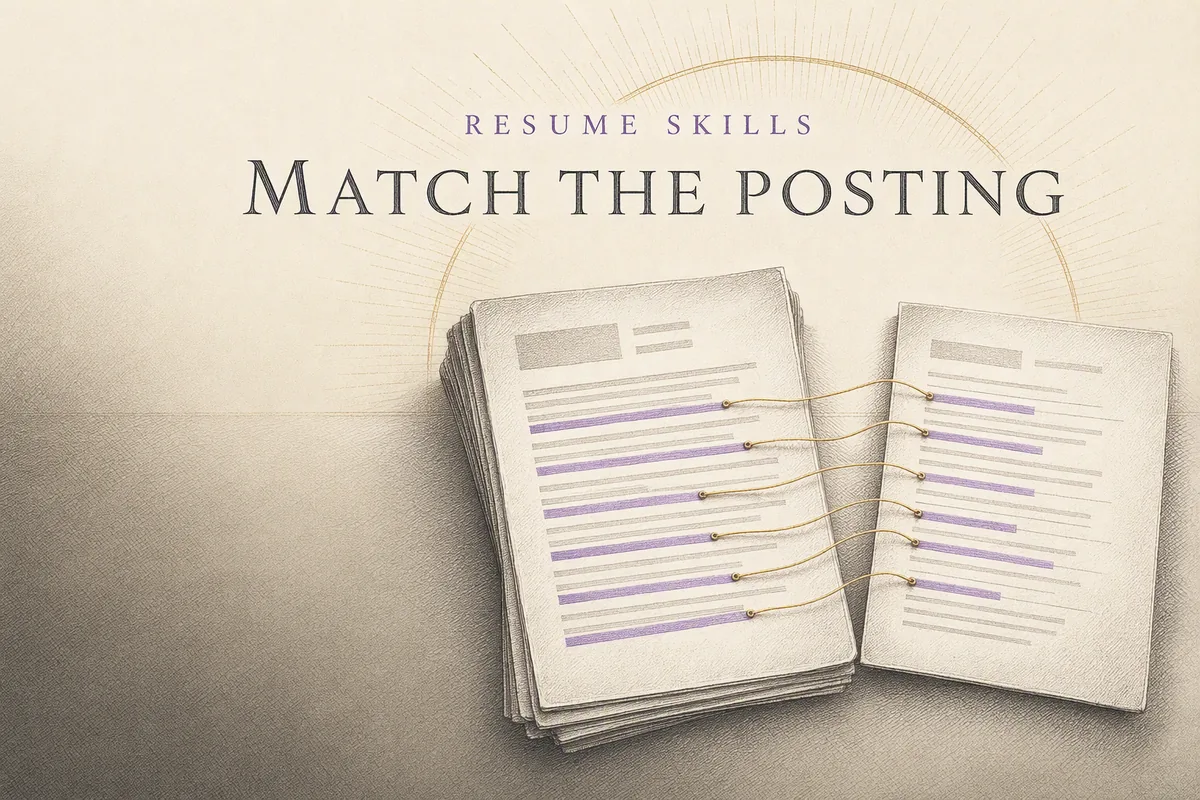
Open the posting and skip everything above the requirements block. The hiring team already wrote your keyword list: it sits in "Requirements," "Responsibilities," and "Qualifications," in their vocabulary and their order of priority. Your job is extraction, not brainstorming.
Work through a posting this way, once per application:
- Paste the full posting into a plain text file so you can mark it up without reformatting anything.
- Mark every named tool, platform, or system: Figma, Tableau, NetSuite, Jira, Google Analytics.
- Mark every noun that appears more than once. Repetition is the hiring manager telling you what the job actually is.
- Copy the posting's exact wording for each one. "Accounts payable" and "AP processing" are different strings to a parser.
- Split the marked terms into must-haves and nice-to-haves, using the posting's own "required" and "preferred" labels.
- Scan two or three other open roles on the same team for terms this posting left implicit.
- Save the result as a dated candidate list per role, so a similar posting next month starts from something.
Then cut the list down to what you can defend. A term you cannot back with a bullet, a project, or a certificate does not go on the resume, because the interview question comes straight off that line.
Generic top-10 skill articles are written against search volume, not against your posting. That is why they recommend communication and leadership to a warehouse supervisor and a data analyst alike. Use them for vocabulary when a posting is vague. Never as the source of the list itself. The posting is the source.
Keep 8 to 12 skills, ordered by what the posting asked for first
Keep 8 to 12 skills, listed in the order the posting raised them. That range is our recommendation, not a measured threshold. Below eight, the block looks thin next to candidates who read the requirements. Above twelve it reads as a dump, the parser gaining nothing while the human loses the signal.
There is no universal set of top 6 skills for a resume, and any list that claims otherwise is guessing at your role: the six that matter for a billing coordinator and the six for a backend engineer overlap at zero. Build your six from the posting's most-repeated requirements. The same answer covers the "10 good skills to include on a resume" question. Ten is a sensible ceiling for most applications, and the right ten are the ten this job description asked for, in its sequence.
Order the surviving list like this:
- Required named tools and certifications you can demonstrate in an interview.
- Required methods and processes, worded as the posting worded them.
- Preferred or "nice to have" items you genuinely hold.
- Languages, then anything transferable that the posting implies but never names.
Formatting that survives parsing on an ATS-friendly resume is boring on purpose. One heading, "Skills," set as plain text. A comma-separated line or a single-column list, nothing in a table, text box, header, or footer. No skill bars, star ratings, or percentage dials: a parser extracts no value from a graphic, and a recruiter has no reason to believe a rating you assigned yourself. Write each term once in full beside its abbreviation, as in "Search Engine Optimization (SEO)." Both forms then match.
Before you submit, read your list against the requirements block one more time and delete anything the posting never mentioned.
Back every soft skill with a number somewhere else on the page
Teamwork, problem solving, and communication were the three skills employers most often said they look for on college students' resumes in NACE's Job Outlook 2026 Spring Update, and 85% of its 185 respondents wanted evidence of teamwork specifically rather than the word on its own [2]. That survey ran from 12 February to 17 March 2026 among U.S. employers recruiting new graduates. With 185 respondents it is a small sample, and NACE did not publish comparable percentages for problem solving and communication in what we reviewed. So treat it as a graduate-hiring signal, not a rule covering every opening. The instruction still travels. Prove it or cut it.
The lists of seven soft skills that circulate on career sites — communication, teamwork, problem solving, adaptability, time management, leadership, work ethic — are a vocabulary, not a ranking, and no source here establishes an order among them. Asked instead for the top five skills, most of those lists just drop the last two entries. Overlap with what postings actually name is partial, and the gap is where candidates get lazy: adaptability and leadership go in freely because nobody audits them, while teamwork and problem solving are the terms graduate employers told NACE they check against examples [2].
Convert each listed term into one bullet that carries a quantity
Pick the soft skills the posting named, then give each one a bullet in your experience section that carries a number you can defend in an interview: headcount, cycle time, ticket volume, error rate, budget. "Communication" in the skills block becomes a bullet naming who you briefed, how often, and what changed as a result. Time management becomes a deadline you held under a named constraint. Leadership becomes the size of the group and the thing it shipped.
Keep the term in the skills list so the parser matches it, and keep the proof in the bullet above so the recruiter sees the same claim twice. A soft skill with no number anywhere on the page is a line of filler competing with your real evidence for the same glance.
Skills by role: what to list for five common application targets
Hard skills do the screening work, and they differ by role family more than any advice list admits. The table below sets out, for five common application targets, the tool names worth listing verbatim and the credential that functions as a screening keyword in that family. It is a drafting aid compiled from how these roles are typically posted, not a ranked or surveyed list.
| Role family | Core hard skills | Tool names to list verbatim | Credential that screens |
|---|---|---|---|
| Data and analytics | SQL querying, data cleaning, dashboard building, statistical summary | Excel, SQL, Tableau, Power BI, Python | Google Data Analytics Certificate |
| Project coordination | Scope tracking, risk logs, stakeholder reporting, budget tracking | Jira, Asana, Smartsheet, Microsoft Project | CAPM, PMP, Lean Six Sigma Green Belt |
| Marketing | Keyword research, email automation, paid social buying, reporting | Google Analytics, HubSpot, Meta Ads Manager, Semrush | Google Ads Search Certification |
| Customer support | Ticket triage, macro writing, escalation handling, QA review | Zendesk, Intercom, Salesforce Service Cloud | Zendesk Support Administrator |
| Administrative and operations | Calendar management, invoice processing, records accuracy, vendor coordination | Microsoft Office, QuickBooks, DocuSign, Google Workspace | Microsoft Office Specialist |
Spell the tool the way the posting spells it. A req asking for Power BI does not match "BI tools," and a parser scoring "Microsoft Excel" against your "advanced spreadsheets" gives you nothing. Match the string.
Digital literacy is the row people overrate. Listing it as a skill reads as padding at every level above intern, because the named tools already demonstrate it and the recruiter assumes it either way. The credential column is the opposite case: an in-progress certificate still earns its line, written as the certificate name plus an expected completion date. It matches the same keyword a finished one does, and it gives the screener something to ask about.
Cut these from the skills section, even when they feel true
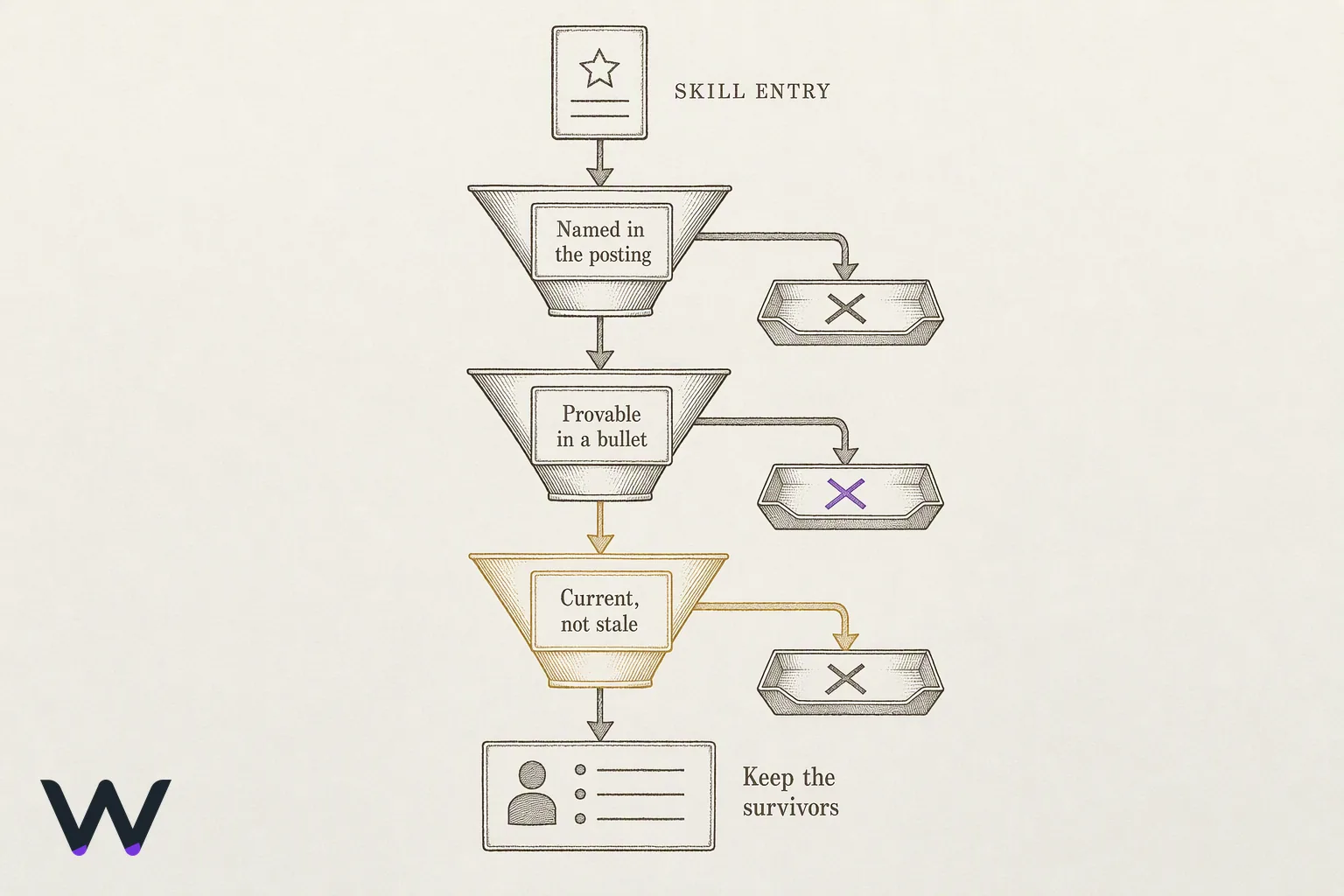
Delete self-ratings. Star rows, percentage bars, and "advanced / intermediate / basic" tags all invite a judgment you cannot control. A parser reads the bar as decoration, and a recruiter reads your own modest label as a reason to pass. State the skill. Let the bullets rank it.
Cut the baseline tools next: Microsoft Word, email, web research, typing. Listing them signals that you ran out of real skills, and on an ATS they match nothing a hiring manager filters for. The same goes for a stack of soft skills with no supporting bullet anywhere on the page. Four unproven traits in a row read worse than none.
Stale skills come off too. A tool you last touched five years ago, in a version that has since been replaced, becomes a question you will answer badly. The test is simple: anything you could not discuss for ten minutes with a practitioner does not belong in the list.
Career changers get the hardest version of this call. Keep the transferable hard skills the new posting names, drop the old field's proprietary tools that nobody in the new one screens for, and resist the urge to pad the gap with adjacent-sounding terms. Gaps in employment need no coverage from the skills section at all. That block describes what you can do now, not when you last did it, so write it as of today and leave the chronology to the experience section.
Frequently asked questions
What are the top 5 skills to put on a resume?
The five to lead with are the five the job posting names most often, which means the list changes with every application. Teamwork, problem-solving, and communication rank as the top three employers look for on college candidates' resumes in NACE's Job Outlook 2026 Spring Update, a survey of 185 respondents recruiting new graduates between February and March 2026 [2]. Add the two tools the posting names. That is your five.
What are the top 6 skills for a resume, and the 10 good ones?
Six or ten is a formatting question, not a skills question. Keep 8 to 12 entries so the section fits three lines and every entry traces to a phrase in the posting. Group them: tools, methods, domain. Cut any skill you cannot point to in a dated bullet below, and cut anything a hiring manager assumes of a working adult.
What are the 7 soft skills?
The circulating seven are teamwork, communication, problem-solving, adaptability, time management, leadership, and conflict resolution — a vocabulary in common use, not a sourced ranking. The U.S. Department of Labor's O*NET database does separate skills from both abilities and knowledge, and splits skills into basic and cross-functional ones [1]. In NACE's 2026 spring update, 85% of the 185 employers surveyed looked for evidence of teamwork on a resume, not a label [2]. Evidence means a bullet with a number in it.
Should a professional summary for resume repeat the skills section?
No. A professional summary for a resume should carry your two highest-priority keywords from the posting inside a working sentence, not reprint the full list. Parsers read both sections, so one duplicated phrase is redundant weight. Recruiters start at the top of page one, and a second copy of your skills list spends that space twice. Write the summary as a claim with a number in it.
Does a skills-based resume beat a chronological one for ATS?
No published parsing benchmark comparing the two layouts is cited here, so take this as a recommendation: default to reverse-chronological. Dated employer-title-date blocks are the most conventional structure for the experience section, and they let a screener read your experience length without interpreting anything. A skills-forward layout earns its place in one case: reframing a pivot, where your recent titles argue against the role you want. Even then, keep the dated roles directly below the skills block, with months and years intact.
Build your skills section from one posting tonight, then diff it against the next posting you open.
Last updated: 1 October 2026
References
- The O*NET® Content Model — onetcenter.org
- The Key Skills Employers Seek on College Students' Resumes — naceweb.org

Stop applying. Start interviewing.
- ✓Wobo finds matching roles and applies for you
- ✓Tailored resume, cover letter and answers included
- ✓You focus on interviews, we handle applications