Last updated: 2026-09-28
A resume is a short document listing your work experience, skills, and education, written for one specific job you are applying to. It argues for one role, not your whole career, and university career-center guidance puts a new graduate or early-career applicant's resume at typically one page [2]. Not a CV. The first thing that reads it is usually software: an applicant tracking system stores and parses applications before a recruiter opens one [1]. Below: how a resume differs from a CV and from a cover letter, the seven sections in the order they appear, the formatting that survives parsing when the same file goes to thirty employers, and where resumes actually get rejected.
What is a resume?
A resume is a short document that lists your work experience, skills, and education for one specific job you are applying to. Most run one page. It is read first as a screening document: a recruiter or hiring manager scans it to decide whether you match the posting well enough to interview. It argues for one role, not your whole career.
That last part is what most job seekers get wrong. A resume is not a record. It is a pitch with a word limit, and the limit forces a choice about what to leave out.
Three things belong in it, always: what you did, where you did it, and what changed because you did it. Everything else is optional. Titles, dates, employers, and a skills block carry the facts. The bullets under each job carry the argument.
Your resume is parsed by software before a recruiter reads it
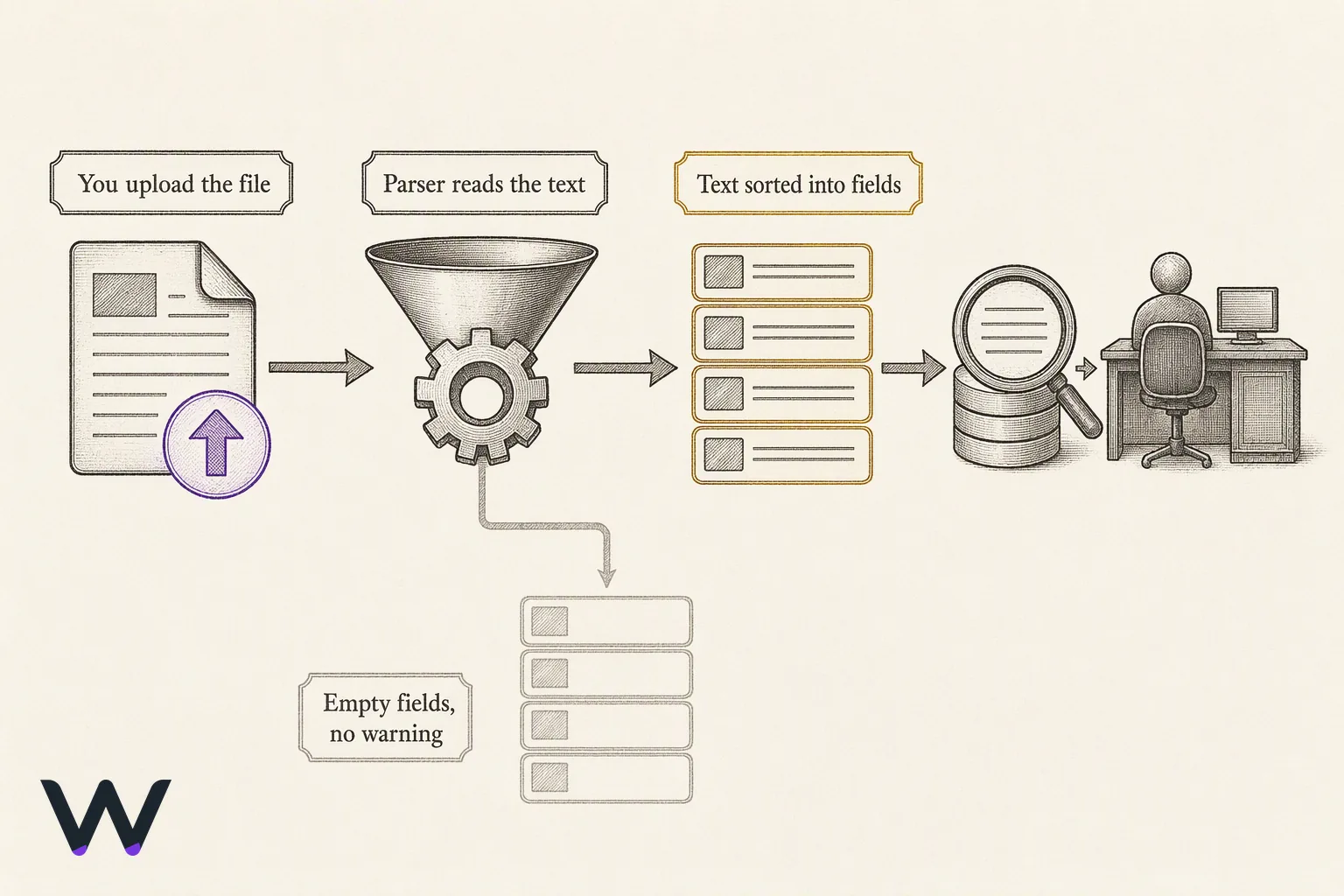
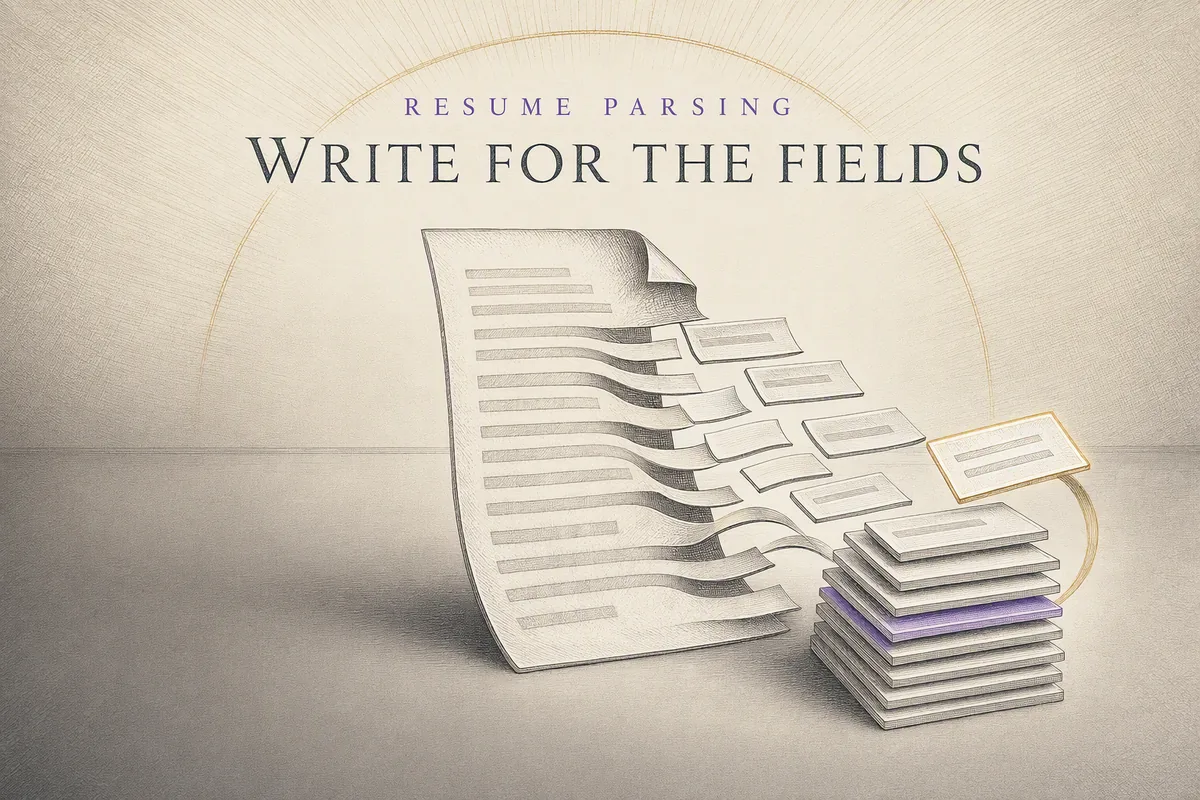
The first thing that reads your resume is not a person. It is an Applicant Tracking System — the software that stores, parses, and searches applications before a recruiter opens one. SHRM, the trade association for U.S. HR professionals, wrote in 2011 that these systems had "revolutionized recruiting by automating the storing and processing of resumes" [1]. That is trade-press description of the category, not documentation of how any current parser behaves, so treat what follows as practice guidance rather than a specification. Parsing is the step that matters to you: the ATS reads your file, pulls the text out, and tries to sort that text into fields — name, email, employer, job title, dates, skills.
When the parse goes wrong, it goes wrong quietly. Your resume still uploads. It just arrives in the recruiter's search index with an empty job-title field, or three years of work attached to the wrong employer, and you never find out.
Structure decides the outcome. The layout rules below track what university career centers advise for ATS submission — avoid images, columns, and headers and footers, and keep section headings literal [4] — with the rest of the list our own reading of how a search index gets used:
- File format. Send the .docx or .pdf the posting asks for. If it does not say, .docx parses more predictably than a design-tool PDF.
- One column. Two-column layouts get read in the wrong order, so your skills end up interleaved with your job titles.
- Real text, not images. A logo, a skills chart, or a header saved as an image contributes nothing — the parser sees a picture.
- Standard section headings. "Work Experience" and "Education" map to fields. "Where I've Made an Impact" maps to nothing.
- Dates in a consistent format. Pick
Mar 2024 – Presentand use it in every entry. - Keywords in the sentence, not in a block. Recruiters search the index by skill and title. The words from the posting need to appear where you actually did the work.
Plain formatting is not the timid choice here. It is the one that keeps your experience searchable.
What is a CV resume, and is a CV the same as a resume?
A CV and a resume are not the same document. A curriculum vitae is a comprehensive record of education, experience, and professional qualifications used mainly in academic settings. A resume summarizes skills and experience for one specific position. Length follows from that difference, with an early-career resume typically running one page and a mid-career professor's CV reaching about 20 [2].
Here is how the two differ on the three axes that decide which one you send.
| Resume | CV | |
|---|---|---|
| Typical length | One page, early-career | Up to ~20 pages, mid-career professor |
| Scope | Skills and experience for one position | Full record of education, experience, qualifications |
| Where it is used | Industry hiring | Academic settings: faculty, fellowships, grad school |
| Changes per application | Yes, tailored each time | Rarely, it accumulates |
Source: length, scope, and setting from University of Illinois Career Center guidance, an undated career-services advisory page rather than a survey of real documents [2]; the tailoring row is our own characterization.
One complication worth knowing: outside the United States, "CV" is often the everyday word for a one-page industry resume. If a posting in London or Berlin asks for your CV, it usually wants the resume. Read the length expectation, not the label.
What is a cover letter for a resume, and when it is worth the extra 20 minutes
A cover letter is a short letter to a named company explaining why you want that role and what connects your experience to it. A resume cannot do this. A resume is a list of what happened, in reverse order, with no place to say why a career pivot makes sense or why this employer specifically. The letter is where the reasoning goes.
Harvard Business Review argued in March 2025 that cover letters still matter even when a posting does not require one, while naming the standard objection — that "recruiters don't read cover letters and that they are a waste of everyone's time" [3]. That piece is editorial argument, not a study, and neither side of it comes with a measured rate at which recruiters open the letter. So the question is better resolved on tailoring cost than on either claim.
Write one when the application is worth 20 minutes: a role you would take over your current job, a company where you can name a specific product or problem, or an application where something about your history needs explaining. Skip it for the rest. A generic cover letter attached to the fortieth application says nothing a recruiter cannot read off the resume, and it takes the time you should have spent tailoring that resume instead.
What does a resume look like: the sections, in the order they appear
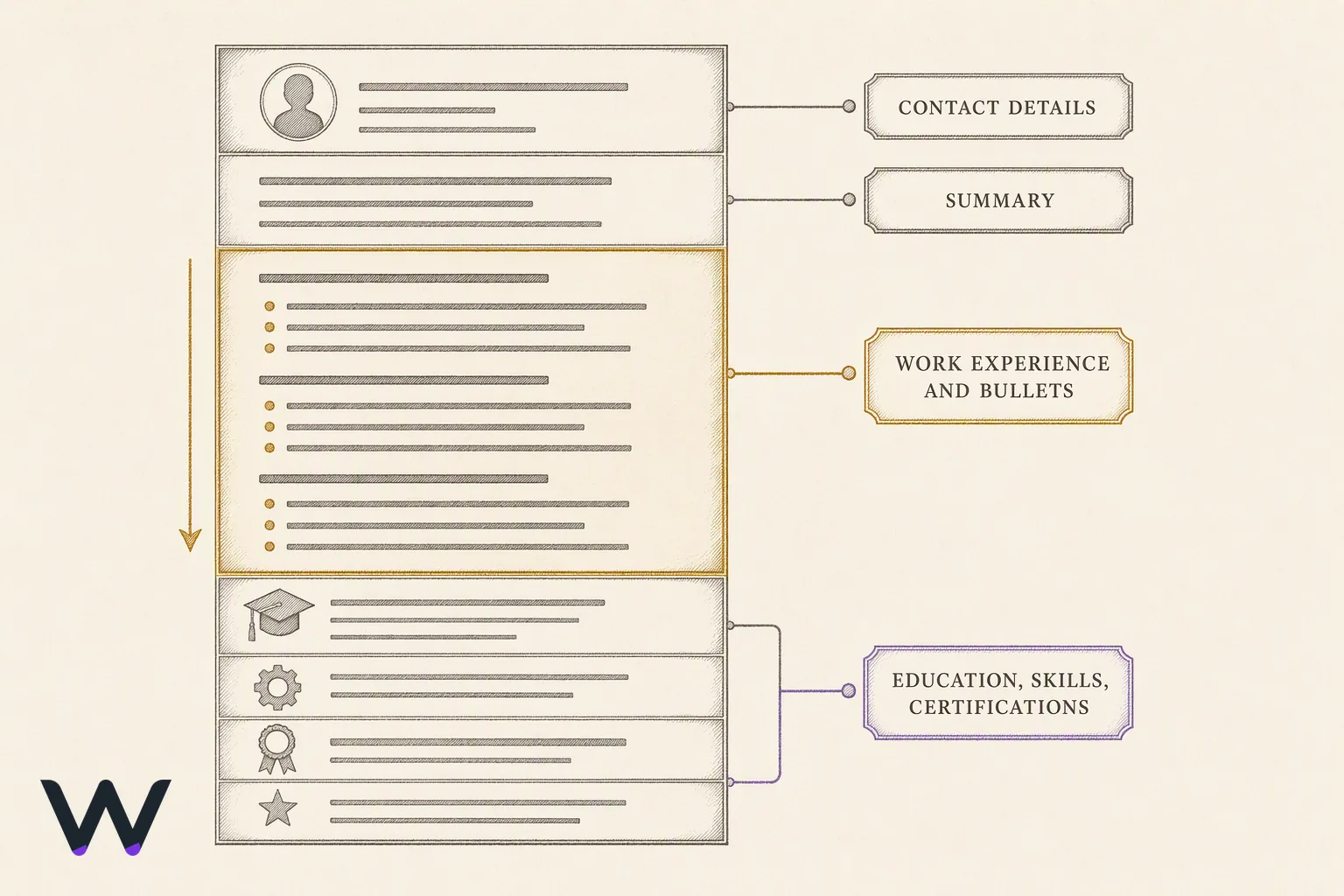
A resume is a single document of plain, labeled sections in a fixed order, and almost every resume you will ever see uses the same seven. Top to bottom:
- Contact information: name, city and state, phone, professional email, LinkedIn URL. No street address, no photo.
- Summary: three or four lines naming your role, how long you have done it, and what you are best at.
- Work experience: employer, job title, location, start and end dates, then bullets under each role.
- Education: institution, credential, field, graduation year. It sits below experience once you have worked a couple of years.
- Skills: the tools, software, and languages a job posting would actually name.
- Certifications: credential name, issuing body, date earned. Skip this heading if you have none.
- Optional closers: portfolio or GitHub link, publications, volunteer work, spoken languages.
Reverse chronological order runs through the whole document. Most recent job first, most recent degree first. A reader scanning the page expects your current title in the upper third, and anything else reads as a puzzle.
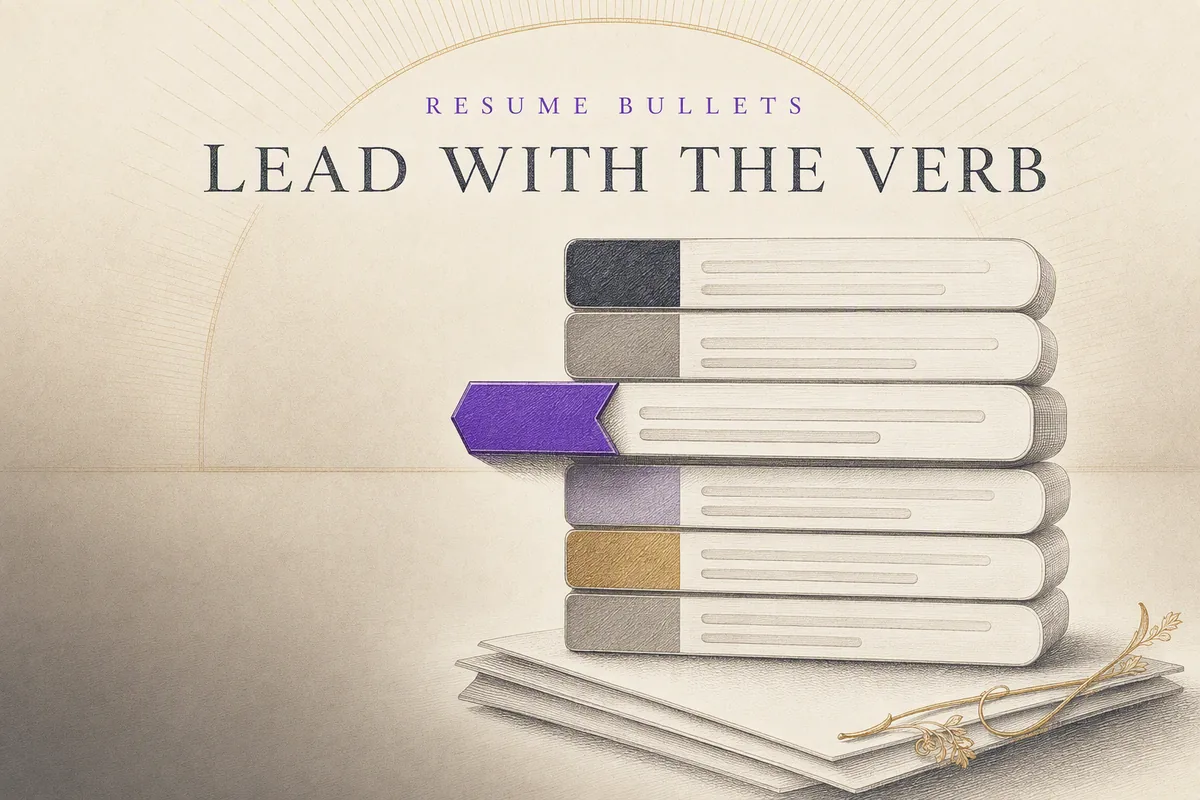
The bullets under each role are where the document either works or does not. Each one opens with a past-tense verb, names the thing you did, and ends with the outcome or the scale. "Managed the inbox" tells a recruiter nothing. "Handled customer email for a two-person support team, cutting response time by half" tells them the size of the job and what changed. Three to five bullets per recent role, fewer as you go back.
What to put on a resume, then, is a short factual record with no adjectives holding it together. Headings labeled in the plainest words available: "Work Experience", not "My Professional Journey". Everything else is decoration.
What should a resume look like when you are sending it to 30 employers
A resume you are sending to thirty employers should look deliberately plain: one column, black text on a white page, literal section headings, no graphics. University of Pittsburgh's career center advises building the file in Microsoft Word using a standard font such as Arial, Calibri, or Times New Roman, avoiding images, columns, and headers and footers, and converting the file to PDF rather than printing to PDF when you submit [4]. That guidance comes from a career service, not from an ATS vendor's technical documentation, and the page does not name which platforms it was tested against. But the last distinction is not fussiness. A printed-to-PDF file can arrive as an image of your resume, and a parser reads an image as an empty page.
How to write the resume, mechanically: keep one master DOCX holding every role, every bullet, and every skill you can back up. That file never gets sent anywhere. Each application gets a copy of it, trimmed and aimed at one posting.
Then tailor. University of Arizona's career center advises reading the job description, highlighting the keywords and phrases that repeat or are emphasized, and matching that language in your resume so the relevant skills stand out to the screening software [5]. The same page attaches a condition worth repeating: mirror the wording for experience you genuinely have, not experience you would like to claim. Keyword matching is a translation job, not an invention job.
Per application, change three things and leave the rest alone: your summary line, the order of your skills list, and the top two or three bullets of your most recent role. Employers, titles, and dates stay fixed forever. That is roughly a four-minute edit once the master file exists, which is what makes volume applying survivable.
Headings stay boring for the same reason. Pittsburgh's guidance is to use a literal heading such as "Experience" rather than a rebranded version of it [4]. Give the page real margins, a blank line between roles, and body text you can read at arm's length. White space is what makes a human reader keep going after the parser is done.
Resume summary examples, resume skills examples, and resume objective examples
Career stage decides which of the three you write. A professional summary goes at the top once you have real work to summarize. An objective is for people who do not yet: students, first job, or a switch so sharp that your history argues against you. Never both. Here are hypothetical models to adapt, not to copy:
- Summary, mid-career: "Customer success manager with six years in B2B software, owning renewals for a 40-account book and lifting retention two years running."
- Summary, career change: "Retail store manager moving into operations analysis. Built the scheduling and inventory reporting for a seven-store region, self-taught in SQL and Excel modeling."
- Objective, entry-level: "Recent accounting graduate seeking a staff accountant role, with two internships in accounts payable and a completed CPA exam section."
- Hard skills line: "Python, SQL, Tableau, Salesforce, Google Analytics, advanced Excel including pivot tables and VLOOKUP."
- Soft skills, embedded: put these in your experience bullets, not in a list. "Trained four new hires" beats the word "leadership" every time.
The skills section belongs to hard skills. Named tools, named languages, named platforms — the things a job description lists and a recruiter searches. A standalone line reading "communication, teamwork, detail-oriented" is the most skippable text on any resume, and every applicant has already written it.
The case against keeping an objective past your first job is structural, not a matter of taste: it spends your most valuable four lines telling an employer what you want, in a document whose job is telling them what you have done. Rewrite it as a summary.
Where resumes get rejected: gaps, career changes, and decorative formatting
Employment gaps sink fewer applications than job seekers fear. SHRM's 2019 guidance to employers — editorial advice to recruiters rather than a survey finding — is to evaluate a candidate's skills and experience first and then raise any gap in direct conversation, rather than inferring a reason from the dates alone [6]. Treat it that way on the page. Give the period a line, name what you did in it, and keep moving: "Career break, caregiving and part-time freelance design". One line. No apology attached.
Career changes fail for a different reason, and it is fixable. The rejection usually comes from a resume that still describes the old job in the old job's vocabulary, leaving the reader to do the translation. Rewrite your bullets in the target field's nouns before you blame the change itself.
What genuinely gets a resume dropped is duller than any of that. Typos in your own job titles. An email address you no longer check. A portfolio link that returns a 404. Two-column layouts, icons, and skill rating bars that a parser turns into gibberish.
Open your resume, click every link on it, and read the contact block out loud. That is tonight's task.
Frequently asked questions
Should a resume be one page?
One page is the default for applicants below roughly ten years of experience, and career-center guidance puts a new graduate or early-career professional's resume at typically one page [2]. Treat that as a readability convention, not a filtering rule. No applicant tracking system rejects a document for running onto a second page. Recruiters skim; one page forces you to cut the weakest third yourself.
How many pages should a resume be?
One page early-career, two once you have a decade of relevant experience worth showing. Length only runs long for academic and federal documents: a curriculum vitae for a mid-career professor can reach about 20 pages, because a CV is a comprehensive record of education, experience and qualifications rather than a summary aimed at one job [2]. Match the document to the application, not to a page count.
Can a resume be 2 pages?
Yes, a two-page resume is fine when page two carries relevant experience rather than overflow. The test is content, not permission. Keep the strongest material — recent roles, quantified results, the skills the posting repeats — on page one, since that is what a reviewer reads first. Old jobs, early coursework and tool lists you no longer use belong on the cutting-room floor.
How to spell resume?
All three spellings — resume, résumé and resumé — are accepted in U.S. usage, and none will get an application rejected. Use the unaccented "resume" in filenames and in text you type into application form fields, where accented characters can survive badly through parsing and storage. Applicant tracking systems, in SHRM's description of them, automate the storing and processing of applicants' resumes [1], and plain ASCII gives them nothing to mangle.
References
- Applicant Tracking Systems Evolve — shrm.org
- Resume vs. Curriculum Vitae (CV) — illinois.edu
- Cover Letters Still Matter—Even If They're Not Required — hbr.org
- Resume and CV Writing Tips – Applicant Tracking Systems (ATS) — pitt.edu
- Tailoring Your Resume — arizona.edu
- How to Evaluate Resume Employment Gaps — shrm.org

Stop applying. Start interviewing.
- ✓Wobo finds matching roles and applies for you
- ✓Tailored resume, cover letter and answers included
- ✓You focus on interviews, we handle applications