Last updated: 2026-09-17
The resume tips that matter when you are sending forty applications are the ones you can run in under fifteen minutes: one base resume, a swapped top third, and bullets that lead with a number. Everything else is polish. More than 165 million job applications produced 1.2 million hires in Gem's 2026 Recruiting Benchmarks Report [2], roughly 137 applications per hire (165,000,000 / 1,200,000 = 137). Software reads that stack first. Below: the five moves that survive a fifteen-minute budget, the format decision you make once, an ATS parsing fix list, a 12-term skills section, the 90-second swap, and the mistakes ranked by cost.
What are the top 5 tips for a resume when you're applying at volume?
The top five resume tips that survive a fifteen-minute-per-application budget: keep one base resume and swap only its top third, mirror the posting's job title and tool names, start every bullet with a result, delete the objective, and name the file so a human can find it again. Five moves, in that order. The rest is polish.
| # | Move | What it costs | What it buys |
|---|---|---|---|
| 1 | Swap the top third only — headline, summary, first three bullets | 2 minutes | The section a recruiter reads first matches the posting |
| 2 | Mirror the posting's nouns — its job title, its tool names | 30 seconds | Your file uses the terms the searcher is searching |
| 3 | Lead each bullet with the outcome | Once, in the master file | "Cut invoice errors by a third" beats "Responsible for invoicing" |
| 4 | Delete the objective | Once | Three lines at the top go to what you deliver |
| 5 | Name the file Lastname-Firstname-Resume-Role.pdf | 10 seconds | Findable in a downloads folder of forty files |
Four of those five are one-time work in the base file. Only the first two recur per application, which is the whole reason the budget holds at fifteen minutes.
The ordering is not arbitrary, and it is worth knowing what it rests on. Moves 1 and 2 are the two the published guidance supports directly: SHRM's tailoring guide tells applicants to realign the skills wording to the posting's keywords and reorder bullets to match, rather than write a new resume each time [3], which is exactly the top-third swap. Moves 3 through 5 rest on something weaker — the observable behaviour of a screen that lasts seconds rather than minutes. Treat the first two as sourced practice and the last three as reasonable defaults with a low cost of being wrong.
Most resume help online is written for someone perfecting the one job resume they care about most, and it quietly assumes unlimited minutes. Ignore the per-application rewrite, the bespoke design, the fresh summary paragraph for every posting.
Over 70% of the more than 2,500 U.S. professionals in a 2026 Glassdoor survey said they do not feel hopeful about their search, and Glassdoor's lead researcher noted that sending more applications no longer reliably produces more interviews and offers [1]. Effort is not the input that has been missing. Time yourself on the next application and see which of the five you actually completed.
The math that changed in 2026: more applications per hire, less human reading
More than 165 million job applications produced 1.2 million hires in Gem's 2026 Recruiting Benchmarks Report [2]. That works out to roughly 137 applications for every hire (165,000,000 / 1,200,000 = 137). Nobody reads a stack that size by hand. Software reads it first, ranks it, and hands a recruiter a shortlist, which means your file has two audiences and the machine one goes first.
Two notes on what that ratio is and is not. It is an aggregate across every employer and role in Gem's dataset, not a per-candidate odds figure — your own ratio in a niche function with fifteen applicants is a different number entirely. And it counts applications against hires, not applicants against hires, so one person sending forty applications appears forty times. The direction is solid and the arithmetic is arithmetic; the precision is not.
The channel numbers say the online application is still where the volume lives.
| Channel | Share of offers [1] | Share of interviews [1] | Per-attempt strength |
|---|---|---|---|
| Online application | 60% | 66% | Cheap to send, low conversion |
| Referral / recruiter / in-person | 40% | 34% | Referral interviews convert 35% better [1] |
Both routes work. One is slower per attempt and better per attempt. Read the table as a split of your week rather than a choice: the online channel still produces the majority of offers, so it deserves the majority of the hours, but the referral column is where an hour buys the most per attempt.
Here is the part that changes what you do on Saturday morning. Your ceiling is not resume quality, because the ninetieth-percentile resume and the seventy-fifth-percentile resume both clear the same parser and both get the same brief human skim. Your ceiling is minutes.
With ten hours a week and an hour per application, you send ten. At fifteen minutes each, you send forty and keep an hour back for two referral conversations. Same week, same effort, four times the surface area — plus the two conversations in the channel that converts best.
That arithmetic is why the base-plus-swap system beats the perfection checklist. A perfection checklist prices every application the same, no matter how well you fit it, and burns the budget on postings you were never going to win. A base resume with a swappable top third prices the cheap ones cheaply and leaves room to spend forty-five minutes on the three roles that deserve it.
Open your sent folder, pick the last five applications, and write down the minutes each one cost. If the total is over two hours, the fix is not a better resume. It is a resume you stop rebuilding.
Pick the best resume format once, then stop redesigning it
Pick reverse-chronological and move on. It is the format a recruiter expects to see when they open the file, and the one that gives a parser the least to misread. The table below compares the three formats on what a reader meets first and who each one actually fits.
| Format | Top of page one | Fits | Verdict |
|---|---|---|---|
| Reverse-chronological | Most recent job, with dates | Anyone with continuous work history | Default |
| Functional | Grouped skill clusters, no dates | Long gaps you cannot explain in a line | Skip |
| Hybrid | Short summary, then dated roles | Career changers with transferable output | Only for a pivot |
Functional is the one to be careful with. It hides dates, which is exactly what it was designed to do, and a recruiter who cannot find a date range assumes the worst version of what you are hiding. That last step is an inference about reader behaviour rather than a measured finding, so weigh it accordingly — but the cost of the safer choice is zero, because the reverse-chronological version with the gap labelled says the same thing and hides nothing. Hybrid earns its place only on a pivot, where the summary has real translation work to do, and that case is the one with published backing: HBR's guidance for career changers puts a personal statement explaining the pivot and the transferable skills at the top of the page [4]. See the objective section below for what goes in it.
Then freeze the specifications so you never re-decide them:
| Spec | Setting |
|---|---|
| Length | One page early career, two pages after, second page earns itself |
| Columns | Single, top to bottom |
| Margins | Half an inch minimum — tighter reads cramped and buys nothing |
| Font | One system face throughout (Times New Roman, Calibri, Helvetica) |
| Headings | Bold, body size or one step up |
| Files | .docx for upload forms, PDF for direct email |
These are conventions, not findings — no study sets your margin at half an inch. They are here so the decision is closed rather than correct, and any internally consistent set of specs would do the same job.
File type is the one real decision left. Upload the .docx version into any form that asks you to upload a resume, and attach the PDF when you are emailing a person directly. PDF holds your layout; .docx survives older parsers that mangle it. Keep both versions in the same folder, named identically apart from the extension.
Good resume examples worth copying share this trait: they look boring and they read fast. Build the base file once this week, export both formats, and then treat the design as closed. Every minute you spend on margins after that is a minute not spent on an application.
Build an ATS resume that parses correctly on the first upload
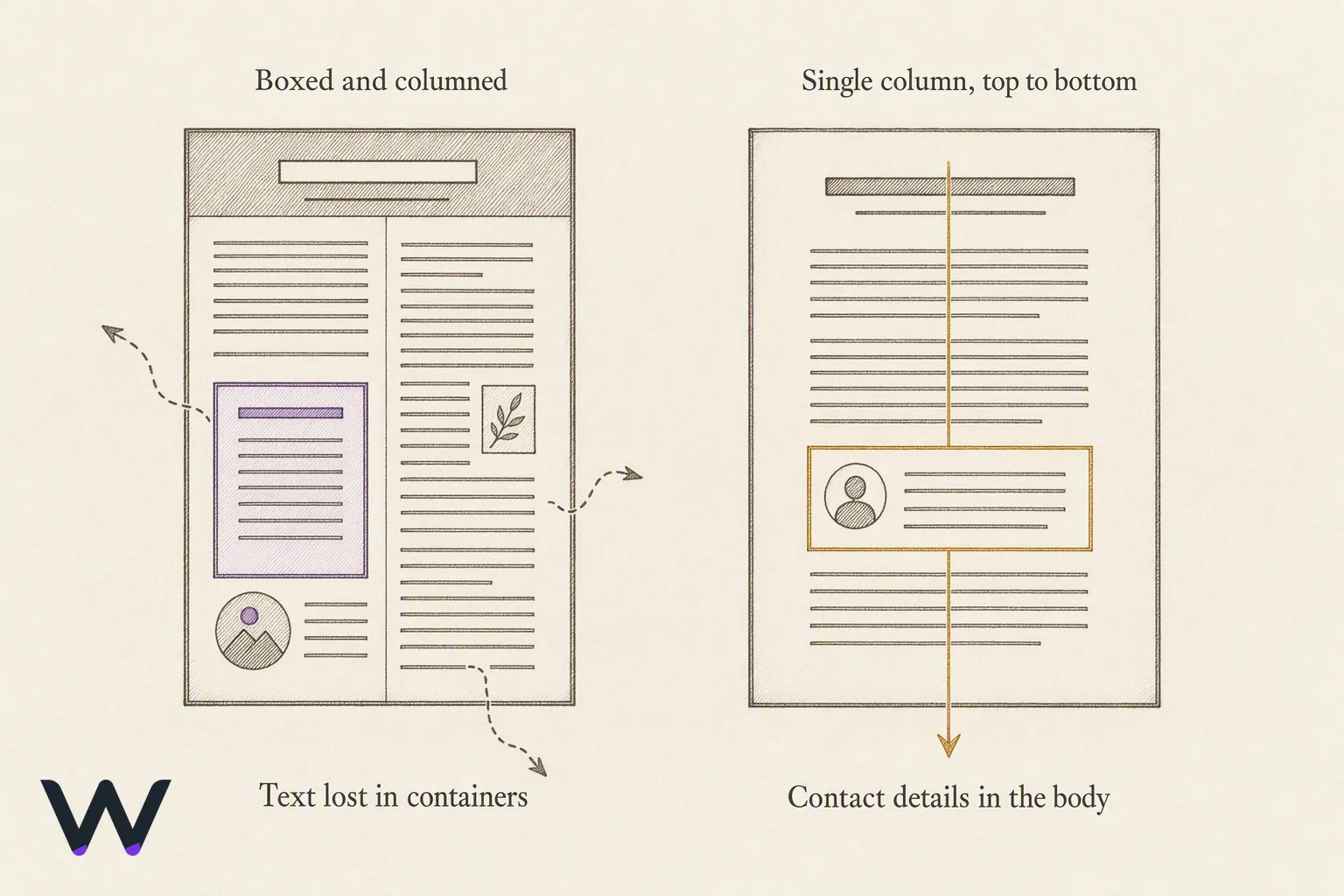
Formatting breaks parsing far more often than word choice does, so fix the layout before you touch keywords. Applicant tracking systems read a resume as a stream of text, and anything that hides text inside a container gets dropped or scrambled on the way in. Workday, Greenhouse and Lever all behave differently on the edge cases, which is the argument for a file plain enough that the differences stop mattering.
The list below is the conservative version of what the market treats as parser-safe formatting. No vendor publishes its parsing rules, and the failure modes here are inferred from what survives a text extraction rather than from documentation — which is why the test that follows the list matters more than the list does.
| Remove | Why it breaks the parse |
|---|---|
| Tables and text boxes — including Word's invisible alignment ones | Text inside a container may not reach the text stream at all |
| Headers and footers holding name, phone or email | The most important fields land in the zone parsers most often skip |
| Two-column layouts | Parsers often read across the page instead of down it |
| Icons, logos, skill bars | Carry no text — a five-star rating parses as nothing |
| Screenshots or images of text | Invisible to the parse, however good they look |
| Invented section names | Use "Work Experience", "Education", "Skills" |
Test it in three minutes, for free. Open your resume, select all, paste into a plain text file, and read the result top to bottom. If your job titles land in the wrong order, if dates detach from employers, or if half a bullet vanishes, the parser will make the same mistake. Fix, re-export, re-paste. The test is not an approximation of what the system does — it is close to the same operation, which is why it catches most of what a paid checker would. It is a floor, not a guarantee: passing it means your text is extractable, not that any particular system ranked you well.
ATS resume checkers are worth less than their pricing suggests. They reliably catch what the copy-paste test already caught: unreadable containers, missing contact details, section headings they do not recognize. What they cannot tell you is whether your bullet proves the claim it makes, and their match scores are not the score any recruiter sees, because the tool is guessing at a job description weighting it does not have.
Keyword matching still matters, in one narrow way. Use the posting's own noun for the thing, not your employer's internal name for it. If your company called its CRM "the Hub" and the posting says HubSpot, the posting wins — nobody is searching a database for your internal vocabulary. This one is sourced rather than inferred: SHRM's ATS guidance is explicit that the fix is realigning the skills section's wording to the posting's keywords [3].
Run the paste test on your base file today, then never repeat it unless you change the layout.
Skills to put on resume: choose 12, not 40
Build the skills section from your own target postings, not from a generic list of skills to put on resume. Open the ten most recent jobs you actually intend to apply to, paste them into one document, and count which tools and platforms repeat. Terms that appear in most of them earn a spot. The rest is line space you pay for twice.
Order the section this way:
- Software and platforms by name: Microsoft Excel, HubSpot CRM, Google Ads, Adobe Illustrator.
- Methods and processes you can defend under questioning in an interview.
- Certifications, with the issuing body spelled out and the date earned.
- Languages, with the level stated plainly.
Cap the block at around a dozen entries. Past that, a recruiter stops reading and starts skimming for the terms they asked for, and a long list makes the relevant one harder to find rather than easier. The dozen is a working number rather than a threshold anyone has measured — the principle underneath it is that the terms you were hired for should not be diluted by the ones you touched once, and any cap tight enough to force that choice does the job.
Keyword stuffing starts at a specific point, and it is not a word count. It starts when a term sits in your skills section that no bullet in your work history demonstrates. A recruiter finds that gap in one question, and the cost is not the missing skill — it is that every other line on the page now needs checking too.
Keep soft skills out of the list entirely: "strong communicator" proves nothing standing on its own, while the same claim inside a bullet about running weekly stakeholder reviews does the work. Technical skills belong in the list because they are checkable. Everything else has to be shown somewhere a human is already reading.
Skills for resume tailoring: the 90-second swap per application
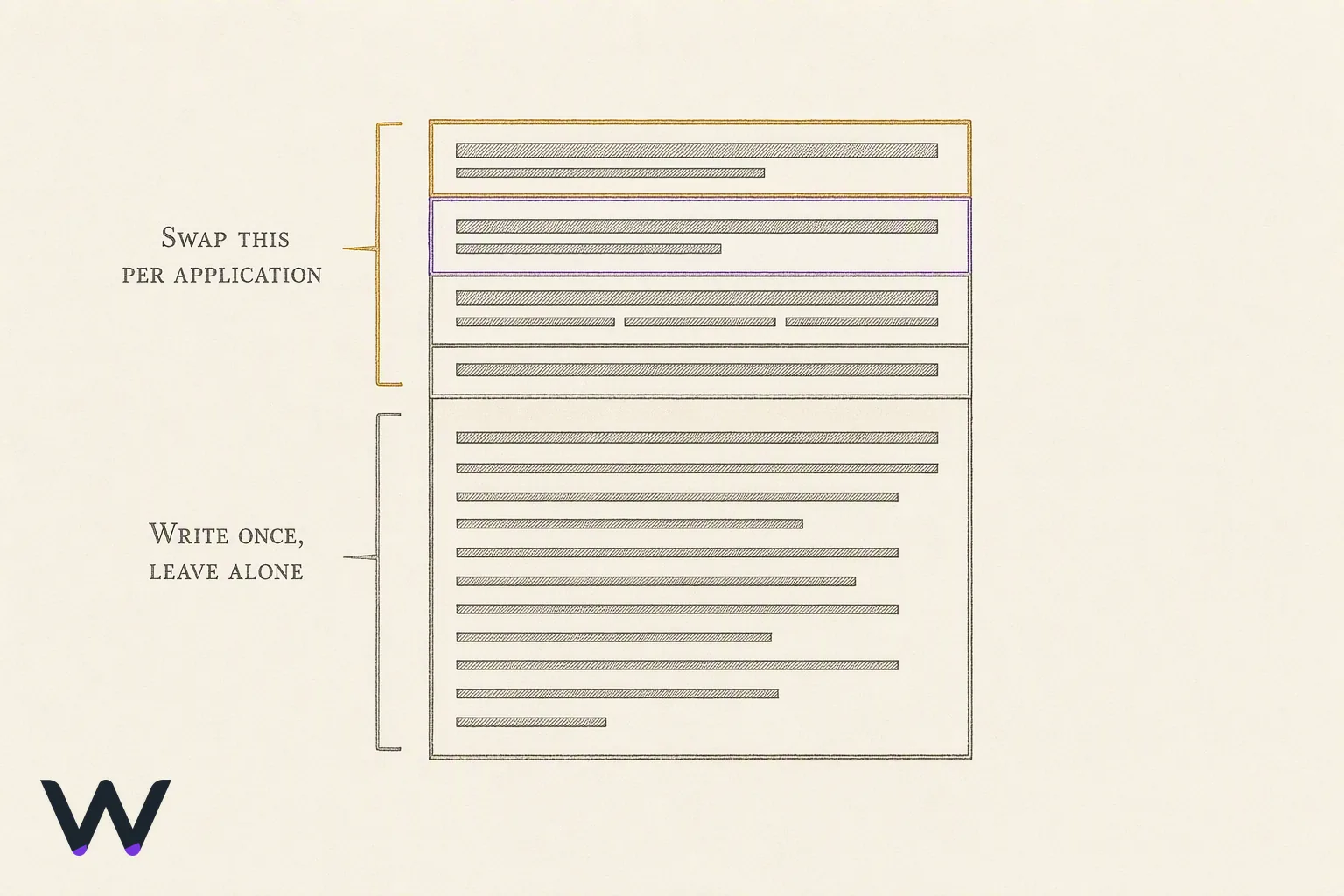
Keep one base resume per role family and edit three things per application: the skills wording, one line of the summary, and the top three bullets under your most recent job. Tailoring is an edit, not a rewrite: align the skills section with the posting's own keywords and reorder bullets so the ones the employer cares about sit first [3]. The reordering costs nothing and carries most of the benefit — the bullets already exist and already have their numbers, so all you are deciding is which one a recruiter meets first.
Run it in this order, with the posting open beside the file:
| Step | Edit | Seconds |
|---|---|---|
| 1 | Reorder the top three bullets under your latest role so the closest match sits first | 30 |
| 2 | Rewrite the skills row in the posting's own terms | 30 |
| 3 | Change the one summary line naming the role and the headline result | 30 |
The three edits are SHRM's two recommendations — realign the skills wording, reorder the bullets [3] — plus one summary line. The thirty-second slots are a budget, not a measurement: they exist to keep the edit bounded, and the only number worth trusting here is the one your own timer produces on the third run.
Use the posting's nouns instead of your synonyms. If the listing says "stakeholder management" and your resume says client relations, change the words. A job description is a list of what the hiring manager will search for, written by the person doing the searching.
A role family is whatever set of postings shares a vocabulary — one base file for analyst roles, another for operations, if you are applying to both. Two or three base files is manageable. Seven means you are rewriting under another name.
Set a timer the first few times you run it. The edit gets faster once the base file is clean, and anything past two minutes means you have drifted into rewriting.
Replace the objective for resume with a three-line summary
Delete the objective if you already work in the field you are applying to. It spends three lines describing what you want, at the top of a page that should be proving what you can do. Replace it with a three-line summary: what you do, the scale you do it at, and the single result worth leading with.
Three readers still earn an objective:
- Career changers. Name the pivot and the transferable skills behind it. This is the one case in the list with direct published backing: HBR advises career changers to open with a personal statement explaining the pivot and the transferable skills rather than a traditional objective line [4], because the alternative is leaving a recruiter to connect two unrelated job titles on your behalf — and they will not.
- First-time applicants. With no relevant history to summarize, the slot has to state the target instead. No source says so; the reasoning is only that an empty summary is worse than a stated target.
- Applicants from another city. One line saying you are relocating removes the question your address raises before anyone asks it. Also unsourced, and also close to free to do.
Everyone else runs the summary. The test is simple: read your opening three lines and ask whether a stranger could name one thing you have delivered. If not, those lines are still an objective wearing different words.
Write every bullet once, with the number attached
Write every bullet the way a stat is written: verb, object, number, timeframe. "Responsible for managing the onboarding process" tells a recruiter you held a job title. "Rebuilt onboarding for X new hires a quarter and cut week-one support tickets by Y percent" tells them what changed while you were there. Same job. One of them survives a short skim.
Action verbs do the front-loading:
| Use | Avoid |
|---|---|
| Rebuilt, Negotiated, Shipped, Cut, Recovered | Assisted, Helped, Worked on, Responsible for |
That table is craft convention, not a research finding — nobody has run a controlled test on "Rebuilt" against "Responsible for." What is defensible is the underlying claim: a bullet naming an outcome carries information that a bullet naming a duty does not, and the reader has to do less work to extract it.
The verb sets the claim size, so pick the largest one that is honestly true and stop there. "Led" when you contributed is the kind of thing an interviewer unpicks in two follow-up questions, and inflation is the fastest way to lose an interview you already earned.
When you have no metrics, you still have arithmetic. Most people skip quantifying because they never had a dashboard, then write duty statements for eight years of work. Count instead: how many accounts, how often, how large, how fast, how many people downstream. "Handled scheduling for a team" becomes "Scheduled shifts for a team of X across Y locations." Scale and frequency are numbers, and nobody needed a dashboard to know how many locations there were.
The quantify-and-qualify pairing is what makes the bullet land: the number says how much, the qualifier says why it mattered to the business. Number without context reads like trivia. Context without a number reads like everyone else's resume.
Do this once. Write your full set of achievement bullets in a master document, in their strongest form, before you apply to anything. Every application after that is selection, not composition. That is the whole reason good resume examples look effortless — the writing happened weeks earlier, on a Sunday, not at 11pm against a posting deadline.
Three tailoring depths compared: a time budget you can check
Tailoring is a spending decision, not a virtue. Pick the depth by what your own numbers say: take your callback rate on untailored sends as the floor, published tailored-resume response rates as the ceiling, and ask how many extra interviews the gap buys per hour spent.
| Depth | Time per application | What changes | Use when |
|---|---|---|---|
| Master resume | 0 minutes | Nothing | Volume sends, weak-fit roles |
| The 90-second swap | 90 seconds | Headline, top three bullets, skills row | Most applications |
| Full rewrite | One sitting per role | Every section, plus the summary | Shortlist roles only |
The middle tier is the one nobody prices, and it is worth being explicit about what it rests on. The published guidance covers the kind of edit — SHRM's position is that realigning the skills wording and reordering the bullets is the tailoring that matters, not a fresh resume per posting [3]. What no source establishes is the share of the benefit that edit captures, or that ninety seconds is the right price for it. The reasoning for the tier is structural rather than measured: the headline, summary and first bullets are the part of the page a parser weights and a fast human reader reaches, so an edit confined to that region touches the material both audiences actually see, while the sections a full rewrite improves are the ones further down. That is an argument, not a measurement, and it is the weakest load-bearing claim in this article — if you have callback data of your own across both depths, trust yours over this.
Run the swap as your default. Reserve the full rewrite for the three or four jobs you would actually accept on Monday. And be honest about the top row: sending the master resume untouched is a legitimate choice for a weak-fit posting, as long as you are not running your whole week that way.
The mistakes that waste the most applications, ranked
Rank your fixes by what kills the application outright, not by what annoys a stylist. Recruiter-facing advice tends to collapse into three words — clear, concise, consistent — meaning readable at a glance, no sentence that could be shorter, and identical formatting for every date, title, and bullet. That framing is a common shorthand rather than anything a body has defined or standardized, so treat it as a memory aid for the three properties and not as a canonical checklist. Typos rank below all three. They cost you credibility, not the screen.
Ranked by damage:
| Rank | Mistake | Fix |
|---|---|---|
| 1 | Wrong or missing contact details | A dead phone number ends the process before anyone reads a bullet — check both fields today |
| 2 | Unexplained employment gaps | Year range plus a four-word reason: "Full-time caregiving, 2024-2025" |
| 3 | A career transition with no translation | Do it in the summary — nobody connects your old titles to their job for you |
| 4 | Job hopping shown without pattern | Group contract roles under one header so six short stints read as one freelance run |
| 5 | Dead or missing portfolio links | Include the link when the work is the argument; test every URL in a private window |
| 6 | Proofreading last | Read the bullets bottom to top, one sentence at a time |
The ranking is ordered by failure mode rather than by measured frequency, and it is our ordering rather than a published one. The career-transition row is the one with outside support — HBR's advice to lead a career-change resume with a statement explaining the pivot and the transferable skills is the same fix stated as a positive [4]. The rest is reasoning about how applications die: the top three end the application silently — nobody writes back to tell you your phone number bounced or that they could not work out what your last job has to do with theirs. The bottom three cost you a fraction of your credibility with a reader who is already reading.
The do's and don'ts collapse into one rule: do state what changed because you were there, don't state what you were assigned. Everything else — fonts, borders, whether you center your name — is cosmetic.
If you want outside resume help, ask a person in your target function rather than a generalist reviewer. They will catch the translation failure, which is the expensive one. A proofreader catches commas.
Frequently asked questions
What is the difference in cv vs resume?
A resume is a short, competency-based marketing document that targets what a specific posting asks for. A CV is credential-based: a comprehensive listing of degrees, publications, grants and appointments that runs at least two to three pages even for an entry-level candidate [5]. In the US, CVs belong to academic, scientific, medical and research positions, and to fellowship or grant applications, while a resume is used for most other job applications [5].
What is cv resume in international job applications?
Outside North America, "CV" almost always means the same short document Americans call a resume. A posting in Berlin or Sydney asking for a CV wants two pages, not a publication list. This is a convention rather than a rule anyone publishes, and it varies by country and by sector, so read the page-count expectation in the posting rather than the label on it. When the posting says nothing, send two pages and move on.
Should I include an objective in resume documents in 2026?
Include an objective only in three cases: you are changing careers, entering the workforce with no relevant history, or relocating to a city your address does not show. Everyone else should run a three-line summary of results instead. Harvard Business Review tells career changers to open with a personal statement explaining the pivot and the transferable skills, which is a better version of the same slot [4]. The other two cases follow the same logic without the same backing.
Do ATS resume checkers reflect what real systems see?
ATS resume checkers catch the two failures worth catching: parsing errors and keyword gaps against the posting. What they cannot see is any individual employer's configuration — knockout questions, minimum-experience filters, and scoring weights all live inside the recruiter's instance, and no vendor publishes them. Treat a checker score as a formatting pass, not a prediction. SHRM's advice to realign skills wording and reorder bullets to the posting is the fix a checker is pointing at [3].
What are the 5 P's of a resume?
The 5 P's are position, proof, presentation, proofing, and personalization: target one position per version, prove each claim with a number, present it in a format a parser can read, proof it for consistent dates and titles, and personalize the skills line to the posting. This is a mnemonic for the workflow in this article rather than an established industry framework — it is useful for remembering the order, not for citing. Four of those five are base-file work you do once.
References
- Here Are 5 Outside-the-Box Strategies to Land a New Job in 2026 — entrepreneur.com
- The 2026 Recruiting Benchmarks Report — Gem — gem.com
- 5 Tips to Tailor Your HR Resume for ATS Review — shrm.org
- Switching Careers? Here's How to Write a Strong Resume — hbr.org
- The Difference Between a Resume and a Curriculum Vitae — arizona.edu

Stop applying. Start interviewing.
- ✓Wobo finds matching roles and applies for you
- ✓Tailored resume, cover letter and answers included
- ✓You focus on interviews, we handle applications