Last updated: 2026-09-25
Eleven phone interview questions fill almost every screening call. The answers below are written once and reused across all of them. The screen is standardized by design: a corporate recruiter, not the hiring manager, asks every candidate for one opening the same fixed questions, so the answers compare side by side [1]. A per-job rewrite is wasted work. What changes between calls is one clause, not the answer.
The questions below recur across industries and seniority levels, ordered by where they land in a real call: the opener first, "Do you have any questions for me?" last. Every recommendation here is attributed, and the sources sit in three tiers. Primary and regulatory material comes first — the EEOC's own guidance on interview accommodations under the ADA [14]. Then professional-body and institutional guidance: SHRM's recruiter-facing instructions on how screens are actually run [1], MIT's career development office on preparing behavioral stories [10], UMass Amherst's career-advising program on the "why this role" answer [2], and a 2026 phone-screen guide from Western Governors University's careers office [6]. Last, industry practitioners writing from inside hiring: Harvard Business Review on resume gaps [4], the technical-interview platform interviewing.io on word-for-word negotiation lines [3], staffing firm Robert Half on company research [7], and Gem's 2026 benchmarking data on how many interviews a hire now takes [13]. Every figure below sits on one of those rows. Where none of them carries a number, the sentence is written so it does not need one.
Build number 4 first, salary expectations. It ends more screens early than any behavioral answer does, and it is the only answer here you cannot take back. Running six to ten screens a month and short on time? Go straight to the 90-second checklist and run it before your next call.
How job interview phone screening actually works in 2026
A job interview phone screening is a standardized first-round call run by a corporate recruiter, not the hiring manager, in which every candidate for one opening answers the same fixed questions so the answers can be compared fairly. That is not a candidate-side guess about the process. It is how SHRM, the main US professional body for HR, instructs recruiters to run the call [1] — which is why it is worth building around, because it describes the instrument as the people operating it are told to operate it. The call filters. Nobody gets hired on it.
There are also more of these calls to get through than there used to be. Gem's 2026 Recruiting Benchmarks Report, which aggregates hiring-funnel data from recruiting teams, puts the rise in the average number of interviews per hire at 33% since 2021 [13]. That is the arithmetic behind reusable answers. The same candidate now runs more screening conversations per offer, so the per-call rewrite that felt affordable a few years ago no longer is.
What they ask in a 15-minute phone interview is narrow by design: a summary of your background, why this role, why you are leaving, your salary expectation, your notice period, and two or three must-have skills lifted straight off the posting. None of those need a story. Initial phone interview questions stay at the surface because the recruiter is checking a requisition's boxes, not probing depth, and a 15-minute slot leaves about a minute per question once the intro and the logistics are paid for.
Recruiters score three things while you talk, according to the same SHRM guidance written for the people conducting screens: whether you carry the conversation naturally or sound over-rehearsed, how direct and relevant each answer is, and whether your motivation and cultural fit match the role [1]. The middle one is where most screens are lost. Candidates answer the question next to the one they were asked, and the recruiter writes "unclear" in the box.
The questions recur across unrelated employers because the instrument is the same everywhere. A hospital system and a fintech startup both have to establish availability, compensation range, relevance, and basic communication before spending a hiring manager's hour, and both have the same reason to ask it identically of everyone: answers only compare if the questions match [1]. The variation between screens is small and predictable. Build the answers once, then treat each phone interview with a recruiter as the same call with one clause swapped.
The phone interview cheat sheet: all 11 questions on one screen
The 10 main interview questions people search for are the first ten rows here. The eleventh, salary expectation, is the one that ends screens early, so it stays on the sheet.
| # | Question | Answer shape | Target | Swap per company |
|---|---|---|---|---|
| 1 | Tell me about yourself | Now, then, why here | 45 sec | The "why here" clause |
| 2 | Why are you interested in this role? | Fit statement plus one line from the posting | 30 sec | The quoted line |
| 3 | Walk me through your resume | Three roles, one sentence each, then the pivot | 60 sec | Which role you slow down on |
| 4 | What are you looking for next? | One constraint, one ambition | 25 sec | The ambition |
| 5 | Why are you leaving? | Neutral cause, forward reason | 20 sec | Nothing |
| 6 | What is your salary expectation? | Band plus the basis for it | 20 sec | The band |
| 7 | Tell me about something you owned | Situation, action, result with a number | 60 sec | The project chosen |
| 8 | What are your strengths? | Two strengths, one proof each | 30 sec | One strength named in the posting |
| 9 | What is your biggest weakness? | Real gap plus the fix in progress | 25 sec | Nothing |
| 10 | When could you start? | Date plus notice period | 10 sec | Nothing |
| 11 | What questions do you have? | Two questions, one about the team | 45 sec | The team question |
Seven of the eleven never change. Print the sheet, keep it beside the phone, and write the swap column fresh for each company before you dial.
1. "Tell me about yourself"
What you say first in a phone interview is your name and a time check, before any question arrives: "This is [your full name], thanks for making the time. Is the line clear on your end?" Ten seconds, then stop talking and let the recruiter drive. Candidates who open with a pitch get interrupted, and the interruption costs more than the pitch was worth.
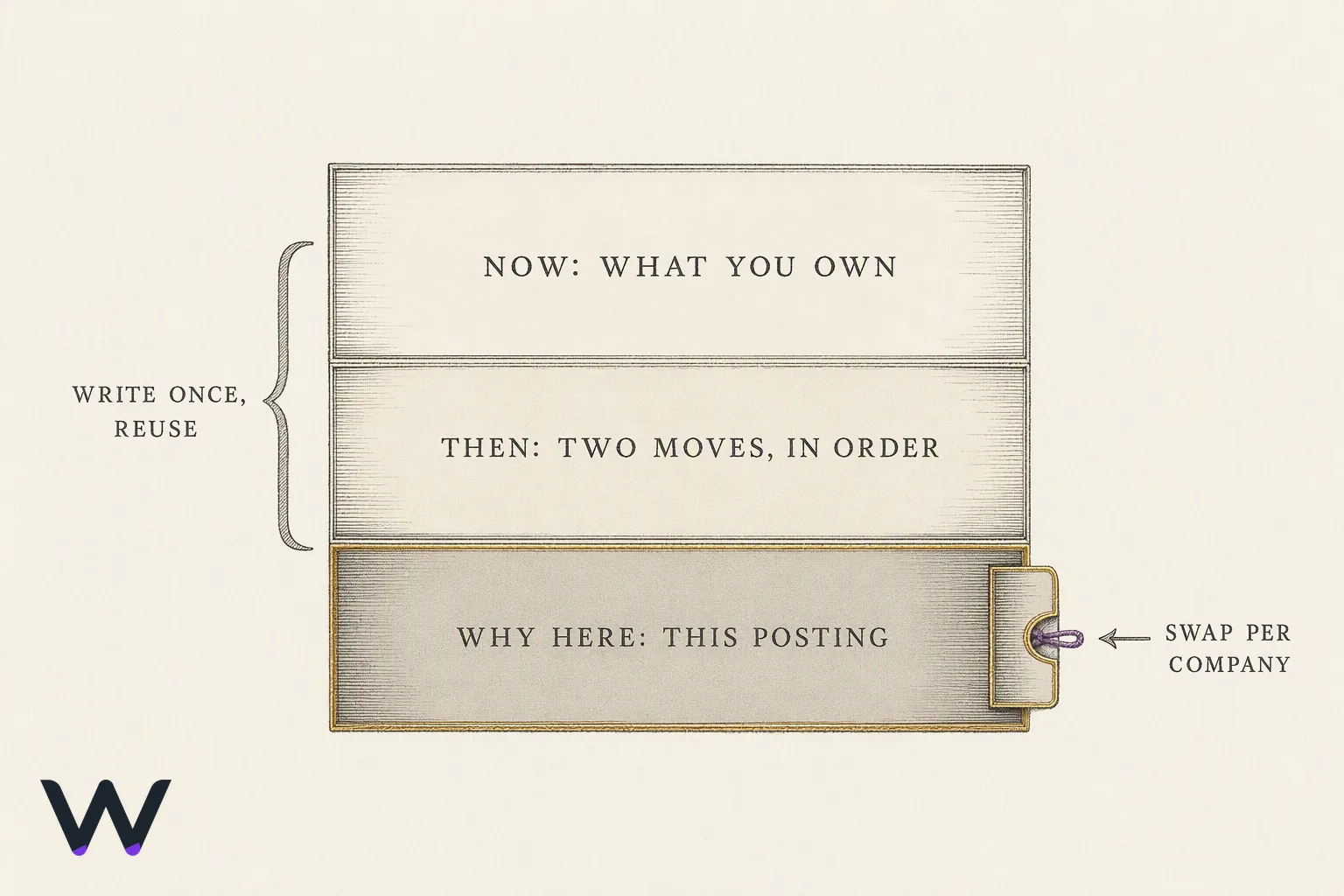
The answer itself has three fixed parts and one swappable clause, and it runs about 45 seconds:
- Now (1 sentence): current title, employer type, and the thing you are responsible for.
- Then (2 sentences): the two moves that got you there, in order, each with one number.
- Why here (1 sentence): the swappable clause, naming this role and the one thing in the posting that pulled you.
A phone interview conversation sample, in that shape: "I run onboarding for a 40-person logistics team, about 30 new accounts a quarter. I started in support, moved into implementation two years in, and cut our setup time from six weeks to three. I am here because this role owns the handoff from sales, which is the part I have been doing informally anyway."
Rehearse it aloud against a clock before the call, not in your head. The only time cap here that comes from a published 2026 screening guide rather than from interview folklore is WGU's careers office, which puts this answer at 60 to 90 seconds, practised out loud [6]. Take the 45-second version if the recruiter asked an open question. Cut to the Now sentence and the why-here clause if they framed it as "quick intro" — that phrasing means they have a list to get through and your elevator pitch is in the way.
2. "Why are you interested in this role?"
Build this answer as two clauses and only rewrite the second one. Clause one is permanent: the kind of work you want and why your track record points at it. Clause two is per application: one concrete thing from this posting, named in the employer's own words. "You are building out the reporting layer in-house, and the last two years of my job have been exactly that migration."
You cannot say why you want the job until you understand what the job is. That means reading the specific team, products, and problems named in the posting rather than the boilerplate around them — UMass Amherst's SBS Pathways career-advising line on this question, and the whole research requirement for a screen [2]. Robert Half, writing from the staffing side of the same conversation, extends it one step: the research covers what is currently happening with the company and with its industry, not just the role description [7]. Company mission statements are not it.
The under-a-minute rule: open the job description, skip the first two paragraphs and the benefits block, and take the one responsibility line that would not appear in any other posting for the same title. Paste it into your tracker beside the company name. That line is clause two.
Use the two-clause build if you are running six or more applications a week. Skip it, and write the answer from scratch, when the role is a genuine stretch or a career change, because the permanent clause has to argue for the move and a reused one will not.
3. "Walk me through your resume"
Treat this as verification, not storytelling. The screener has your resume open on a second monitor and is checking that the dates, titles, and employers you say out loud match what is printed there. Give them a route, not a memoir: three stops, told in order. Where you started and the skill it gave you. The move that changed your trajectory. The job you are in now, in three sentences, because that is the one they are hiring against.
Gaps and short stints get a line written before the call, never improvised during it. Harvard Business Review's guidance on resume gaps is blunt: say nothing about the break while you walk through your work history and you hand the interpretation to whoever is on the other end of the line [4]. Name the gap and what closed it in the same breath, whether that was caregiving, freelance contracts, or a certification.
How much you owe them is less than most candidates assume. SHRM, reporting staffing consultant Laura Mazzullo's advice to recruiters, says a brief factual explanation — out of work to care for a family member, for instance — is enough [8]. That is the screener side of the same transaction HBR describes from the candidate side, and the two agree: the gap needs a sentence, not a defence.
A stint under a year takes the same shape, for the same reason the gap does. An unexplained item on the page gets explained by the reader, and their version is rarely the generous one [4]. State the length, state the reason, move to the next stop without waiting for a reaction.
The three stops are permanent. Only the last sentence of the third one changes per application.
4. "What are your salary expectations?"
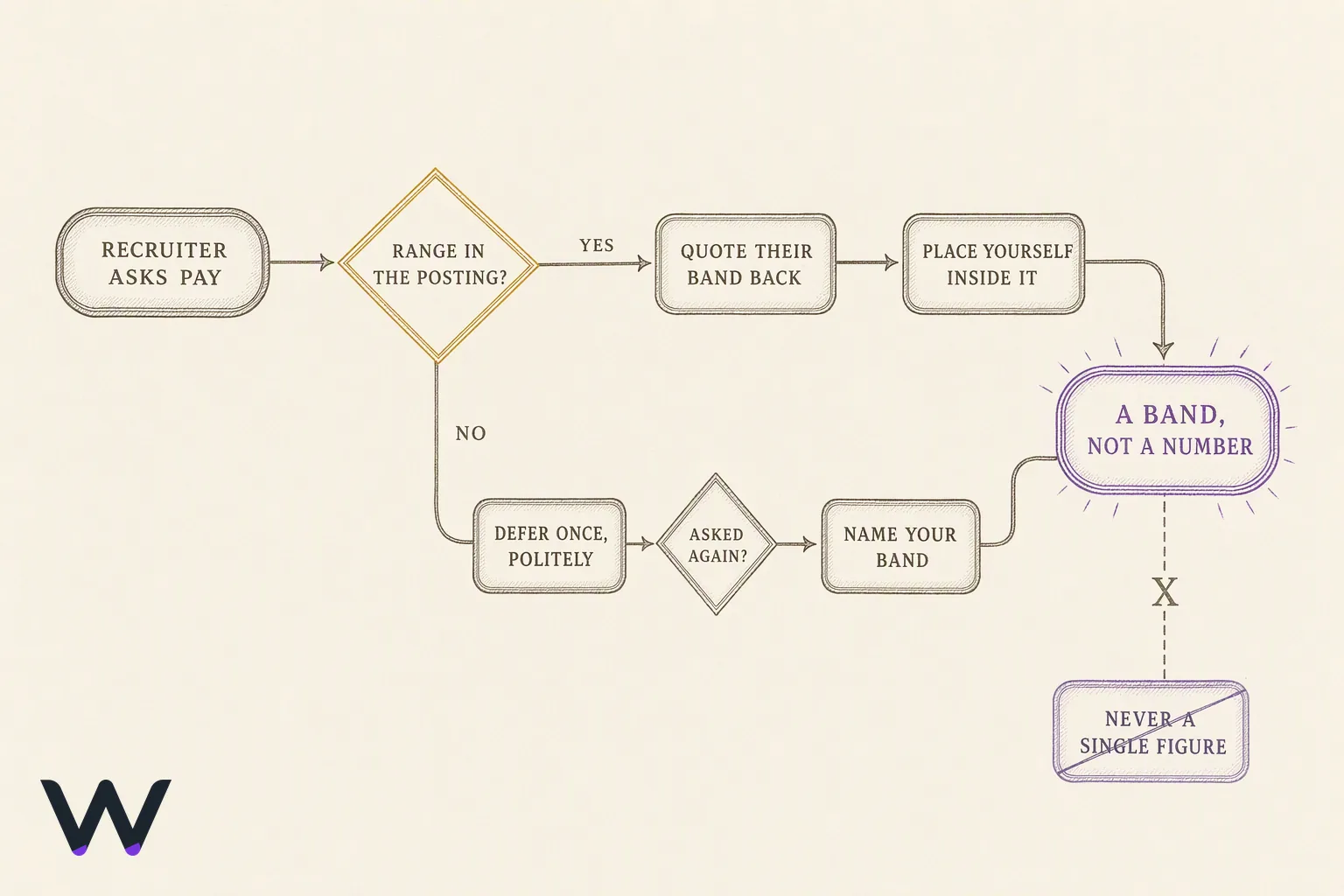
Never say a single number first. A point estimate becomes a ceiling the moment a recruiter writes it down, and it is the one answer in this whole screen you cannot walk back. Say a band or say nothing yet.
Check the posting before the call, because in much of the United States the employer has already answered the question for you. SHRM's 2026 reporting on pay transparency counts 18 states plus Washington, D.C. that legally require employers to include salary ranges in job postings, which is what makes asking a recruiter for the band a reasonable question on a first call rather than a bold one [5]. That count moves as new statutes take effect, so treat it as the state of play SHRM recorded rather than a permanent number, and check your own state's rule before you rely on it. When the range is printed, your answer is arithmetic, not courage: quote the posted band back and place yourself inside it. "Your posting lists the range, and I'm comfortable in the upper half of it given the reporting work in my last two roles."
When the range is not printed, defer once. The interviewing.io recruiter-negotiation guidance — written by a technical-interview platform that runs the calls it is describing — recommends a line that says you would rather learn more about the opportunity before naming a figure [3]. That works exactly once per call. If the recruiter pushes a second time, give a band drawn from comparable posted ranges for the same title and metro, state it as a band, and stop talking. The deferral buys information, not silence: the point of the extra round is that you name your band knowing more about the scope than you did a minute earlier [3].
Three rules hold across every screen. Quote their number before you offer yours. Give a range no wider than about 15% end to end, or it reads as a guess. Anchor on total compensation, not base, so equity and bonus stay on the table later.
Write the band once a month. Update it when the postings you are actually applying to move, not when you feel underpaid.
5. "Why are you leaving your current job?"
Answer forward, never backward. The screener is not gathering evidence about your old manager. They are checking whether you leave jobs badly, and whether their role solves whatever your current one does not. The template has two halves and no third: what you have outgrown, stated as a capability, plus what this role has that your current one structurally cannot give you. "I've taken the analytics work as far as it goes on a two-person team, and this role owns the data model end to end."
Say nothing about the grievance. Not the reorg, not the commute, not the manager who took credit. Even a fair complaint costs you more than it explains.
Layoffs take one sentence, stated plainly and early: the role was cut in a reduction, you were one of a group, and here is what you have been doing since. A firing takes one sentence too, and the framing matters more than the brevity. Coursera's interview-prep guidance is to present a termination as a mismatch of skills or goals rather than as a personal failure [9]. In practice that means the past tense plus what changed after it: "That role ended because the fit was wrong on process, and I've since worked in environments with clearer written specs." Then stop. Whoever speaks next is not you.
6. "What do you know about our company?"
Four minutes, three sources, one sentence. That is the whole routine, and it is the single highest-return customization in this system, because it is the only answer a screener can verify you actually did work for. Run it in the browser tabs you already have open before the call starts.
Source one is the job posting itself. Pull the one responsibility that sounds like a problem rather than a duty, in their exact wording — the specific team, products, and challenges the posting names are the material, not the language wrapped around them [2]. Source two is the company's own recent output: the newsroom, the engineering or product blog, the last three posts on their LinkedIn page. Source three is a Google News search on the company name, filtered to the past month, which catches funding rounds, layoffs, launches and lawsuits the site will never post about itself. Robert Half's guidance for this exact question points at the same two axes — what is happening with the company, and what is happening in its industry [7] — and the news search is how you cover the second one without reading a sector report.
Then write one sentence that connects a thing you found to a thing you have done. "You opened the Austin office in March and the posting says the role supports that team, and my last two years were building processes for a team in a second location."
One sentence is the deliverable. Not a paragraph, not a list of facts. A recited About page reads worse than admitting you skimmed. The published bar for a call you care about is WGU's: at least 30 minutes across the company's website, its recent news, and the job description [6]. The four-minute version is the floor you can hold at volume, and the difference between the two is depth, not steps.
Keep these in a file with one row per company, the sentence in the second column. Write the row while the tabs are still open, not the night before.
7. "Tell me about a time you handled a conflict at work"
Build three stories, not fifteen. Behavioral interview questions on a screening call are competency based questioning run at speed, and a screener with 20 minutes will ask one, maybe two. The same three situations cover almost all of them, because interviewers rotate through a small set of competencies: conflict resolution, problem solving examples, and ownership of something that went wrong.
Preparing a small fixed set in advance rather than improvising is the standard institutional advice, not a shortcut. MIT's career development office tells candidates to have 3 to 5 STAR stories ready before the interview so the likely behavioral questions are already covered [10]. Three is the working minimum for a screen, and the range above is the reason building more than a handful is wasted effort.
Write each one in STAR method order — Situation, Task, Action, Result — and cap it at 90 seconds spoken. The three that do the work:
- Conflict with a peer or a stakeholder. A disagreement over scope, priority, or quality where you and one named person wanted different things, and you resolved it without escalating.
- A project that broke. A deadline missed, a number that came in wrong, a client who churned. The Result here is what you changed afterward, not a rescue.
- A decision you pushed back on. You argued against your manager or a senior colleague, showed your reasoning, and either changed the call or accepted it and executed anyway.
Those three flex. "Tell me about a time you handled a conflict at work" and "tell me about a difficult stakeholder" are the same story with a different first sentence.
One rule holds on the phone specifically: put the Result first if you are over time. Screeners are scoring how direct and relevant the answer is [1], and a story that runs four minutes to reach its number fails that test no matter how good the number is. Trim the Situation. Nobody needs the org chart.
8. "What are your greatest strengths and weaknesses?"
Pick one strength and anchor it to the first bullet of the job description, not to your favorite thing about yourself. If the posting leads with "manage a reporting pipeline across three teams," the strength is coordination under conflicting deadlines, and the evidence is one sentence about a specific pipeline you ran. Strengths discussion is a matching exercise. Treat it like one.
The weakness half is where phone screens punish the standard script. "I'm a perfectionist" and "I care too much" get flagged faster on a call than in a room, because the screener has no body language to soften it and is listening specifically for whether you sound over-rehearsed [1]. A polished non-answer reads as a candidate who has not thought about their own work.
The structure that survives is not a candidate-side trick either. SHRM's own guidance on answering common interview questions tells candidates to name a real weakness and describe the specific steps they are taking to overcome it, instead of deflecting [11]. So: "I was slow at SQL joins, so I've been doing one query a day against a practice dataset since June." Real gap, named fix, present tense.
Skip anything that is a core requirement of the role. A weakness in the first bullet is a disqualification, not honesty.
9. "When could you start, and are you authorized to work here?"
Four logistics questions disqualify more candidates at the screening stage than any behavioral answer does, and every one of them is a minimum qualifications verification the recruiter has to tick before passing you on. Have a one-line answer for each, said without hesitation:
- Start date. "I could start within two weeks of an offer." Name a date if you have one; vagueness here reads as a competing process you are waiting on.
- Notice period. "I owe my current employer four weeks." State the obligation and honor it. Two weeks is the customary minimum among US employers, per SHRM's HR guidance, which is exactly why the screener asks [12] — they are checking the gap between your obligation and their start date. A candidate who offers to walk out on Friday tells the recruiter exactly how they will leave this job.
- Location and travel. "I'm in Chicago, available on site two days a week, and comfortable with monthly travel." Answer all three parts of the question before they ask the follow-up.
- Work authorization. "I'm authorized to work in the US and don't require sponsorship now or in the future." If you do need sponsorship, say which visa and what transfer takes. A recruiter who finds out at offer stage has to restart.
Hesitation on any of these costs more than the answer itself. Pause on "are you authorized to work here" and the screener hears a complication you are hiding, even when the answer is a clean yes.
Keep these four in a note next to your phone. They never change between applications, which is exactly why people stop rehearsing them and fumble the easiest question on the call.
10. "Are you interviewing anywhere else?"
Say yes, keep it to one sentence, and name no employers. The recruiter is reading your competitive pipeline status for a single purpose: working out how long they have before you are off the market. "I'm in active conversations with a few other companies, and I'm further along with one of them" carries all the signal the question is looking for. It says demand without handing anyone a list.
Naming the employer costs you twice. The recruiter now knows your alternative and can price against it, and you have leaked a company's hiring plans to a competitor for nothing in return.
The leverage lives in the sentence after. When several screens land in the same week — and with interviews per hire up 33% since 2021 [13], several in a week is the normal shape of an active search — follow the answer with a timeline ask: "I'd like to keep these on a similar schedule, so what does your process look like from here?" That turns an interrogation into a scheduling conversation, and it is the only moment in the call where asking a recruiter to hurry sounds reasonable rather than pushy.
If nothing else is in flight, do not invent a pipeline. Say you are applying selectively and this role is one of the few you targeted. It is true, it is checkable, and it reframes a thin pipeline as deliberate choice.
11. "Do you have any questions for me?" — and the good phone interview questions to ask back
Ask four questions, in this order, and stop. A phone interview with a recruiter is the cheapest place in the whole process to find out whether the next round is worth your remaining hours, and the recruiter is usually the only person who will answer all four plainly.
- Pay band. "What range is budgeted for this role?" In the 18 states and Washington, D.C. where posted ranges are already required [5], this is a confirmation question; everywhere else, the recruiter on this call is the cheapest place to get the number, and asking costs nothing you have not already risked by answering question 4.
- Interview structure. "How many stages are there after this, and who is in each one?" You are costing out the process before you agree to it — and when the average hire now takes a third more interviews than it did in 2021 [13], the stage count is the single most useful number you can leave the call with.
- Why the role is open. "Is this a new headcount or a backfill?" A backfill invites the follow-up about what changed, and the answer is often the most honest thing said on the call.
- Timeline. "When are you hoping to have someone in the seat?" Anything vague here usually means the requisition is not fully approved.
Three questions to skip on a first call: anything about vacation, anything you could have read on the careers page, and "what does a typical day look like?" A recruiter screening for minimum qualifications cannot answer the last one with authority, and it burns a slot you needed for the band.
Close by pinning the follow-up communication. Ask what the next step is and by when you should expect to hear, then note the date. If that date passes, you have a specific, unarguable reason to email, which beats a check-in message with no hook in it.
The 90-second phone interview prep checklist to run before each call
Run the same six steps before every screen, in the same order, on the job description open in one tab and your reusable answers in another. The point is not preparation in general. It is converting a generic answer set into a company-specific one fast enough that you will actually do it on the eighth call of the month.
- Read the job description for its three loudest requirements and underline the exact nouns. Those nouns go into your "tell me about yourself" answer, unchanged.
- Scan the company's own recent news page, not press coverage, and note one thing happening in its industry [7]. One sentence of specifics is all you need, and it is the difference between sounding interested and sounding available.
- Say your opening answer out loud once, against a timer, capped between sixty and ninety seconds [6]. Reading it silently does not catch the place where you run out of breath.
- Set your salary number and your floor before the phone rings, so the compensation question meets a decision instead of a calculation.
- Write your four questions for the recruiter at the top of a blank page, leaving room under each for the answer.
- Put the job title, the company, and the recruiter's name where you can see them. Screens blur together at volume, and there is no recovery from getting the company wrong.
Your STAR stories are not on this list on purpose. Those get built once, 3 to 5 of them, well before any specific call [10]. If you are writing them in the ninety minutes before a screen, you are preparing the wrong thing.
WGU's published standard is at least thirty minutes of research per call, covering the company website, its recent news, and the job description [6]. That is right for a role you badly want and wrong as a default at volume: reserve it for the shortlist and run the six steps everywhere else.
Then log one line after you hang up: date, company, the question that caught you out, and a score out of five for how the call went. After a handful of screens that log stops being a diary and becomes your edit list. The question that keeps appearing in the fourth column is the answer to rewrite this week.
Phone interview tips that only apply on the phone
Voice strips out every signal you practiced in a mirror. The screener cannot see you nod, lean forward, or hold eye contact, so all of that effort lands nowhere. Pace, pitch, and the length of your pauses carry the entire call. That is the whole channel.
- Stand up and pace a short loop; the breath change reads as energy down the line.
- Smile before the first syllable rather than during it, so the shape reaches the vowel.
- Count two beats after the screener stops talking. Phone lag eats your first word otherwise.
- Say "let me think about that for a second" instead of going quiet; silence reads as a dropped line.
- Record a voicemail greeting with your full name before you apply anywhere, because recruiters call unannounced.
- Take the call from a spot where you have already held a long call without a drop, on a wired headset.
- Keep your notes on paper. Typing is audible, and it sounds like you are searching rather than answering.
Ignore most of the in-person advice, because it assumes a room. Dressing up changes nothing a microphone can hear, and posture only matters insofar as it opens your chest. Video-call rules are a separate set entirely: framing, background, and lighting decide a Google Meet screen and mean nothing on a phone. Do not prepare for the wrong one.
Accessibility is worth asking about directly, and for deaf and hard-of-hearing candidates it is a legal entitlement rather than a favour. The EEOC's guidance on hearing disabilities under the ADA requires employers to provide a sign language interpreter — in person or through video remote interpreting — for a candidate's interview absent undue hardship, and that duty carries over to phone and video screening calls, where captioning or CART service is the practical substitute [14]. So if captions help you process speech, ask the recruiter to move the screen to a video platform with live captions, or to send questions ahead by email. Recruiters book that without comment. The request costs you nothing, and a screener who treats it as a problem has told you something useful about the employer.
Red flags, both directions — and a phone interview conversation sample
Red flags in a phone interview run both directions, and the recruiter's are easier to catch because time pressure squeezes them out. Watch for a screener who cannot name the hiring manager, will not give a salary band, or describes the role in the exact language of the job ad. A req described as open "for a while" with no start date attached is often unfunded, or already earmarked for an internal candidate. Asking what you currently earn before describing the job is another one — and in the jurisdictions that now require a posted range [5], a recruiter who cannot produce one on request is worth a second look.
Your own red flags are duller and more common. Screeners drop candidates who ask no questions, who cannot say why this company rather than the other eleven, who talk over the recruiter's question to get to a rehearsed answer, and who go vague on notice period or work authorization. Nervousness is not one of them. Screeners hear shaky voices every day and discount them. Flat enthusiasm is the thing that kills a screen, because motivational fit is one of the three things SHRM tells recruiters to score [1], and a mass-applier who does not know where they are scores nothing on it.
A composite fifteen-minute screen, hello to next steps
Recruiter: "Hi, is now still a good time?" You: "It is. Thanks for making the time." Recruiter: "Great, tell me a bit about yourself." You: [your reusable answer, cut to sixty seconds, with the company's own noun swapped in] Recruiter: "What are you looking for compensation-wise?" You: "What range is budgeted for the role?" Recruiter: "We're looking at the mid band for this level." You: "That works. Who would I report to?" Recruiter: "We'll be in touch this week." You: "What's the next step, and when should I follow up if I haven't heard?"
Send the follow-up email that afternoon. Three lines: thanks, one detail the recruiter mentioned about the team, and a sentence confirming you want the next round.
Frequently asked questions
What are red flags in a phone interview?
Phone interview red flags are mostly process failures, not rudeness. A recruiter who reschedules twice without apology, will not name the company before you commit, or reads the job ad aloud instead of describing the work is signalling a role that is not real or not funded. Refusing to name a band is a flag anywhere, and a louder one in the 18 states and Washington, D.C. that require the range in the posting to begin with [5]. On your side, asking nothing at the end is the most common one.
What do they ask in a 15-minute phone interview?
A fifteen-minute phone screen covers five things: tell me about yourself, why this role, a quick pass over your current or last job, notice period and availability, and salary expectations. The screener is checking logistics and basic fit, not depth — SHRM's recruiter guidance frames the call as a consistent, comparable set of questions asked of every candidate [1]. Expect one question about something specific on your resume, and leave two minutes for your own.
What do you say first in a phone interview?
Answer the phone with your full name: "Priya Raghunath speaking." That one line confirms the recruiter reached the right person, sets a clear audio level, and skips the awkward "is this the right number" exchange. If they called unannounced and you are not ready, say so and propose a time later that day.
What are the 10 main interview questions?
The ten that fill almost every screen: tell me about yourself, why this role, why this company, walk me through your resume, greatest strength, greatest weakness, a conflict you handled, a failure and what changed after, where you want to be in a few years, and salary expectations. Prepare these once — 3 to 5 STAR stories cover the behavioral half of that list [10] — and reuse them everywhere.
References
- Tips for Recruiters: How to Conduct Effective Phone Screens — shrm.org
- How to Answer the "Why Are You Interested in This Role?" Question — umass.edu
- Exactly what to say when recruiters ask you to name the first number… and other negotiation word-for-words — interviewing.io
- How to Explain a Gap in Your Resume — hbr.org
- Wide Salary Ranges May Undermine Pay Transparency Goals — shrm.org
- Phone Interview Tips in 2026: How to Nail the First Screen and Move Forward — wgu.edu
- How to Answer, 'Why Do You Want to Work Here?' — roberthalf.com
- How to Evaluate Resume Employment Gaps — shrm.org
- Reasons for Leaving a Job and How to Talk About Them in an Interview — coursera.org
- Using the STAR method for your next behavioral interview (worksheet included) – Career Advising & Professional Development | MIT — mit.edu
- How to Answer Common Interview Questions — shrm.org
- Ask HR: Should I Offer More Than 2 Weeks' Notice? — shrm.org
- Key takeaways from the 2026 Recruiting Benchmarks Report — gem.com
- Hearing Disabilities in the Workplace and the Americans with Disabilities Act — eeoc.gov

Stop applying. Start interviewing.
- ✓Wobo finds matching roles and applies for you
- ✓Tailored resume, cover letter and answers included
- ✓You focus on interviews, we handle applications