Last updated: 2026-08-20
Most second interview questions come from six recurring families, and the wording barely changes between employers, so one answer bank beats prepping each company from scratch. The round itself is real evaluation: technical hiring loops run about 18 days from screen to final interview against roughly 14 days for business roles [2], and a Meta behavioral session fits five or six questions into 35 minutes [3]. Reaching this round means you made the shortlist, not the payroll.
Below: what a second round actually tests, the ten questions it repeats verbatim, the 45-minute answer-bank build, the anchored 1-to-5 rubric interviewers mark you against, how format shifts by industry and over video, the five questions to ask back, and the three-move recovery when an answer goes sideways.
What is a second interview, and what is typically asked during one?
Second interviews start where the screen stopped. A second interview is the evaluation round run by the hiring manager and the people you would sit next to, not the recruiter who checked your eligibility. Second round interviews test depth and fit: how you made a decision, what you did after something broke, what your first hour looks like on a live problem this specific team is facing. Six question families cover most of what is typically asked.
The two rounds are not run by the same person for the same reason. A recruiter screens for eligibility: salary band, notice period, location, the non-negotiables printed on the job description. A hiring manager screens for capability: judgment, ownership, and whether the problems in your last job look like the problems in this one. Same conversation on paper. Different scoring sheet.
Six families cover almost all typical interview questions in a second round:
- Behavioral depth. "Walk me through a project that went wrong and what you did next."
- Situational. "A client escalates in your second week. Walk me through your first hour."
- Role craft. A live task, a portfolio walk-through, or a take-home the team lead marks against real work.
- Motivation and fit. "Why this role, and why now?"
- Working style. "What kind of manager gets your best work?"
- Terms. Salary expectations, start date, notice period, on-site days.
Round one rewards a clean summary of your CV. Round two punishes it. The same answer that passed a fifteen-minute phone screen reads as evasive when the person asking has to live with the hire and knows exactly which follow-up to ask. Every family above has a follow-up attached, and the follow-up is the actual question.
Prepare the six families once, across every application. Prepare the employer specifics per company, right before the call.
🎯 Focus on Interviews, Not Applications
AI applies to matching jobs 24/7 with tailored content · You prepare for interviews
Automate My Job Search →★ 4.7/5 on Reviews.io
Second interviews now decide more than they used to — here is the pass rate
Reaching a second interview means you made the shortlist, not the payroll. Employers run a second round precisely because they have more than one candidate they would accept, and the round exists to separate them. So the honest answer to whether the 2nd interview settles the job is no, and treating it as a formality is the most expensive assumption in the process.
The whole hiring cycle is shorter than the wait between rounds makes it feel. Median time-to-fill for nonexecutive positions ran 39 calendar days in 2026 recruiting benchmarking research, an improvement on the prior year [1]. That single number has to absorb sourcing, screening, the second round, references, and internal offer approval. Which means the second interview usually sits in the back half of the 39 days, close to the decision, with less runway behind it than candidates assume.
The gap between rounds is a scheduling artifact, not a signal. It is set by the calendars of the three or four people who have to be in the room, plus whoever signs off on the band. A quiet week after a strong second interview usually means a panel member is on leave. It rarely means a rejection is being drafted.
What has changed is what the round is asked to carry. Structured second interviews now absorb work that used to sit in separate stages: the skills test, the team fit conversation, the money conversation, sometimes the reference framing. Fewer touchpoints, same decisions, so each touchpoint scores heavier.
My read: candidates over-index on the first interview because it is the one they might not get, and under-prepare the round where the actual comparison happens. Flip that ratio. Give the second round more prep time than the screen, and prep the comparison, not the introduction. If you know who else is likely on the shortlist, name the thing you do that they probably do not.
Build one answer bank instead of prepping each company from scratch
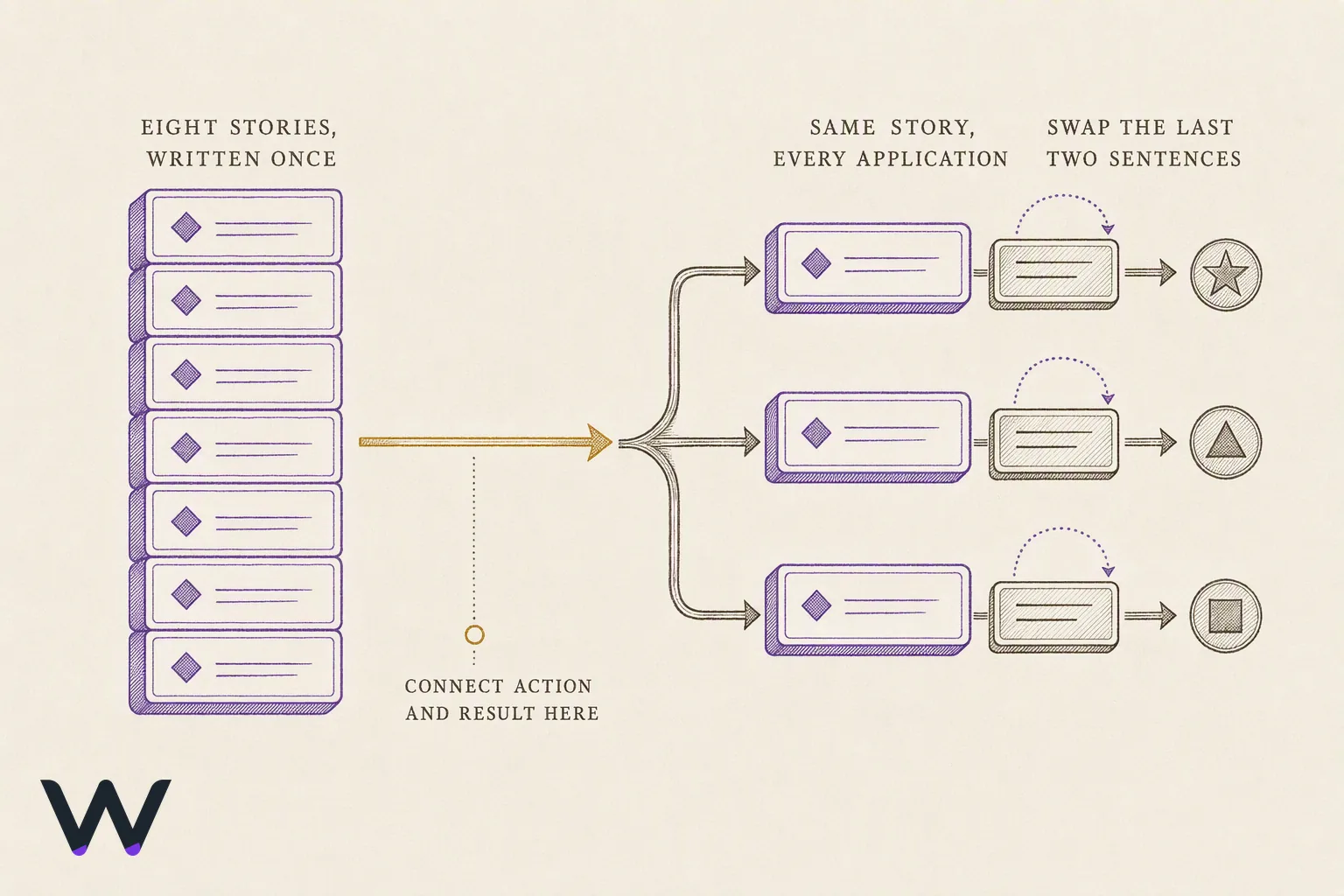
Write eight stories once. Reuse them across every application, swapping only the last two sentences. That is the whole system, and it is how you pass a 2nd round interview without spending an evening per employer: the substance comes from your own work, which does not change company to company, while the relevance comes from two sentences that do.
The eight stories map to the recurring question families:
- The delivery story. You shipped something with a real deadline and a real constraint.
- The failure story. You owned a bad outcome, named your part in it, and changed something afterwards.
- The conflict story. You disagreed with a colleague and the working relationship survived.
- The influence story. You got a decision changed without any authority to change it.
- The process story. You found something broken, fixed it, and it stayed fixed.
- The fast-learn story. You picked up a tool or domain quickly because nobody else could.
- The ambiguity story. You made a call with incomplete information and defended it.
- The measurable story. You can state the result as a number your employer would recognise.
Write each in STAR order: situation, task, action, result. Keep them to about a minute spoken. Action gets the most words, because that is the part the interviewer scores; situation is scene-setting and should be two sentences at most. Write the result before you write anything else. If a story has no result you can say out loud, it is not one of your eight.
Then the swap. The last two sentences of every story are the only per-company work: one sentence connecting the action to something in this job description, one connecting the result to a problem this employer has. Fifteen minutes of research fills both.
Rehearse out loud, not in your head. Silent rehearsal hides the fact that your delivery story runs four minutes. Record two of them on your phone and listen back once, which is unpleasant and faster than any other feedback available to you. Sample interview questions from the employer's own careers page are worth more than a generic practice interview questions list, because the wording tends to survive into the room.
Build the eight this week. Every application after that costs you fifteen minutes.
The top 10 interview questions second rounds repeat, with exact wording
Second rounds recycle a small set of questions, and the wording barely moves between employers. Prepare these ten verbatim rather than by theme, because the theme version of your answer is the one that sounds rehearsed and says nothing.
- "Walk me through your career so far and where you want it to go." Tests career goals and whether this role is a step or a stopgap.
- "Why this role, and why now?" Tests whether you read past the job title into the actual scope.
- "What are you looking for that your current job doesn't give you?" Tests motivation, and quietly tests how you talk about people who are not in the room.
- "What is your biggest professional failure?" Tests ownership. A failure that was somebody else's fault scores zero.
- "What would your last manager say you need to work on?" Tests self-awareness against a named source they may later call.
- "What does a manager need to do for you to do your best work?" Tests management style fit and how much supervision you need.
- "How do you prefer feedback delivered?" Tests coachability. Answer with a mechanism, not an adjective.
- "What are your salary expectations for this role?" Tests research and confidence at the same time.
- "If we made you an offer, when could you start?" Tests start date reality: notice period, gardening leave, anything already booked.
- "What questions do you have for us?" Tests preparation, and it is scored, whatever anyone says.
Two of these deserve a position rather than a technique. On salary, give a band and the reason for it in one breath, then stop talking. Deflecting to "whatever's fair" reads as unprepared to a hiring manager and as cheap to a recruiter, and you cannot revise upwards later. On the closing question, never ask something the careers page answers. Ask what the person in this role will be judged on at six months, then write the answer down in front of them.
Take these ten, write your answers under each, and mark which of your eight stories carries which question.
Common behavioral interview questions: answer past-tense, in 90 seconds
Behavioral questions ask what you did, not what you would do, so every answer sits in the past tense and names one incident. At Meta, a behavioral interview runs 45 minutes, split into 5 minutes of introductions, 35 minutes of questions, and 5 minutes for your questions [3]. Interviewers fit five or six questions into that middle block and score the answers across eight focus areas [3]. Do the division: 35 minutes across six questions is under six minutes each, and follow-ups eat most of that. So your first pass should land around 90 seconds and stop.
The STAR method framework is fine as a container and useless as a ratio. Most candidates spend a minute on Situation and fifteen seconds on Action, which is backwards, because Action is the only part anyone scores. One sentence of situation. One sentence of task. Four or five sentences of what you personally decided and did. A result with a number in it.
Map your eight stories to three prompt families
Three families cover almost every common behavioral interview question you will meet in a second round:
- Conflict resolution: "Describe a disagreement you had with your manager." The winning version ends with the disagreement resolved and the relationship intact, not with you being right.
- Accountability and failure: "Describe a project that missed its goal and what you did about it." Pick one with a real cost attached. A failure story where nothing went wrong is the most transparent lie in second-round interviewing.
- Self awareness and feedback: "What is the hardest piece of feedback you have received?" Name the feedback verbatim, then name the specific behaviour you changed.
Two stories per family, plus two spares, is eight. Each story serves multiple prompts because interviewers ask for the trait, not the anecdote.
Run mock interview questions with a phone timer face-up. Record one answer, play it back, and cut every clause before the word "I". Ninety seconds is tight until you have done it four times.
Situational interview questions test judgment, not history
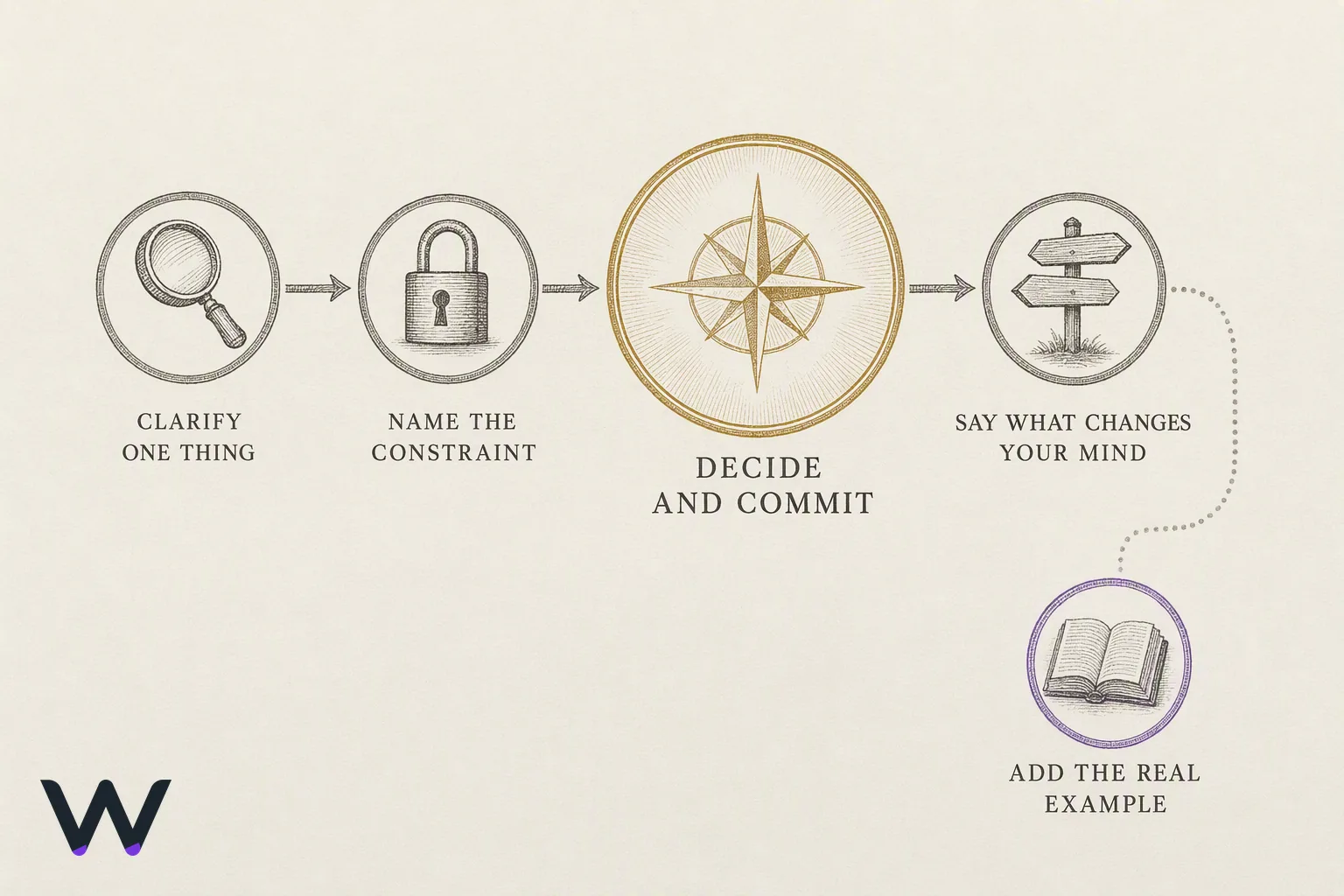
Situational interview questions start with "What would you do if" and are scored on your reasoning, not your résumé. A behavioral prompt checks whether you have done the thing. A hypothetical checks whether your judgment holds up with incomplete information, which means the interviewer is listening for how you narrow the problem before you answer it. Candidates with thin experience often prefer these prompts. They should: nobody can out-experience you on a scenario that has not happened.
Typical interview questions in this family sound like "A client asks for something that breaks the deadline, what do you do?" or "Your teammate misses two handoffs in a row, how do you handle it?" Answer in four beats, in this order.
Clarify one thing. Ask a single question that changes the answer, then answer as though you got a reply: "Is the deadline contractual or internal? Assuming contractual, here is what I do."
Name the constraint you are optimising for. Time, cost, the relationship, or the standard. Saying which one you are protecting is decision making under uncertainty, out loud, and it is the whole point of the exercise.
Decide. Pick one path and commit to it in a sentence. Candidates who list options without choosing read as someone who will escalate every judgement call to their manager, and interviewers mark that down hard.
Say what would change your mind. "If the client had flagged it before the sprint locked, I would have traded scope instead." One line, no hedging beyond it.
Skip the invented scenario when a real one exists. Problem solving under pressure lands harder when you answer the hypothetical, then add the sentence "the closest thing I have actually done is" and give thirty seconds of the real one. You get scored on both frames for the price of one answer.
Practise the four beats on scenario based questions from the job ad itself. Take the three hardest bullets in the responsibilities list and turn each into a "what would you do if" prompt.
Culture fit questions are scored against a rubric — here is what it looks like
Structured interviewers do not score culture fit on vibes. They mark each answer against an anchored rating scale, usually 1 to 5, where each point has a written description of what that answer sounds like. The rating gets entered into the hiring system before the debrief, so the panel argues about your score, not about you. Aim every answer at the 4 and 5 anchors.
Here is what a typical company culture fit scale looks like for a question about work style preferences or team dynamics.
| Score | Anchor | What the answer sounds like |
|---|---|---|
| 1 | Contradicts the value | Blames a former team, no ownership |
| 2 | Generic agreement | "I am a team player", no example |
| 3 | Relevant example, thin detail | One story, outcome not stated |
| 4 | Specific example plus tradeoff | Names what they gave up and why |
| 5 | Example, tradeoff, and transfer | Adds how they would apply it here |
The gap between a 3 and a 4 is the tradeoff sentence, and it costs you about eight words. "I took the slower rollout because the support team was already at capacity." A 5 adds one clause about this employer: "which is why I asked about your on-call rotation earlier."
Read the company values page before the second round, and read it as a checklist of question topics rather than as marketing. A value listed there is an employer evaluation criteria row on somebody's scorecard. If the page says "bias to action", expect a prompt about shipping something before it was ready.
One caution on the whole exercise. Culture fit assessment cuts both ways, and a scale you keep scoring a 2 against is data about the job, not a deficiency in your prep.
Pull the five values off the careers page, write one story against each, and mark your own answers with the scale above. Anything you score a 3, rewrite with a tradeoff.
How second interviews differ by industry, and in a video call
Format follows sector, and the calendar follows format: technical hiring loops take about 18 days from screen to final interview against roughly 14 days for business roles [2]. Take-home skills assessments showed up in about 13% of all hires in the 2026 Ashby benchmark [2]. Applied skills assessment is more common than most job seekers expect, and less common than tech Twitter suggests.
Source: the May 2026 Ashby talent trends report [2].
| Track | Loop length | Take-home rate | Second round usually is |
|---|---|---|---|
| Technical | ~18 days | 7.6%–14.3% | Live problem plus system discussion |
| Business | ~14 days | 8.6%–22.7% | Case, mock pitch, or panel |
Business roles carrying the higher take-home ceiling surprises people. High application volume is what drives it, so the more crowded the posting, the likelier an unpaid exercise sits between you and the offer.
Sales and customer-facing second rounds run as role-play: you pitch the interviewer, who plays a sceptical buyer. Agency and creative rounds are a portfolio walkthrough where role specific questions get asked about decisions you made two years ago. Hospitality, retail and hourly roles often use a shift trial or an informal lunch, and the informal one is still scored. Healthcare and public sector default to a panel of three to five, reading from a fixed question list in a fixed order.
Virtual delivery: same answers, different mechanics
Content does not change on video. Delivery does, in four ways worth rehearsing once.
- Camera at eye level, laptop on books if needed. Looking down reads as looking away.
- Notes taped beside the lens, never below the screen. Eight bullets maximum.
- Pause a full beat after the interviewer stops. Lag makes normal turn-taking sound like interrupting.
- Dress code matches the onsite version of the same interview. Panel means jacket, shift trial does not.
Book a test call with a friend on the exact platform the invite names. Discover your microphone problem on Tuesday, not during the panel.
Ask five questions back, and screen the employer for red flags while you do
Five questions, asked in that order, do two jobs at once: they read as preparation, and they pull out the things a job description will never tell you. Ask them near the end, when the interviewer has relaxed. Write the answers down.
- "How did this role come to be open?" A new headcount and a backfill are different jobs. If it's the third person in the seat inside two years, the problem is the manager or the scope, not the hires.
- "Who will I report to, and who does that person report to?" You are mapping organizational structure. Hesitation here usually means the reporting line is still being argued about upstairs.
- "What does the first ninety days look like, and who decides whether it went well?" A manager who can answer the second half has a real definition of success. One who says "you'll figure it out" is handing you their own unfinished thinking.
- "What's the decision timeline from here, and who else signs off?" Vagueness at this stage predicts a stall. Two named people and a date predict an offer.
- "What's the hardest part of this job that isn't in the description?" The honest answers are specific: a legacy system, a demanding stakeholder, a quarter-end crunch. "Nothing really" means they haven't done the job or won't say.
The filtering happens after you hang up, not in the room. Score each employer on how many of the five got a concrete answer. Anything that scores two or lower goes to the bottom of your list, regardless of the salary band.
Company research before the call sets up all five. Fifteen minutes on the interviewer's LinkedIn history, the company's last funding or earnings note, and the team's job postings from the past year tells you whether this team is growing or patching. Ask the questions that your research already half-answered. You'll hear which half they choose to tell you.
🎯 Focus on Interviews, Not Applications
AI applies to matching jobs 24/7 with tailored content · You prepare for interviews
Automate My Job Search →★ 4.7/5 on Reviews.io
Recovering from a bad answer beats delivering a clean one
Every candidate fumbles an answer. The recovery is the tell, and interviewers mark it. A repair takes three moves: check, correct, conquer, as the University of Florida Career Connections Center frames it [4]. Check means saying out loud that the answer went sideways. Correct means giving the better version in two sentences. Conquer means moving on without apologizing twice.
The script is short enough to memorize: "I want to take another run at that — the example I gave doesn't show what I actually did. Here's the one that does." Then tell the better story and stop talking. Interviewers hear self-correction as judgment, not weakness. It's also the single hardest thing to fake, which is why it moves a scorecard.
If you only realize it afterwards, the follow-up email is the second window. Send the thank you email within twenty-four hours, and give one paragraph — not four — to the answer you'd like back. Name the question, give the sharper example, close. Career services staff make the same point about candidates who spiral after a rough round: "you wouldn't have been asked to interview with the organization if they didn't see potential in you" [4].
Three mistakes sink otherwise strong second rounds:
- Raising salary before they do. Second interviews are where compensation usually comes up, but let the employer open it. If pressed, give a band and say it's flexible on the whole package.
- Repeating your first-round answers verbatim. The second panel has read the notes. Bring new examples.
- Apologizing for nerves. It reframes everything you said afterwards as compromised.
Practice the repair line the same way you practice answers. Say it out loud once before every second interview, so it arrives as a reflex instead of a decision.
Frequently asked questions
What are the 5 hardest interview questions?
The hardest questions are the ones with no clean answer: "Why are you leaving your current role?", "What's your biggest weakness?", "Describe a failure of yours", "What are your salary expectations?", and "Why should we hire you over the other finalist?" Each one invites either a lie or an overshare. Prepare a true, short, non-defensive version of all five and reuse them across employers.
Does the 2nd interview mean I got the job?
No. Clearing the screen puts you on a shortlist, usually two to four people, and the second round is where that shortlist gets compared. It raises your odds without settling them. An offer can land in the room at the end of that meeting, and Robert Half's second-interview guide notes you are not obliged to answer on the spot [5]. Ask for the terms in writing.
How to pass a 2nd round interview?
Bring new material. The second panel has your first-round notes, so repeating those examples reads as a thin bench. Prepare three fresh stories, one question per interviewer, and a specific answer on why this employer rather than the category. Confirm the decision timeline before you leave. Then send the follow-up the same day.
What is typically asked during a second interview?
Second interview questions go deeper on fit, scope and money: your approach to the role's real problems, how you work with the people in the room, what your compensation range is, and when you could start. Expect situational scenarios drawn from the team's actual backlog. Expect at least one question you already answered in round one, asked differently to test consistency.
References
- 2026 Recruiting Executives Benchmarking: Attracting Critical Talent — shrm.org
- Recruiting Operations Benchmarks | 2026 Talent Trends Report — ashbyhq.com
- How software engineering behavioral interviews are evaluated at Meta — interviewing.io
- Recovering from a Bad Interview — ufl.edu
- 15 Second Interview Questions to Expect (With Answers!) — roberthalf.com

Focus on Interviews, Not Applications
- ✓AI applies to matching jobs while you prep
- ✓Tailored applications on company sites
- ✓You prepare, we handle the rest