Last updated: 2026-10-15
To accept a job offer while you're still interviewing elsewhere, aim to finish with a signed offer confirmed in writing and every other application closed without burning a recruiter relationship. Accepting costs nothing. The work takes a few focused hours inside the employer's response window. If all you have is a verbal "we'd love to have you", do Step 1 and wait there until the letter arrives. Order matters because of the general US at-will rule: an employer can still withdraw an offer after you accept and before your start date [1]. Withdraw from the other applications last.
- Get the offer in writing before you say yes.
- Check every term against what you were told.
- Negotiate or ask for more time before you accept.
- Say yes on the call, then confirm in writing.
- Send the acceptance email using the copy-paste template.
- Sign the offer letter or employment agreement.
- Withdraw from your other applications once contingencies clear.
- Give notice and prepare for onboarding.
What you need before you start
- The written offer letter. Without one, the title, salary and start date you agree to are only what you remember from a phone call.
- The recruiter's or hiring manager's direct email. A generic careers inbox can leave your acceptance unread while the deadline passes.
- The response deadline, word for word. "Please respond by end of week" and a fixed date are different deadlines, so ask which one applies.
- Your minimum salary and earliest start date. Write both down before you reread the offer, so the excitement of getting it doesn't lower them.
- Where every other application stands. A list of stage and next contact for each role stops you from withdrawing from an interview you still need.
Step 1: Get the offer in writing before you say yes
Ask the recruiter to email the offer letter before you answer, even verbally. You should have a document or email in hand that names the title, salary, start date and any contingencies.
A verbal job offer protects you very little. Under the general US at-will rule, an employer can withdraw an offer at any time and for any reason, even after you accept and before you start [1]. That summary comes from one law-firm article. The same article notes that New Jersey courts have allowed claims when a candidate relied on the offer by quitting a job or relocating, and state law varies [1]. A written job offer does not override the at-will rule. What it gives you is a written record of what was promised.
Some employers are slow to send paper. If that happens, send a recap the same day: "Thanks for the call. To confirm, you offered me the [title] role at [salary], starting [date], contingent on [checks]. Could you reply to confirm these terms?" A reply that confirms those terms becomes your record.
If the offer is contingent on a background check or employment eligibility verification, ask HR which checks they run and whether you will be able to see the results before they make a decision. Seeing the results first gives you a chance to catch errors.
Step 2: Check every term against what you were told
Lay the offer letter beside your notes from the recruiter call and check it line by line. Each row should either match or get marked "mismatch".
| Term | What the letter should state | Flag it if |
|---|---|---|
| Title | Exact job title and team | Title differs from the posting or call |
| Salary | Base pay, pay period, currency | Figure or pay period differs from the call |
| Bonus and equity | Bonus target, stock options or grant amount, vesting schedule | Says "eligible for" with no amount |
| Benefits | Health insurance start date, plan type | Start date is blank or vague |
| Retirement contributions | Employer match and when it begins | Missing entirely |
| Location and schedule | Office, hybrid or remote; required days on site | Differs from what the recruiter described |
| Supervisor | Name and title of your manager | No one named |
| Start date | A specific calendar date | Says "to be confirmed" |
The row people skip most is the benefits start date. If health coverage starts later than your first day, you need a plan for the gap before you accept, not after.
Put every flagged line into a single email to the recruiter and ask for a corrected letter. A verbal "we'll fix that" doesn't count as a match until the corrected letter shows it.
Step 3: Negotiate or ask for more time before you accept
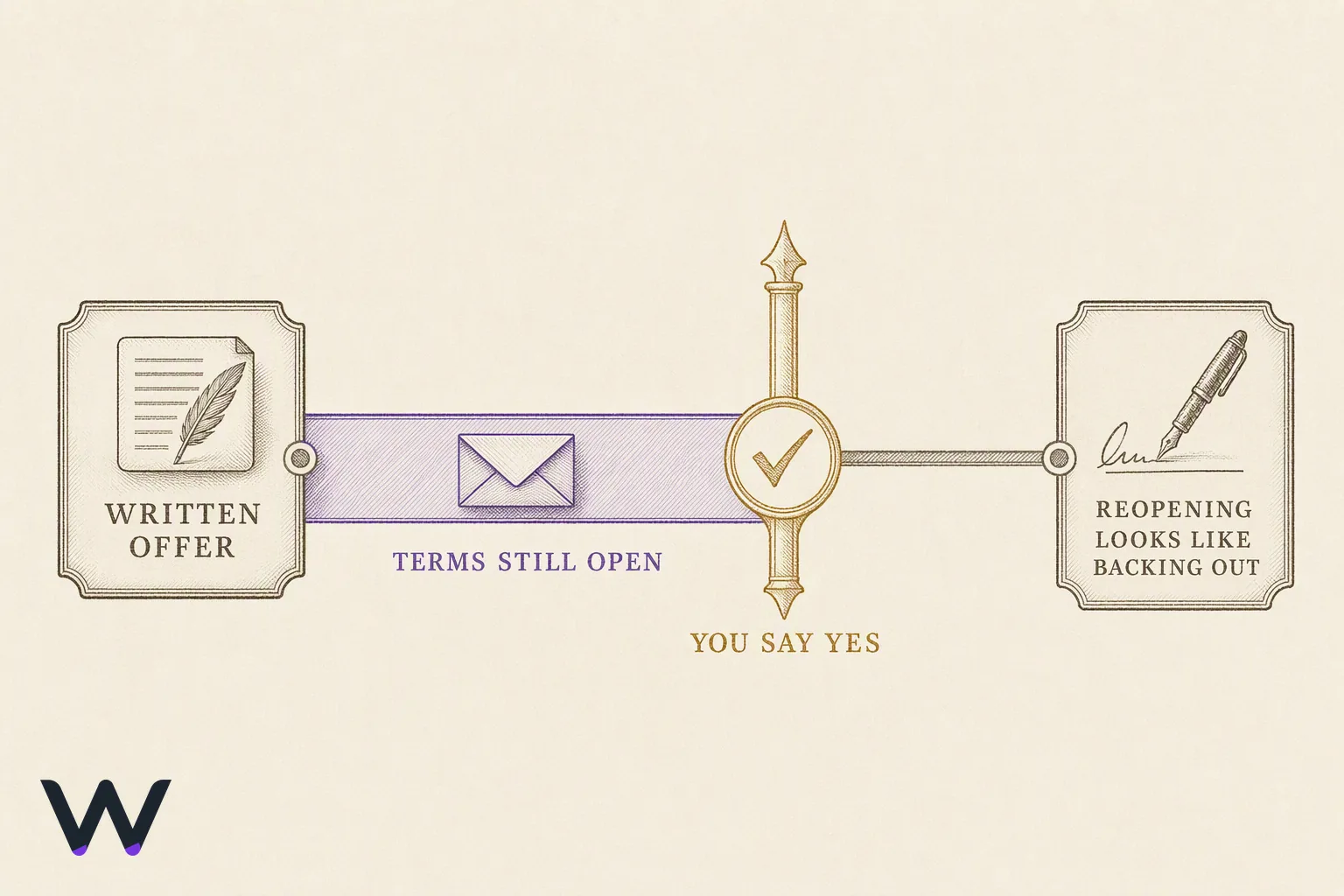
Your bargaining position ends when you say yes. Salary, start date, title and remote terms are all open while the offer is pending. After you accept, reopening any of them looks like backing out. Put every change you want into one message to the recruiter, not a drip of three.
Recruiter deadlines can be tighter than the hiring manager's own timeline. Interviewing.io founder Aline Lerner's advice is to "ping your hiring manager, explain that you're still thinking, and ask if it's OK to take a few more days." [2] Her post says this request is almost always granted. That claim comes from coaching tech candidates, not from measured data [2]. Once you get a reply with a new date, write that date beside the date your other company expects to decide.
Mention a competing offer only if you have it in writing. The same guide calls inventing one "unethical" [2]. A late-stage interview is not an offer, so describe it accurately: "I'm in final rounds elsewhere and expect an answer next week."
Where this usually fails: the employer refuses any extension. Ask the other company whether it can move faster, then decide on the offer you actually have.
Step 4: Say yes on the call, then confirm in writing
To accept a job offer politely, thank the hiring manager, say yes in plain words and ask what happens next. Three sentences cover it:
"Thank you, and yes, I'll take the role. I can't wait to start working with you all. Could you email the final paperwork so I can sign it?"
Keep the call short. Leave out new requests here, because negotiation belongs in the step before this one.
A yes on the phone only starts the process. Terms said out loud can drift between the call and the paperwork. Send a written confirmation the same day that repeats the title, salary and start date you agreed on.
Where this usually fails: the hiring manager says a number on the call that differs from the offer letter. Don't correct it on the call. Raise it in the written confirmation and ask which figure is final.
Step 5: How to accept a job offer via email (copy-paste template)
To accept a job offer via email, reply in the same thread that delivered the offer letter. Write a clear yes and restate the agreed terms so both sides have the same record. Then ask what the next step is. A complete job offer acceptance email has these parts:
- Subject line: "Accepted: [Job Title] offer, [Full Name]"
- Thank-you: one sentence, addressed to the person who made the offer
- Clear acceptance: an unambiguous yes, with no conditions attached
- Restated terms: title, salary and start date, copied from the letter
- Next-step question: paperwork, signature or onboarding
- Sign-off: full name and phone number
Here is a simple offer letter acceptance email reply sample you can copy:
Subject: Accepted: [Job Title] offer, [Full Name]

Hi [Hiring manager's first name],

Thanks for the offer of the [Job Title] role at [Company].
My answer is yes.

Here are the terms as I have them, so we're working from the same record:
- Base salary: $[amount] per year
- First day: [date]
- Location: [office / hybrid / remote]

What do you need from me before my first day: forms, a signature,
anything else?

Thanks again,
[Full Name]
[Phone number]
If the offer came as an email with the letter attached, a short in-thread reply works:
Thanks, yes: I accept the terms in the attached letter for the [Job Title] role, with a first day of [date].
What's the next step for signing?
Restating the terms is the step people skip, and it is the one that catches mistakes. Where this usually fails: the reply restates a salary that doesn't match the letter. Copy each figure from the offer letter, not from memory.
Step 6: Sign the offer letter or employment agreement
Read the agreement against your acceptance email clause by clause before you sign it. When you're done, you should have one document, or two documents that agree. SHRM advises employers that an offer letter used with a separate employment agreement should cross-reference that agreement, so the two never state conflicting terms [3]. If salary, title or start date differ between the documents, ask HR which one governs before you sign. Not after.
Three clauses deserve a second read:
- At-will language. Employment-at-will is the default U.S. standard, which is why contracts often leave it out, as Cornell Law School's Wex encyclopedia explains [4]. A clause that sets a fixed term changes that default.
- Non-compete. Check how long it lasts, where it applies and which employers it names.
- IP assignment. Check whether it covers side projects you build on your own time.
Whether an emailed yes binds you on its own depends on your state and on the documents themselves. If a clause worries you, an employment lawyer can answer that. Save a PDF of the countersigned agreement as your written record.
Step 7: Withdraw from your other applications once contingencies clear
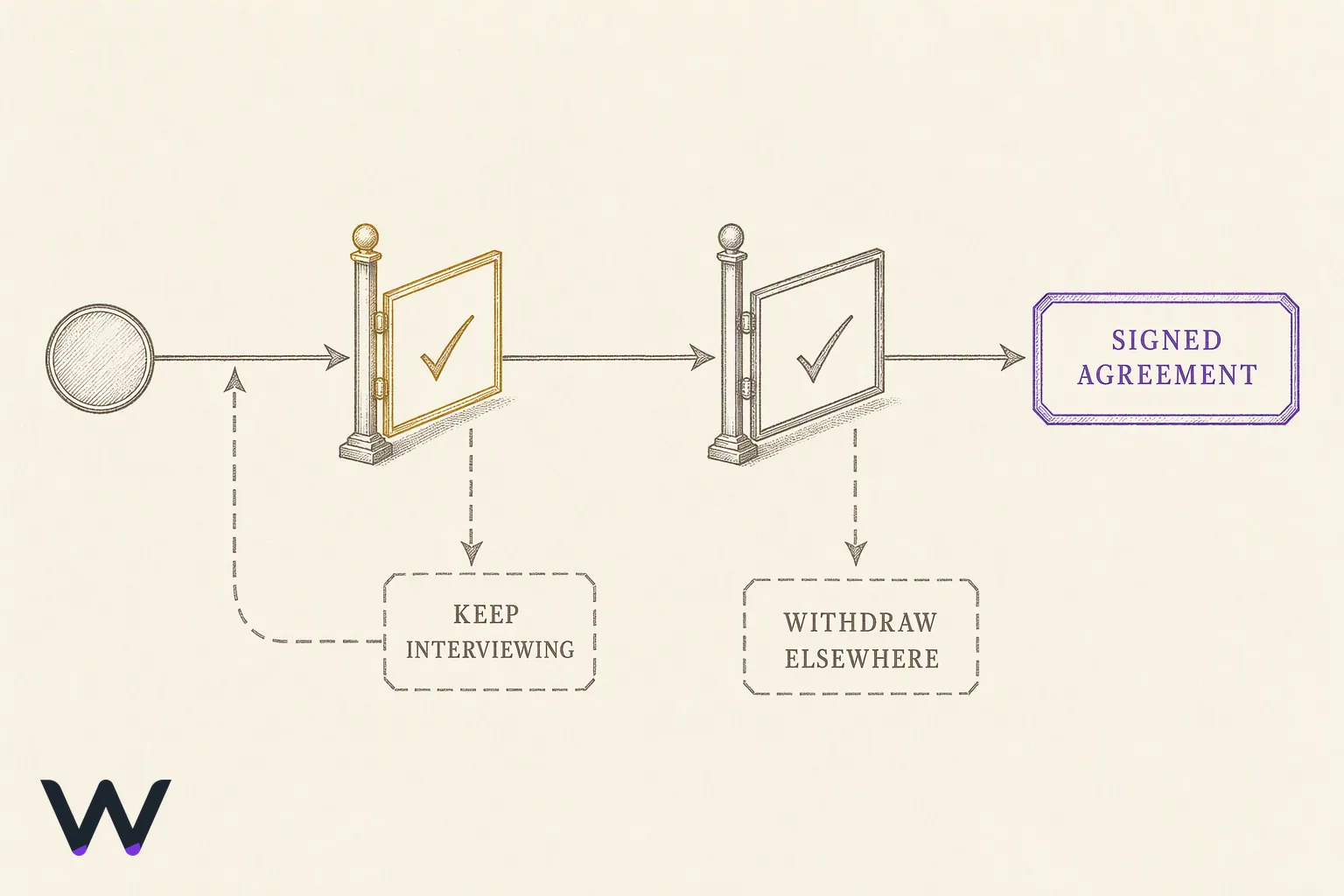
Pull out of other hiring processes only after two things clear: the background check and the signed agreement. Until both are done, the offer can still fall through, and a withdrawn application is hard to restart. So wait.
When both have cleared, send each active recruiter a short note the same day:
"Thank you for your time on the [Role] process. I've accepted another offer and am withdrawing my application. I'd be glad to stay in touch."
If you're declining a competing offer you already hold, that one line isn't enough. Call or email the hiring manager directly, state your career decision plainly, and thank the team members you met by name. Don't give reasons unless they ask. Comparing salaries makes it sound like you're reopening the negotiation. Then connect with the hiring manager on LinkedIn.
The bigger mistake is ghosting. Recruiters change companies, and the one you ignored this quarter could be hiring at your next target employer.
Step 8: Give notice and prepare for onboarding
Resign in writing to your current manager once your new agreement is countersigned, and give the notice period your contract or employee handbook requires. Our resignation letter template gives you a copy-paste version to adapt.
Decide what you'll say to a counter-offer before the resignation meeting, not during it. If you've already signed elsewhere, the answer is no. Say so in one sentence and move on to planning the handover.
Some onboarding paperwork has fixed deadlines. For US hires, the employer must complete Section 2 of Form I-9 within three business days of your first day of work for pay [5]. If the job will last fewer than three business days, the deadline is your first paid day [5]. Bring your identity and work-authorization documents on day one so HR can meet it.
Before day one, ask HR for your start time and location, the name of the person you'll report to, the list of documents to bring, and the date of your first paycheck.
How to check it worked
Run these checks before you tell your other employers you have accepted elsewhere.
- Find the employer's written reply. Search your inbox for the recruiter's name. You should find a reply that confirms your acceptance, not a calendar auto-response.
- Compare the signed document with your email. Title, salary, location and any negotiated terms should match word for word. Fix any mismatch before day one.
- Confirm the start date in writing. The employer's reply and the contract should give the same day.
- Check for an onboarding contact. A named first-day contact, an "IT setup" email or an HR portal invite means the hire has been processed.
When it does not work
Signing before checking is one way an acceptance goes wrong. Six failure cases can still break an acceptance after you send the email. Each row below gives the symptom, its likely cause and the fix.
| Symptom | Likely cause | Fix |
|---|---|---|
| No reply to your acceptance email | Recruiter away, or message filtered as spam | Resend to the recruiter, copy the hiring manager, then phone |
| Contract terms differ from the verbal offer | Letter drafted from an older approval | Do not sign; list each difference and ask for a corrected version |
| You want to renegotiate after a verbal acceptance | Something material changed: cost, commute, scope | Raise one term, say what changed, accept a "no" |
| A better offer arrives after you accepted | Other applications kept moving | Decide before signing; call first, then withdraw in writing |
| Current employer makes a counter-offer | Your resignation exposed a retention gap | Recheck why you started looking; decline in writing if those reasons stand |
| Offer rescinded after background verification | A date, title or reference did not match | Ask which item failed, send documents, request a review |
If you renegotiate after a verbal acceptance, ask about one term only. Do not reopen the whole offer.
Frequently asked questions
How do you say you accept the job offer?
Say yes plainly in your first line: "Yes, I accept the [job title] role at [company]." Then confirm the start date, salary and any negotiated terms in one short paragraph. Thank the hiring manager by name and ask what to expect before day one. Put it in writing even if you already said yes by phone.
What do you say when you accept an offer?
When you accept an offer, say three things: thank you, yes, and this is what we agreed. A line such as "Thank you, and yes, I'm in" covers the first two. Restate your title, pay and start date so any mismatch shows up before you sign. Keep the email short, and close by asking who your first-day contact will be.
References
- Can an Employer Legally Withdraw a Job Offer after It's Been Made? — natlawreview.com
- The unwritten rules (till now) of negotiating with Meta — interviewing.io
- Offer Letters: Start Employment Relationships Off Right — shrm.org
- employment-at-will doctrine — cornell.edu
- Completing Section 2, Employer Review and Attestation — uscis.gov

Stop applying. Start interviewing.
- ✓Wobo finds matching roles and applies for you
- ✓Tailored resume, cover letter and answers included
- ✓You focus on interviews, we handle applications