Last updated: 2026-08-17
Behavioral interview questions ask you to describe something you already did: "Tell me about a time you missed a deadline." They are scored against a fixed rubric, one question at a time. That is why 12 written stories beat 60 memorized answers. Ineffective workplace communication costs U.S. businesses an estimated $2 trillion a year, by Forbes's accounting [2], and the teamwork block below is the longest one in this bank for exactly that reason.
Every figure in this guide is attributed where it appears, and the sources behind them are named in the text: a national survey of U.S. job seekers run by an applicant tracking vendor, Gallup's workplace engagement research, a university career center's own STAR guide, and reported Forbes coverage. Where a claim rests on how hiring generally works rather than on a measured number, it says so plainly and carries no citation.
Below: the STAR template with a word count in each slot, the 12-story bank and how to tag it, question sets for teamwork, conflict, failure, and leadership, the tense test that separates behavioral from situational questions, delivery timing for video and panel rounds, and the five patterns that get scored down.
What are behavioral interview questions?
What are behavioral interview questions?
Behavioral interview questions ask what you actually did, not what you would do. They open with a past-tense prompt — "Tell me about a time," "Walk me through," "Describe an occasion when" — and they expect one specific past event with a decision inside it. Résumé questions test what is on the page. Behavioral questions test whether the page is true.
The grammar gives them away. A behavioral question is past tense and singular: one time, one project, one conflict. A situational question is its hypothetical cousin, opening with "how would you handle," and it lets you answer from imagination. Behavioral interviewing closes that door on purpose, because past performance examples are harder to fake under follow-up than opinions are.
Almost every employer probes the same four competencies, whatever the job title on the posting says. Teamwork and conflict: what you did when a colleague blocked you. Ownership: what you did without being told. Failure and recovery: what broke, and what you changed after. Influence and communication: how you got a decision made by people who did not report to you.
Those four are the competency assessment behind the wording. Learn them, and the question list stops looking infinite.
🎯 Focus on Interviews, Not Applications
AI applies to matching jobs 24/7 with tailored content · You prepare for interviews
Automate My Job Search →★ 4.7/5 on Reviews.io
Behavioral rounds now decide more of the outcome than the résumé screen
The scorecard, not the CV, is where most of your candidacy is decided now. Structured interviewing is defined by its mechanics rather than by any measured effect: the same question set for every candidate, a fixed rubric applied to each answer, and a panel score averaged at the end. Your bullet points got you into the room. The rubric decides the rest.
That shift changes what prep is worth. Polishing a résumé line is a one-time gain that dies at the ATS handoff. A story you can score well on is portable across every employer using a similar rubric, and that is a growing share of them.
The case for structure is partly a case against what unstructured rounds produce. Fifty-three percent of U.S. job seekers reported being asked illegal or discriminatory interview questions, according to Greenhouse's 2025 Workforce and Hiring Report, a national survey of job seekers published by the hiring-software firm [1]. In that same survey, age accounted for thirty-one percent of those reports; health or disability status and physical appearance accounted for twenty-two percent each [1]. Those are not questions a rubric contains. They are what fills the silence when an interviewer has no question list, and unconscious bias reduction is the reason more employers now hand interviewers one.
For you, the practical consequence is narrow and useful. A structured round is predictable. The same competencies come up, in similar words, at company after company, so the marginal cost of your tenth interview should be close to zero.
That is not how most people applying at volume experience it. They rewrite answers per employer, burn an evening per interview, and arrive at the fifth one worse rehearsed than at the first. The work is being repeated instead of reused.
Two things follow. First, treat interview scoring as the target you are optimising for, not the recruiter's impression. Second, stop preparing per company and start preparing per competency, because the competency list is short and the company list is not.
Build the stories once. Map them per posting. Everything below is that build.
The STAR method for answering interview questions, written as a fill-in template
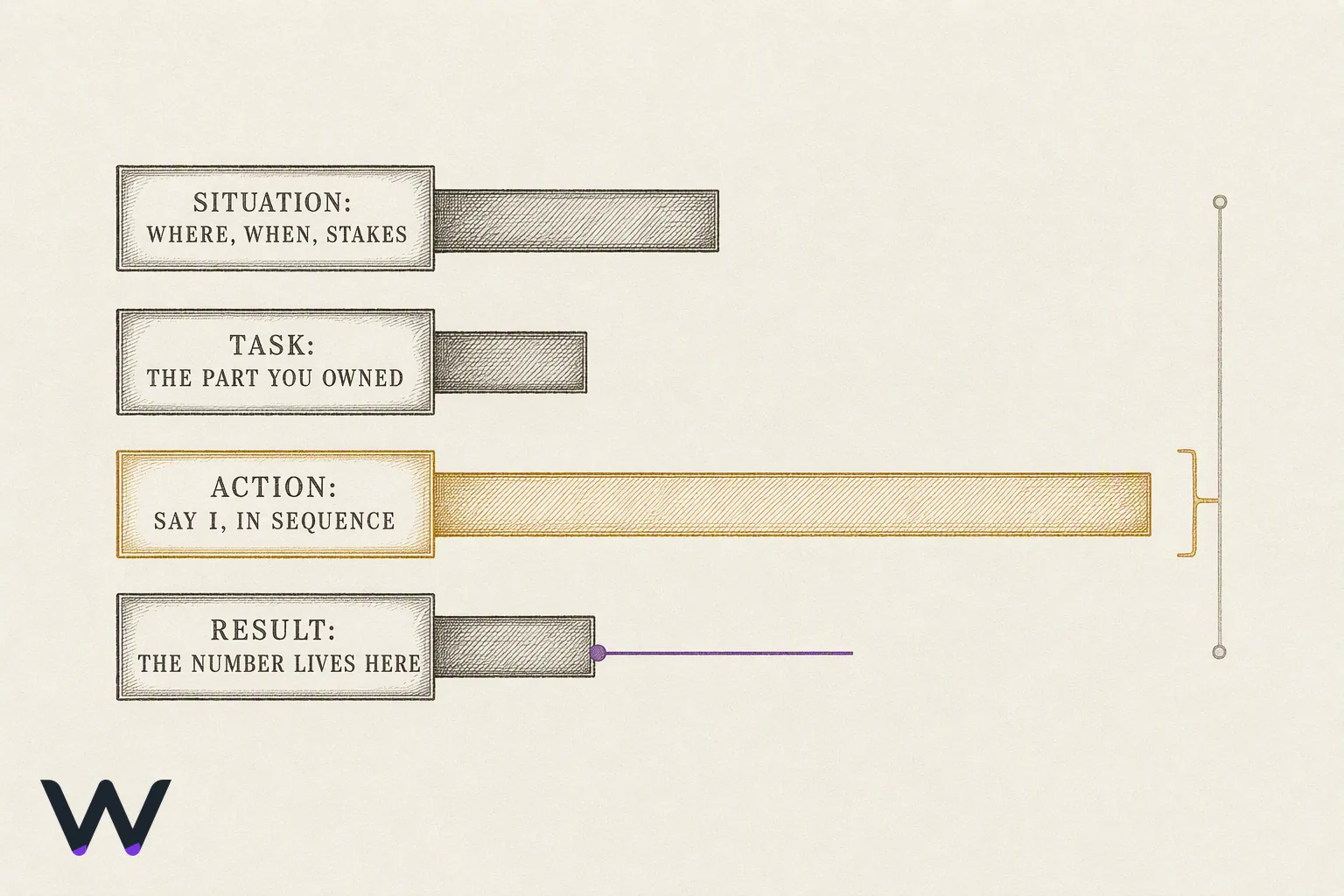
STAR is four slots, and the only hard rule is that the last one carries a number. Fill each slot to its word count and the whole answer lands near two minutes spoken, which is what a scorer expects.
- Situation, twenty-five to forty words. Where, when, your role, what was at stake.
- Task, fifteen to twenty-five words. The specific thing you owned. Not the team's goal.
- Action, eighty to one hundred twenty words. What you did, in "I" not "we," in sequence.
- Result, twenty-five to forty words. The outcome, quantified, plus what changed afterwards.
The Action slot is where nearly every answer goes wrong. It should be the longest of the four by a wide margin, and it should say "I" repeatedly, because a rubric scores your contribution and cannot score the team's. If your Action slot reads "we decided," the scorer has nothing to mark.
The Result slot needs a figure you can defend under a follow-up question. Hours saved per week, tickets closed, percentage of the deadline recovered, headcount you trained, error rate before and after. If nothing was measured, use the closest countable proxy and say how you counted it: "three weeks late became four days late" is a number, and it survives the follow-up because you can explain the arithmetic.
Here is the skeleton with the connective tissue included, so you paste your facts into it and stop composing sentences:
"At [company], during [time period], [problem] meant [consequence]. I owned [scope]. So I [first action], then [second action], and when [obstacle] came up I [decision]. That took it from [before number] to [after number], and [team or process] kept doing it after I left."
Say that aloud twice per story. Not five times. Rehearsed past a certain point starts sounding like a recital, and scorers mark stiffness down.
Build a 12-story bank once, then remap it to every application
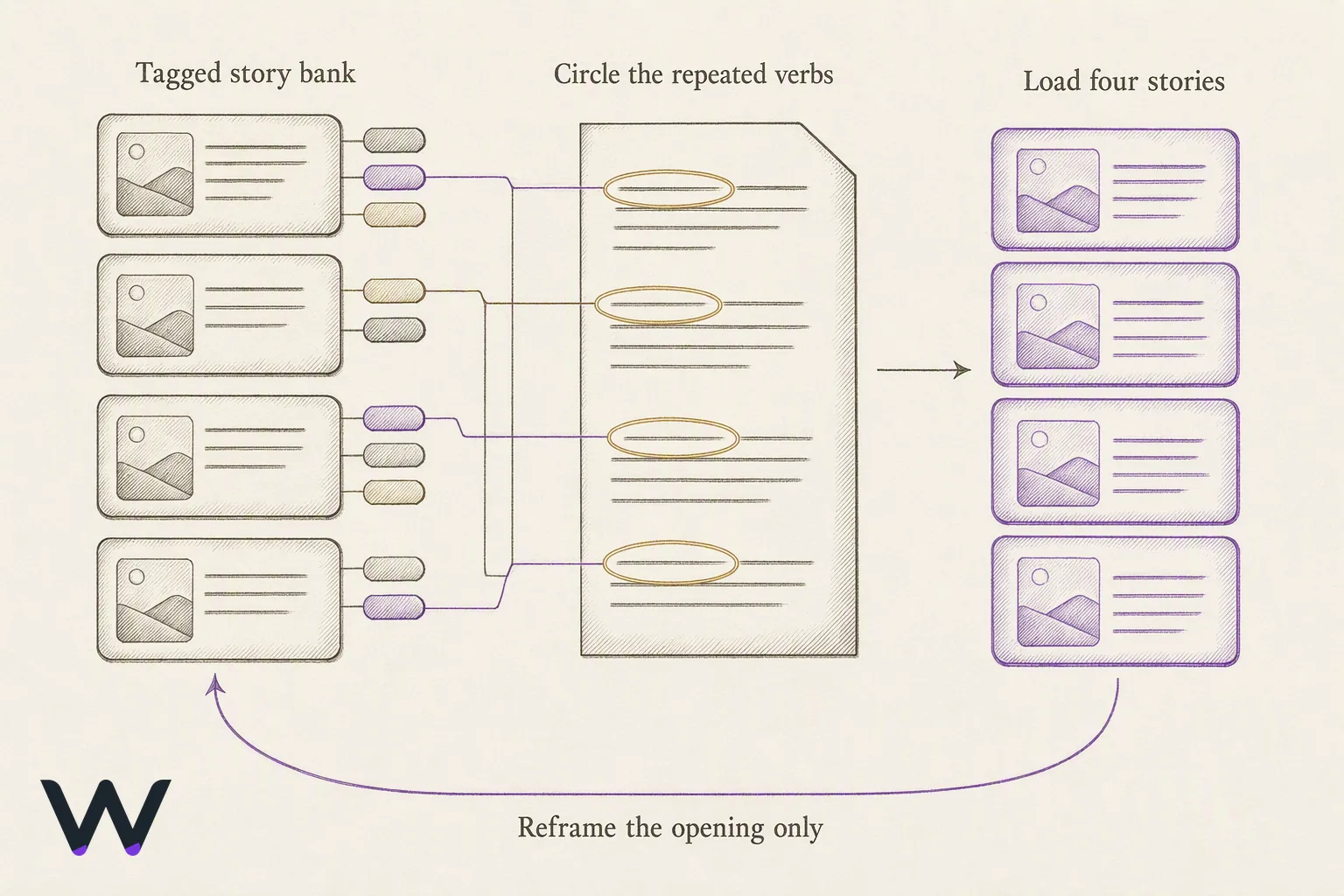
Twelve stories cover the entire question set, and the twelfth one is where most candidates stop needing to write anything new. Each story gets tagged to several competencies, not one, because the same project answers a conflict question and a deadline question depending on which part you lead with. Write them in one document. A plain Google Doc or a Notion Table is enough.
The tagging is what makes the bank reusable across applications.
| Story slot | Primary competency | Secondary tags | Result you must have ready |
|---|---|---|---|
| Shipped under a hard deadline | Ownership | Prioritisation, pressure | Days recovered, scope cut |
| Disagreed with a colleague | Conflict | Influence, communication | Decision made, who changed |
| Project that failed | Resilience | Judgement, learning | What broke, what you changed |
| Convinced someone senior | Influence | Data, communication | Decision reversed, budget moved |
| Fixed a broken process | Initiative | Analysis, ownership | Time saved per week |
| Handled an unhappy customer | Service | Conflict, communication | Outcome, retention |
Six slots, two stories each, and the bank is full.
Now the remapping. Open the job description and mark every verb it repeats: "collaborate," "own," "prioritise," "escalate." Those are the competencies the scorecard will use, in the employer's own vocabulary. Job description analysis takes about ten minutes, and it tells you which four stories to load for that interview.
Then rewrite one thing per application, not eight. Swap the Situation slot's framing so the stakes match the employer's world, and leave the Action and Result untouched. The facts do not change. The emphasis does.
Do this and prep compounds. Application one costs an evening. Application twenty costs the ten minutes of reading the posting and picking four tags.
Your next move: open a blank table tonight, write the six primary competencies as rows, and fill in the two strongest stories you have for each.
Common behavioral interview questions about teamwork, collaboration, and communication skills
Teamwork questions are the most predictable set on the list, and the eight below cover roughly every phrasing an interviewer will reach for. The Forbes estimate cited above — $2 trillion a year in U.S. business costs from ineffective workplace communication [2] — is why a hiring manager keeps asking about it long after they have stopped asking about your degree. Tag three or four stories from your bank to this competency. That is enough.
The common behavioral interview questions in this group:
- Walk me through a project where you and a team hit a shared goal.
- When did you last explain something technical to someone outside your field?
- Describe persuading a colleague to change their approach.
- Where have you worked alongside someone whose working style clashed with yours?
- What is a problem your written communication prevented?
- When did you support a colleague from a background different from your own?
- Walk me through delivering information nobody wanted to hear.
- What project failed on your watch because communication broke down?
Question 3 and question 8 are the two that separate candidates. Persuasion and influence get asked because most work happens across teams you do not manage, and the interviewer wants evidence you can move a decision without authority. Question 8 tests whether you will name your own share of a breakdown.
The filled skeleton: team collaboration and communication skills
Situation (2 sentences, dated). "In March, our four-person support team was answering the same billing question 40 to 50 times a week from a shared inbox."
Task (1 sentence, your scope). "I owned the macro library, so cleaning up the response was mine to fix."
Action (3 to 4 sentences, first person singular). "I pulled the 30 most recent tickets, found three different answers going out for one question, and drafted a single canned reply. Two agents disagreed with my wording, so I sat with each of them for ten minutes and took one of their edits into the final version. I posted the macro in Slack with a one-line note on when to use it."
Result (1 sentence, a number). "Repeat contacts on billing dropped by about a third over the following month."
What that answer leaves out: the org chart, the names of the two agents, and any adjective about how collaborative the team was. Diversity and inclusion questions like number 6 follow the same shape, with one edit — the action describes what you changed about your own behavior, not what you observed about someone else's. Interviewers hear observation as distance.
Conflict resolution, customer service, and working-under-pressure questions
Conflict questions are graded on what you did to lower the temperature, not on who was right. The skeleton that works here splits Action into two halves: de-escalation first, then outcome. Most candidates skip straight to the outcome and lose the half of the answer the interviewer actually scores. Do not skip it.
Seven questions cover this competency:
- Walk me through a disagreement with a coworker and how it ended.
- When did you last push back on your manager, and what did you do?
- Describe an angry or difficult customer you handled.
- Where did you compromise to get a stalled project moving?
- What was the most stressful week you have had at work?
- When did you miss a deadline, and how did you handle the fallout?
- Describe saying no to a customer or a stakeholder.
The de-escalation-then-outcome skeleton
Situation. Name the disagreement in neutral nouns: "a scope disagreement," "a billing dispute," "a duplicate charge on a customer account." Never a character. The moment you say "difficult," the interviewer starts wondering how you describe past colleagues in rooms they are not in.
Task. One sentence on what you were responsible for delivering while the conflict was live.
Action, half one — de-escalation. What you did before you argued your position: asked a question, restated their point back, moved the conversation off a Slack thread and into a call, or waited a day. Name the specific move.
Action, half two — resolution. What you proposed and what you gave up. Conflict answers with no concession in them read as accounts of winning, and every interviewer has met the coworker who wins every disagreement.
Result. The working relationship afterwards, then the business outcome. In that order.
Customer service questions run on the same skeleton with one substitution: the de-escalation half becomes acknowledgment plus a timeline. "I apologized for the second charge, told them the refund would clear in three business days, and messaged them again when it did." Working-under-pressure questions replace de-escalation with triage — what you cut, what you moved, who you told before the deadline slipped rather than after.
One rule holds across all seven: badmouthing costs you the offer even when you were right. Describe the behavior, never the person. "The brief changed twice in a week" is a fact. "My manager was disorganized" is a verdict, and it is the last thing the interviewer remembers about you.
Failure and feedback questions: lead with the lesson, not the damage
Failure answers work at roughly a 30/70 split: three sentences on what went wrong, seven on what you changed afterwards. Candidates invert that ratio. They spend the answer relitigating the setback and hand the interviewer a detailed record of a mistake with no evidence of learning attached. The lesson is the answer. The damage is the setup.
Feedback questions run on the same logic, and the interest behind them is measurable: Gallup's workplace research finds that 80% of employees who say they received meaningful feedback from their manager in the past week report being fully engaged at work [3]. A manager hiring you wants to know whether feedback will land or bounce.
What is your 3 weaknesses best answer?
Give one real weakness, not three, unless the interviewer explicitly asks for three — and when they do, make each one a different kind: a skill gap you are actively closing, a working preference that has cost you something, and a habit you have already built a system around. "I am a perfectionist" fails all three tests. "I under-communicate on long projects, so I now send a Friday status note whether or not anyone asked for one" passes, because it names the cost and the fix in the same breath.
The skeleton that ends on the change:
Situation and Task, compressed to two sentences. What you were responsible for and what the goal was.
Action, one sentence, owned. The decision you made that turned out wrong. First person, no passive voice, no shared blame.
Consequence, one sentence. The concrete cost: a missed date, a rework cycle, a client escalation.
Change, three to four sentences. What you do differently now, when you started doing it, and one time since then it worked. That last part is what makes the answer credible rather than rehearsed.
Use a real failure with a bounded cost. A failure so small it is obviously a humblebrag reads worse than the mistake would have.
Leadership, initiative, decision making, and deadline questions
Leadership questions do not require a manager title, and interviewers know that when they ask an entry-level candidate about leading. What they are scoring is ownership: did you see something that needed doing and take it, or did you wait to be assigned it. Frame every answer in this competency around a decision you made under a constraint — a deadline, a budget, missing information, or a person who was not available. Constraints are what make a decision a decision.
The questions in this group:
- Walk me through something you took on outside your job description.
- Describe a decision you made with incomplete information.
- When have you had to prioritize competing deadlines?
- What happened the last time you delegated work and it went sideways?
- Describe a goal you set for yourself and how you tracked it.
- What is the hardest problem you have solved with data?
- When did you organize a process nobody owned?
The skeleton for a decision under constraint
Situation, with the constraint stated first. "Two deliverables were due the same Friday and one of the two owners was out sick." Lead with what was scarce.
Task. The call that was yours to make, in one sentence.
Action, structured as a decision. Say what your options were, which one you picked, and what you traded away. Two options, named. This is the part that separates a leadership answer from a busy-work answer: an interviewer wants to hear a rejected alternative, because that is the only proof you actually chose.
Result, with the timeline. What shipped, when, and what the cost of the trade-off was.
Delegation answers, question 4, get one extra beat. After the result, add what you changed about how you hand work off — a written brief, a mid-point check-in, a clearer definition of done. Delegation questions are really feedback questions wearing a different hat.
Question 7 is the highest-value one in the set for anyone applying without a title. A process nobody owned is initiative with a paper trail, and it is easy to prove: name the process, the date you started it, and the person who still uses it.
Behavioral vs situational vs traditional: which interview questions to prepare for first
Wording gives the type away before the question ends. Behavioral questions ask for the past: "Walk me through the last deadline you missed." Situational interview questions ask for the future: "How would you handle a client escalation in your first week?" Traditional questions ask you to summarize yourself: strengths, weaknesses, why this company. The tense is the tell.
Three question types, sorted by what each one scores and where your prep hours actually pay:
| Question type | How it opens | What the interviewer scores | Prep order |
|---|---|---|---|
| Behavioral | "Walk me through a time you" | Evidence from an event that happened | First: build the 12-story bank |
| Situational | "How would you handle it if" | Judgement on a hypothetical, no event required | Second: reuse the same stories as precedent |
| Job-specific / technical | "How would you price this feature" | Domain skill for that one role | Third: per application, not once |
| Traditional | "Why do you want this job" | Fit, self-knowledge, motive | Last: one pass, out loud |
Prepare behavioral first, and not because it is the most common. Prepare it first because stories transfer. A situational answer gets stronger when you attach a precedent to it ("I would do X, and the reason I trust that is what happened when..."), so an hour spent on the bank pays into two categories. Traditional questions are the ones candidates over-rehearse and interviewers weight least.
Behavioral answers are also the ones that draw a follow-up questioning technique: the interviewer picks one clause of your story and pushes. "What did you do next?" "What would you change?" "Who disagreed with you?" Prep the second layer of each story, not just the first.
The seven questions to walk in with, whatever the role: a time you failed, a conflict with a coworker, a deadline you saved, a decision made without enough information, feedback that stung, something you led without authority, and why you want this job. Six behavioral, one traditional. That set covers most of a first round.
Delivery: answer length, video and panel rounds, and how to recover when you blank
Time the Action step and let the rest fall around it. The career center at American University's Kogod School of Business, in its own STAR method guide for students, recommends spending 1 to 2 minutes on Action — the longest portion of a behavioral answer [4]. Situation and Task get two sentences between them. Result gets one, with a number in it if you have one. That shape lands a full answer near two minutes: long enough to be evidence, short enough that the interviewer does not start editing you in their head.
When your mind goes blank, buy time out loud rather than filling the silence with a worse story. Say "Let me pick the right example for that" and mean it. Interviewers read a three-second pause as thinking and a rambling wind-up as panic. Forbes, in its reporting on freezing under workplace pressure, advises a 60-second pause away from the situation to calm your nervous system [5]. Inside an interview, your version of that is a sip of water and one slow breath.
Multi-part follow-ups get answered in the order asked, and you say the order first: "Two things there. What I did, then what I would change." Numbering the parts out loud is the single easiest way to sound composed when handling pressure.
Video and panel rounds
On video, look at the camera lens for the Result sentence, even if you drift to the screen elsewhere. Keep notes to one page of story titles, never full sentences, positioned just under the camera. Full sentences make you read, and reading is audible.
On panels, answer to the person who asked, then bring your eyes across the group on your closing line. Panels take notes at different speeds. Pausing a beat after your Result gives the note-takers time to finish writing your best sentence.
Practice interview questions out loud, on a timer, with a recording running. Mock interview questions from a friend are better because they surprise you. Interview practice that stays in your head builds recognition, not delivery.
🎯 Focus on Interviews, Not Applications
AI applies to matching jobs 24/7 with tailored content · You prepare for interviews
Automate My Job Search →★ 4.7/5 on Reviews.io
Mistakes that sink behavioral answers — including when you have no relevant experience
Five patterns get scored down again and again, and four of them are fixable in one rewrite pass:
- The "we" answer: the story never names what you personally did, so there is no evidence of you in it.
- No result: the story ends when the work ends, with no number, no outcome, no what-changed.
- The disguised complaint: a conflict story where the coworker or manager is the villain and you are the reasonable one.
- Wrong scale: a class project answered to a question about managing budget risk, with no bridge between them.
- The 90-second setup: so much context that the Action arrives after the interviewer has stopped listening.
Red flag identification runs both ways here. Blaming is the loudest one an interviewer hears, because it predicts how you will describe them to your next employer.
The same question also changes expected answer by industry and role. "Describe a difficult customer you handled," asked at an agency, wants de-escalation and the account kept. Asked at a hospital, it wants policy followed and the incident documented. Entry level assessment shifts it again: with no work history, the interviewer is scoring workplace adaptation and coachability, not outcomes. Read the job posting's verbs and match them.
When you have never done the thing
Say so, then redirect in the same breath: "I have not managed a direct report. The closest I have is training two new volunteers on a system I set up." Name the analogue, tell that story in STAR, and close with what you would do in the real version. Never answer a behavioral interview question with a pure hypothetical and hope it passes as experience.
The one thing not to say is "I have not been in that situation" followed by silence. Adaptability is what the question is testing, and a candidate who cannot bridge to a nearby example has just demonstrated the absence of it.
Frequently asked questions
What are the 10 most common behavioral interview questions?
The 10 most common behavioral interview questions cluster in four competencies: conflict, failure, leadership, and pressure. In some phrasing, they ask you to describe a coworker you disagreed with, something you failed at, a deadline you missed, an angry customer you handled, a moment you led without authority, feedback that was hard to hear, a week under real time pressure, a decision made without full information, competing priorities you juggled, and a change you disliked but adapted to.
What is your 3 weaknesses' best answer?
Pick one real weakness, not three, unless the interviewer asks for a count. The best answer names a specific gap, the correction already in motion, and the evidence it is working: "I under-communicate on long projects. I now send a Friday status note, and my last project lead stopped asking for updates." Never use a strength in disguise.
What are 7 interview questions?
Seven questions cover most first rounds: why you want this job, a time you failed, a conflict with a coworker, a deadline you saved, a decision made without enough information, feedback that stung, and something you led without authority. Six are behavioral, one is traditional. Build a story for each and the round is mostly prepped.
Can you give me 30 common behavioral interview questions?
Thirty is not 30 separate prep tasks. Every list of that length maps onto roughly eight competencies: teamwork, conflict, failure, leadership, pressure, communication, adaptability, and customer handling. Build 12 stories, tag each with the two or three competencies it can serve, and any 30-question list becomes a remapping exercise instead of new writing.
References
- How to reduce hiring bias with structured hiring — greenhouse.com
- Why Communication Skills Are Your Most Valuable Career Asset In 2025 — forbes.com
- A Great Manager's Most Important Habit — gallup.com
- Behavioral Interviews – Career Development — american.edu
- 6 Tips That Buy You Time When You Freeze In Stressful Job Situations — forbes.com

Focus on Interviews, Not Applications
- ✓AI applies to matching jobs while you prep
- ✓Tailored applications on company sites
- ✓You prepare, we handle the rest