By the Wobo Data Team. Last updated April 28, 2026.
In the last year, brand-name technology employers posted 2,930 senior software engineering roles to the major applicant tracking systems we track. In the same period, those same companies posted just 212 junior roles.
That is a ratio of roughly 14 senior roles for every junior one at the destinations engineers most want to work for. At specific companies, the ratio is significantly worse:
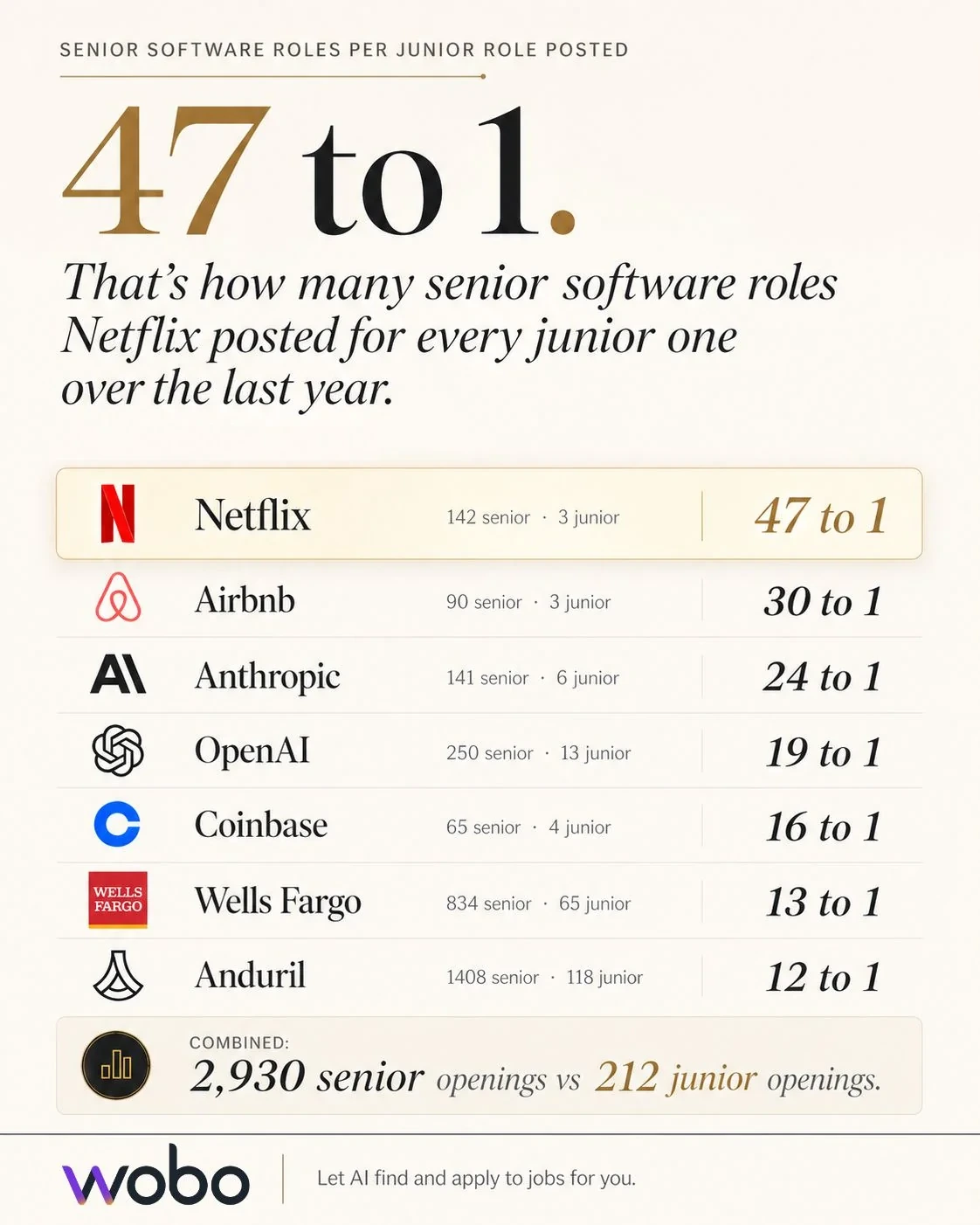
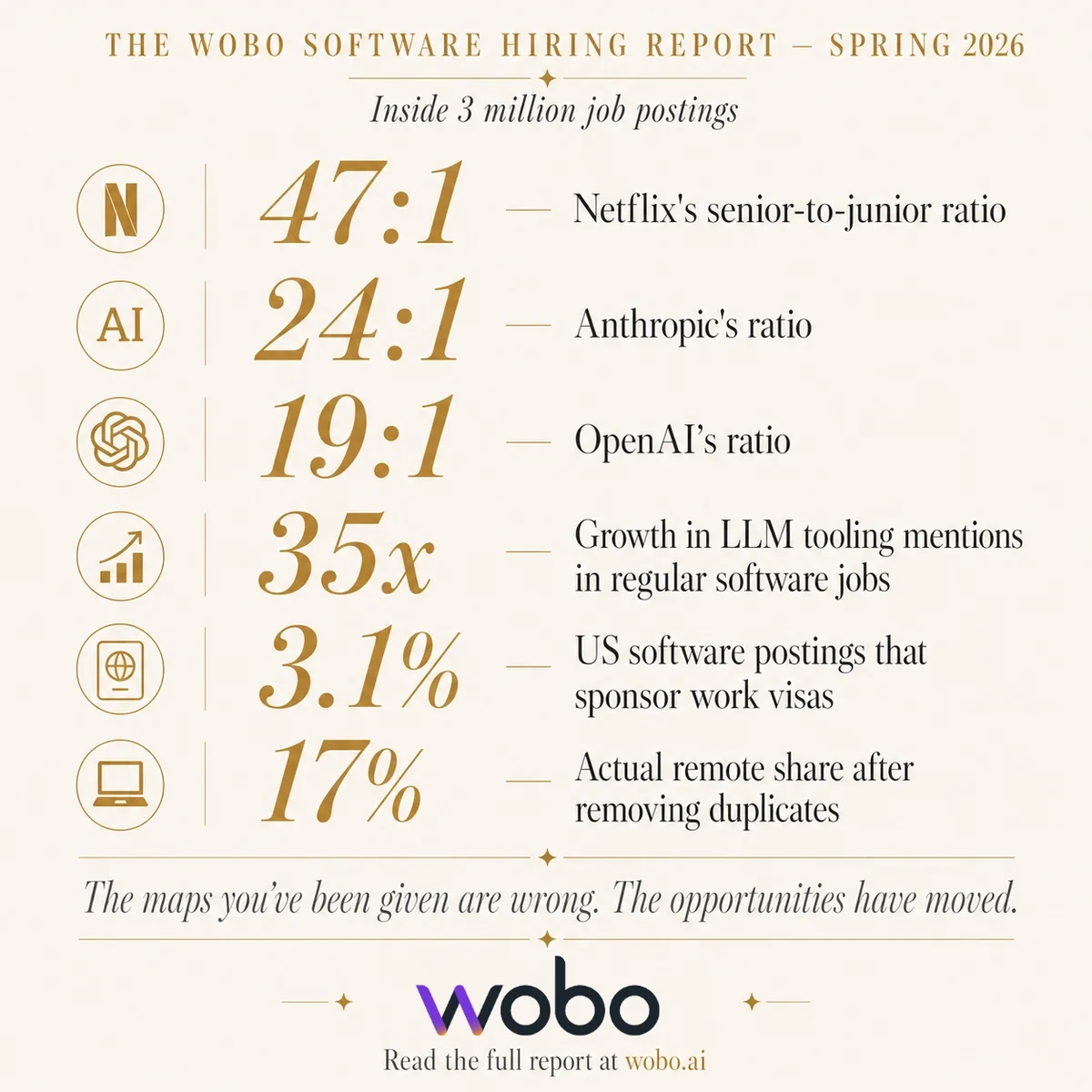
Netflix posted 47 senior software roles for every junior one
Airbnb posted 30
Anthropic posted 24
OpenAI posted 19
Coinbase posted 16
Wells Fargo posted 13
Anduril posted 12
This report is the result of a deeper analysis of 3 million job postings indexed across our platform between January 2024 and April 2026. To analyze each posting we run the full job description through an AI extraction pipeline that pulls out structured fields like seniority level, required technologies, and employment type. Our findings reflect what jobs actually require in their descriptions, not what their titles claim.
The picture that emerges from the data is not the one most career advice in 2026 is built on. The “junior pipeline collapse” that journalists wrote about in 2024[1][2] did not reverse in 2025 or 2026. It calcified. AI hiring did not save it. AI hiring made it worse, in ways the existing reporting has not captured.
What follows is what we are seeing across the data, with the underlying numbers. Some of what we found is solid. Some is suggestive. We have tried to be clear about which is which.
The headline finding
The single number that surprised us most when we ran this analysis: 47 to 1.
That is the ratio of senior to junior software engineering roles Netflix posted on our indexed job boards in the last year. 142 senior. 3 junior.
We initially assumed Netflix was an outlier. It was not. When we expanded the query, we found that nearly every brand-name technology employer is operating in the same ratio band:
Company | Senior roles | Junior roles | Ratio |
Netflix | 142 | 3 | 47:1 |
Spotify | 47 | 1 | 47:1 |
Vanguard | 96 | 3 | 32:1 |
Airbnb | 90 | 3 | 30:1 |
Anthropic | 141 | 6 | 24:1 |
OpenAI | 250 | 13 | 19:1 |
SoFi | 71 | 4 | 18:1 |
Databricks | 288 | 17 | 17:1 |
Perplexity | 17 | 1 | 17:1 |
Coinbase | 65 | 4 | 16:1 |
Scale AI | 33 | 2 | 16:1 |
Barclays | 1,146 | 78 | 15:1 |
Fidelity | 404 | 28 | 14:1 |
Wells Fargo | 834 | 65 | 13:1 |
CVS Health | 334 | 25 | 13:1 |
Anduril | 1,408 | 118 | 12:1 |
Roblox | 149 | 12 | 12:1 |
Broadcom | 416 | 37 | 11:1 |
Mastercard | 633 | 70 | 9:1 |
These are not edge cases. These are the destinations almost every CS graduate, bootcamp completer, and career-switcher is told to aim for.
Across the seven brand-name companies that have generated the most attention in 2026 hiring conversations (Netflix, Airbnb, Anthropic, OpenAI, Coinbase, Wells Fargo, and Anduril), the combined picture is 2,930 senior openings against 212 junior openings. That is the math behind the career frustration that engineers post about every day on LinkedIn.
The conventional explanation for this ratio is that AI has made one senior engineer with Cursor or Claude Code roughly equivalent in output to a small team of mid-level engineers from 2022, so companies have shifted their hiring barbell. There is something to this. But the more accurate framing may be more uncomfortable: companies that used to maintain a junior pipeline as a long-term investment have quietly stopped, and the calculus that justified the change has spread across the entire software industry simultaneously. No single company looks irrational. Collectively, they have closed the door.
🚀 Stop Applying Manually
AI scans the job market 24/7, finds matching roles, and applies with tailored content
Automate My Job Search →★ 4.7/5 on Reviews.io
Where this data comes from
Wobo is an AI job search platform that finds and applies to the best-fit jobs for each user, automatically and at scale. To run that platform, we maintain one of the largest live indexes of US software engineering postings in the industry.
Our index covers most of the US tech hiring market, including the major applicant tracking systems used by both startups and enterprise (Greenhouse, Lever, Ashby, and Workday), with partial coverage of FAANG and other companies that run proprietary systems.
A few notes for anyone using this data:
Trend claims in this report use our most stable provider time series.
Company-level snapshots use the last 12 months across all sources.
We rely on share-based ratios rather than absolute counts wherever possible, since coverage growth distorts year-over-year volume comparisons.
We are not making compensation claims in this report. Salary fields across providers are stored in mixed formats and we have not normalized them in a way we trust.
Some postings yield more than one hire, but because this happens at both seniority levels, the ratios are not meaningfully affected.
If you spot anything that looks off, write us at support@wobo.ai.
The companies running the most senior-skewed pipelines
The headline table understates the pattern. When you sort the full dataset by senior-to-junior ratio, restricting to companies that posted at least 50 software engineering roles in the last 12 months, the spread is dramatic.
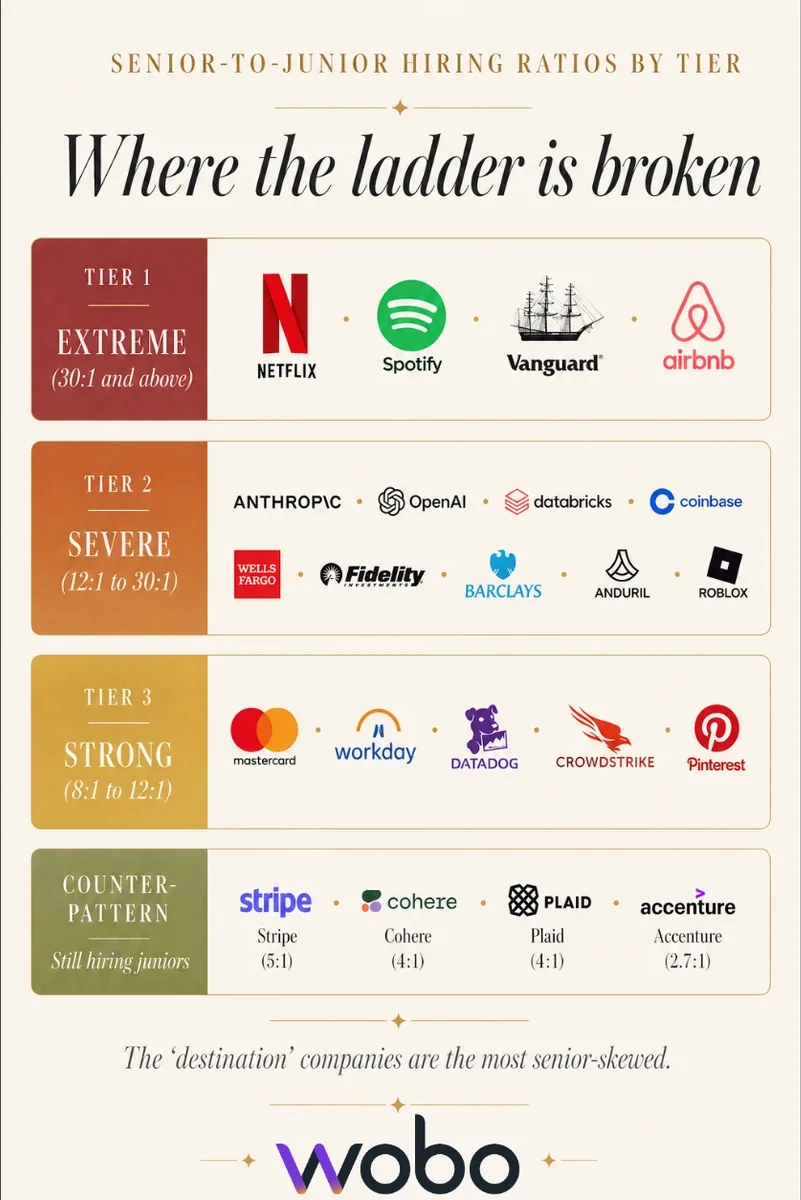
The pattern groups roughly into four tiers:
Extreme (30:1 and above)
Netflix: 47:1
Spotify: 47:1
Vanguard: 32:1
Airbnb: 30:1
Severe (12:1 to 30:1)
Anthropic: 24:1
OpenAI: 19:1
SoFi: 18:1
Databricks: 17:1
Perplexity: 17:1
Coinbase: 16:1
Scale AI: 16:1
Barclays: 15:1
Fidelity: 14:1
Wells Fargo: 13:1
CVS Health: 13:1
Anduril: 12:1
Roblox: 12:1
Strong (8:1 to 12:1)
Broadcom: 11:1
Pinterest: 11:1
Ramp: 10:1
Workday: 9:1
Datadog: 9:1
Mastercard: 9:1
CrowdStrike: 9:1
Moderate (4:1 to 8:1)
NVIDIA, Salesforce, Adobe, Stripe, Snowflake, Walmart, GM, Cloudflare, PayPal, and most other large employers cluster here.
Counter-pattern (under 4:1)
Accenture, GE HealthCare, and Intel hire across a more balanced range.
A few observations from sitting with this data.
The “destination” companies are the most senior-skewed
Netflix, Spotify, Anthropic, OpenAI, and Coinbase are the kinds of names that show up at the top of “best places to work” lists for engineers. They are also the names with the most extreme senior-only hiring patterns. The companies engineers most want to work for are the companies hiring juniors least.
This pattern matches the broader collapse documented in public data. The Federal Reserve Bank of New York[3] reports unemployment among recent computer science graduates aged 22-27 at 6.1% as of early 2025, with computer engineering graduates at 7.5% — both more than double the rates seen in biology or art history. SignalFire’s State of Talent Report[2] found that new graduate hiring at Big Tech firms has dropped over 50% since 2019, with another 25% year-over-year decline in 2024.
AI labs are not creating new entry-level pathways
The four most prominent AI labs in our dataset all hire in the senior-heavy band:
OpenAI: 19:1
Anthropic: 24:1
Scale AI: 16:1
Perplexity: 17:1
The narrative that AI labs would be the natural employer of “AI-native” new graduates does not show up in these companies’ own hiring patterns. The labs building the AI tools that supposedly democratize coding have themselves declined to train a new generation of engineers.
Traditional finance is the same
Major financial services companies are hiring at ratios that would have been considered extreme five years ago:
Vanguard: 32:1
Barclays: 15:1
Fidelity: 14:1
Wells Fargo: 13:1
Mastercard: 9:1
Whatever post-2024 calculus drove tech companies to stop hiring juniors is also operating inside legacy finance.
Some scale-ups are still hiring juniors
A handful of well-known companies are bucking the pattern:
Stripe: 5:1
Cohere: 4:1
Plaid: 4:1
Linear: 4:1
These are not junior-friendly the way 2018 startups were, but they are several times more open than the destination employers. If you are early-career and want a brand-name employer, these scale-ups are where the doors are still meaningfully open.
The counter-pattern companies are interesting
A few large employers hire across a more balanced range:
Accenture: 2.7:1
GE HealthCare: 1.1:1
Intel: 1.8:1
These are companies that either run scaled junior training programs (consultancies, large engineering services firms) or where junior pathways have been preserved through formal early-career programs. We mention them because they are real, and any honest reading of the data has to account for them.
The raw counts at the largest employers
Volume context matters when reading these ratios:
Anduril Industries posted 1,408 senior software engineering roles in the last year. It posted 118 junior. In a single year, this defense AI company alone posted nearly seven times as many senior roles as the entire combined junior count of Netflix, Anthropic, OpenAI, Airbnb, Coinbase, and Spotify combined.
Northrop Grumman posted 2,309 senior software roles, 473 junior. The defense industry is hiring software engineers at scale, and they are mostly hiring senior ones.
NVIDIA posted 2,241 senior, 402 junior. Despite being at the absolute center of the AI hardware boom, its hiring pattern leans senior at 5.6:1.
Accenture posted the most software roles of any company in our dataset, 10,637 in the last year. Their junior-to-senior ratio is the most balanced of any large employer in the data, at roughly 2.7:1. If you are early-career and looking for an actual employer, the consulting firms are doing more pipeline-building than the famous tech companies are.
The new role of senior engineers
The hiring data describes one half of the AI shift. The other half is what senior engineers are now actually doing.
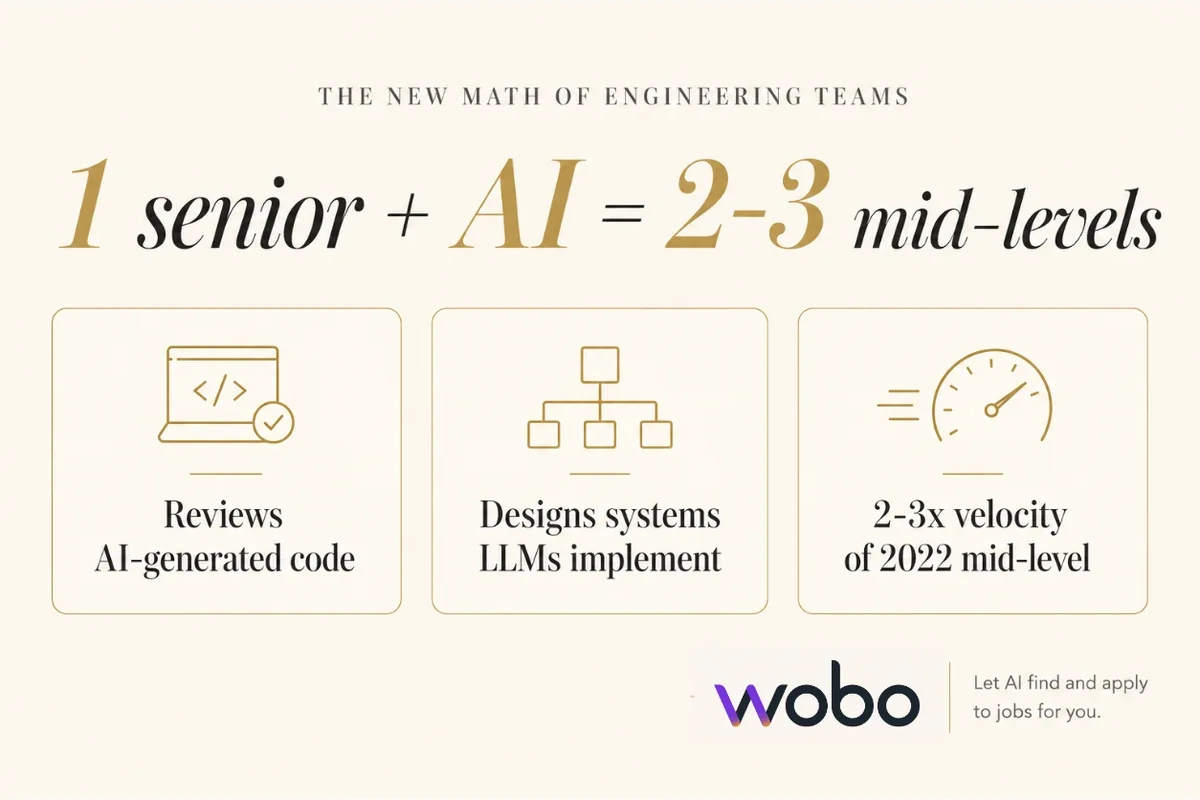
Senior engineers in 2026 are increasingly playing a different role inside teams. Rather than writing every line themselves, they are reviewing AI-generated code, designing systems that LLMs implement, and running the quality control loop on output that one senior engineer with AI tooling can produce at 2 to 3 times the velocity of a 2022-era mid-level engineer. The job description has not changed title. The work has.
This is the more honest answer to “why aren’t companies hiring juniors and mid-levels anymore.” It is not just that AI is faster. It is that the optimal team shape has changed. A senior engineer plus AI tooling produces work that previously required a senior, two mid-levels, and an occasional junior to ship. So companies hire the senior, license the AI, and skip the rest of the org chart.
This shift is not yet fully priced into how engineers think about their careers. The senior role of 2026 looks more like a tech lead with multiplied output than the individual contributor role of 2021. The mid-level role of 2026 increasingly does not exist as a distinct hiring tier. The junior role exists in name on career pages but is, in our data, a vanishingly small fraction of actual postings at most major employers.
Two software job markets, one labor pool
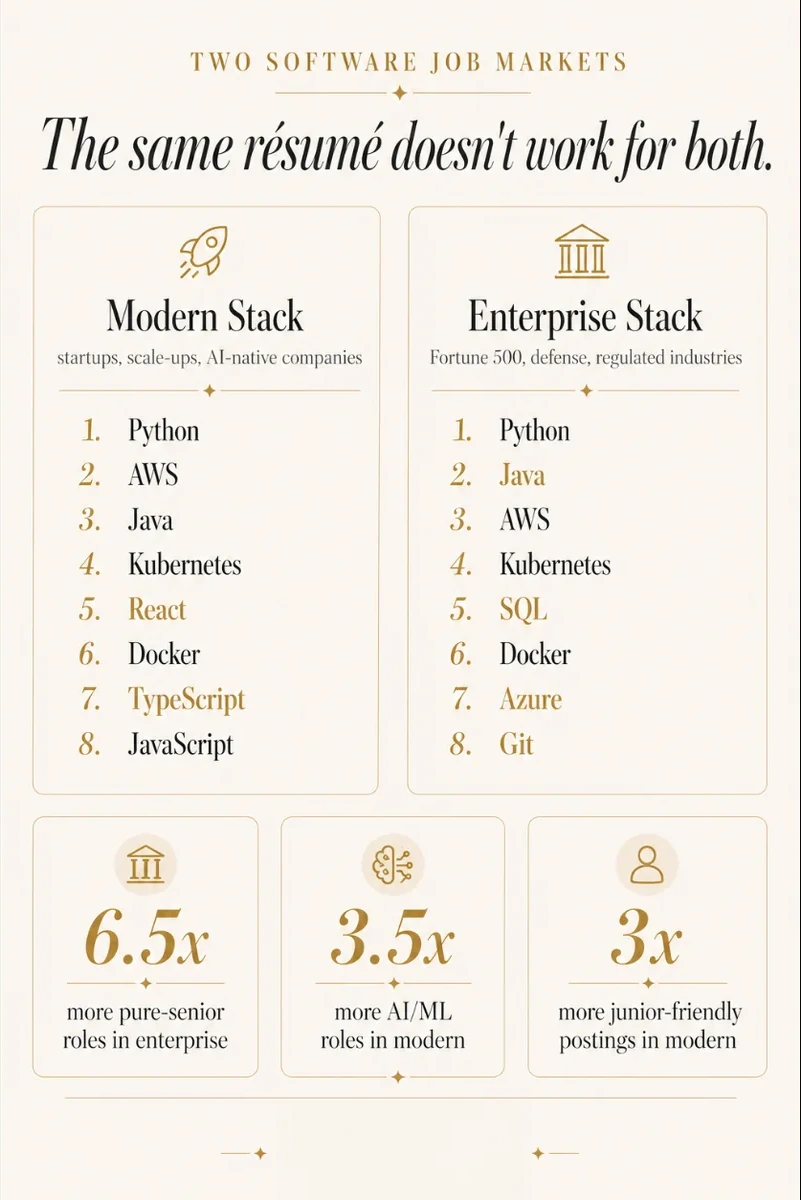
The provider distribution of the data reveals something we did not expect when we started this analysis. There are not really one software job market and several flavors of it. There are two distinct hiring economies running in parallel, and they barely overlap.
Compare the most-mentioned technologies in software job descriptions across the two largest providers in our index, over the same window:
Modern stack provider | Enterprise stack provider |
Python | Python |
AWS | Java |
Java | AWS |
Kubernetes | Kubernetes |
React (#5) | SQL |
Docker | Docker |
TypeScript (#7) | Azure |
JavaScript | Git |
Git | JavaScript |
SQL | Linux |
Azure | C++ |
C++ | Jenkins |
CI/CD | C# |
GCP | Terraform |
C# | CI/CD |
Node.js | GCP |
PostgreSQL | React (#17) |
Angular | TypeScript (#18) |
The differences are meaningful. React appears at #5 in one ecosystem and #17 in the other. TypeScript ranks #7 versus #18. The enterprise side’s top 20 is loaded with technologies that have largely left the modern side’s top tier: Jenkins, C#, Terraform, Oracle, Ansible, PowerShell, AutoCAD, MATLAB, Microsoft Office.
These are not different stacks because the languages have different capabilities. Python and Java are both general-purpose. AWS and Azure are interchangeable for most purposes. Both ecosystems include Kubernetes and CI/CD. They are different stacks because the companies in each ecosystem have different priorities. One side skews toward startups, scale-ups, and modern technology companies that picked their tools in the last decade. The other skews toward Fortune 500 enterprise, regulated industries, defense contractors, and infrastructure-heavy organizations whose stacks were built up over 20+ years.
The seniority distributions follow the same split:
Metric | Difference between the two ecosystems |
Pure-senior roles | 6.5x more common in enterprise |
AI/ML roles | 3.5x more common in modern |
Junior-friendly postings | 3x more common in modern |
The split is not about which companies take AI seriously. The enterprise ecosystem is full of companies that take AI extremely seriously: every major bank, every major insurer, NVIDIA, half the defense industry. The split is about which infrastructure companies built their software hiring on, and that infrastructure is a heavier anchor than the latest narrative of the moment.
For a job seeker, this matters because the same résumé does not work for both markets. The same recruiting channels do not surface both. The same interview prep does not cover both. We think one of the most underrated decisions an engineer makes in 2026 is which of these two markets they are aiming at. Most do not choose. They send the same generic application into both pipelines and wonder why the response rates are bad in one of them.
LLM skills are spreading faster than AI titles
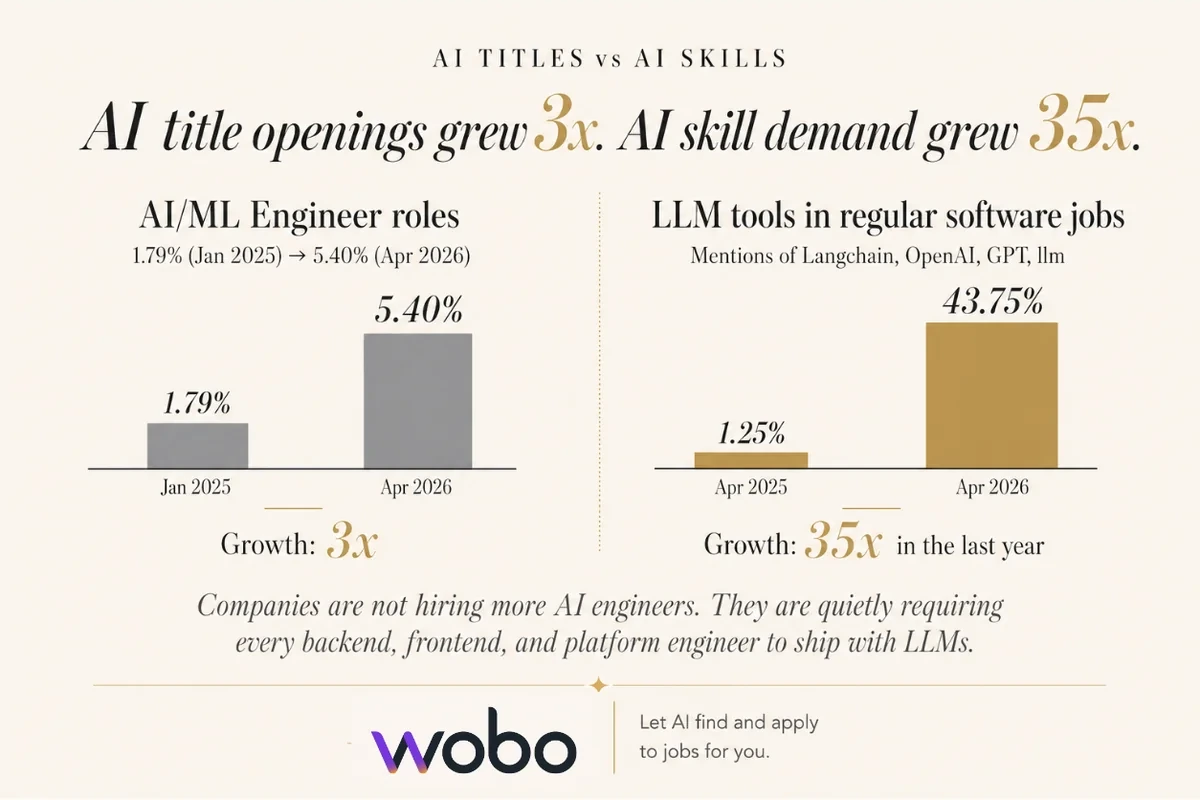
The category most observers point at when discussing AI’s effect on software hiring is “AI Engineer” or “ML Engineer” roles. By that measure, the AI hiring boom is real but smaller than the discourse implies. The share of software postings whose title contains “AI Engineer,” “ML Engineer,” or “Machine Learning Engineer” rose from 1.79% in January 2025 to 5.40% in April 2026. That is roughly a 3x increase in share, with a peak of 6.72% in December 2025.
That is a real shift. It is not the most important shift.
When we instead look for mentions of LLM-specific tooling (Langchain, OpenAI APIs, GPT, “llm”) inside the technology requirements of all software job descriptions, the number tells a different story. Mentions of these tools in regular software job descriptions have grown roughly 35x in the last year. They show up in backend, frontend, and platform roles where the title says nothing about AI.
The number of distinct technologies required in senior job postings has also increased by nearly 1.5x over the same period. Companies are not just shifting toward AI roles. They are widening the technical bar across all senior roles, and adding LLM tools to the list of expected skills.
This pattern aligns with broader labor market reporting. The Washington Post[4] documented in August 2025 that employers are increasingly seeking “AI literacy” across non-AI roles, and LinkedIn’s January 2026 Labor Market Report[5] recorded that US job postings requiring AI literacy increased 70% year over year.
The qualitative claim is unambiguous, even if the precise multiplier on LLM growth carries some uncertainty:
Companies are not, primarily, hiring more AI Engineers. They are quietly requiring every backend, frontend, and platform engineer to ship with LLMs.
This is the more important shift. The “AI Engineer” job category is a small share of the market. The expectation that every senior software engineer should be familiar with LLM tooling has spread across the broader job market substantially faster than dedicated AI roles have grown.
If you are an experienced engineer, your job description has not changed title in the last 18 months. What is in it has. If you are a new graduate trying to break in, the bar has moved. Familiarity with LLM tooling is no longer an “AI Engineer” qualification. It is a baseline expectation in roles that do not even mention AI in the title.
The technologies that won, and the ones that lost
Tracking technology share over the last 16 months:
Technology | January 2025 share | April 2026 share | Change |
Python | 37.3% | 36.1% | flat |
AWS | 23.5% | 22.0% | flat |
TypeScript | 23.5% | 22.0% | flat |
Java | 29.6% | 24.0% | −19% |
React | 14.8% | 22.2% | +50% |
Kubernetes | 4.7% | 6.5% | +38% |
Go | 0.3% | 1.7% | gained |
LLM tooling stack | <1% | ~5% | ~35x |
Python and AWS have not changed share because they are universal enough that almost every job posting now mentions one or both. The mention rate cannot grow further. Java has lost meaningful share.
The technologies gaining ground are the ones associated with modern, AI-native infrastructure:
Go for high-throughput services and agent fleets
Kubernetes for orchestrating LLM serving
React for the frontend layer of AI products
The LLM tooling stack itself
The skill mix is moving. The implication for engineers planning their next 18 months of skill investment is straightforward: if you are skilling up for the wrong stack in 2026, you will be applying for the wrong jobs in 2027.
The remote work numbers are inflated
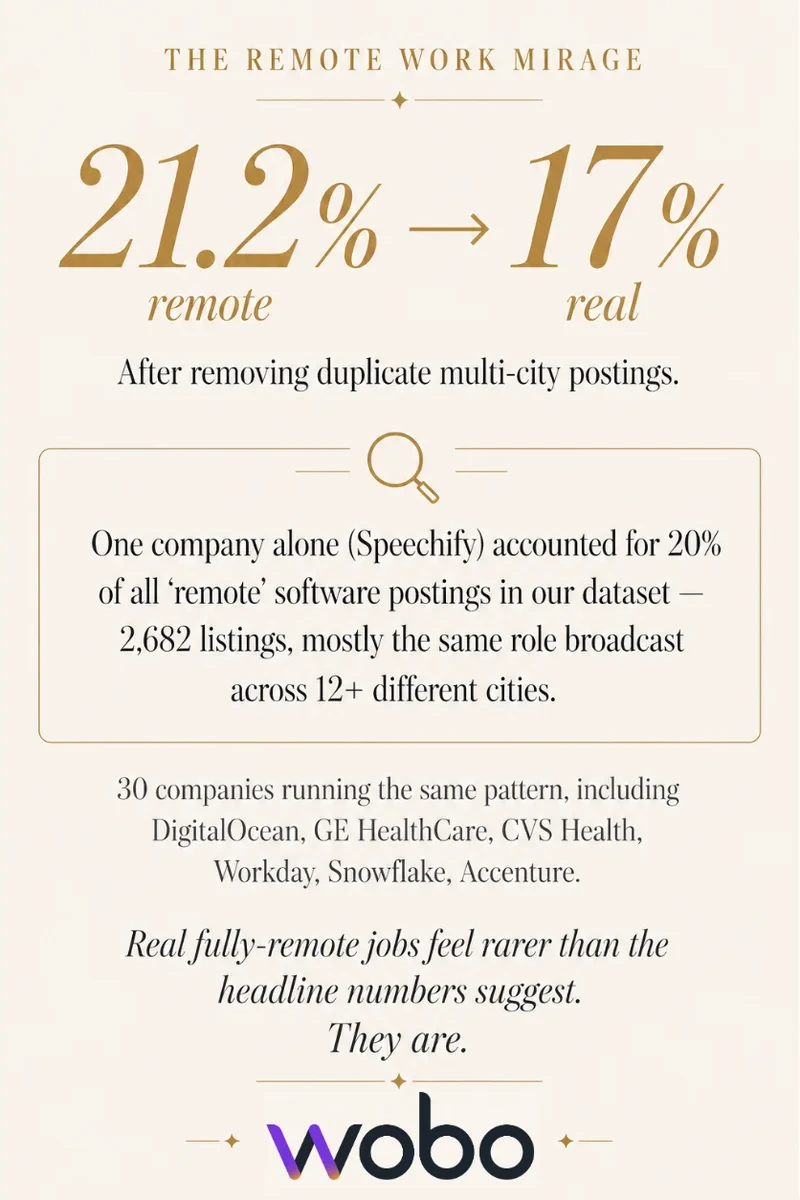
Of the 63,133 software postings in our last 90-day snapshot, 13,365 are tagged as remote (21.2%). That number has been relatively stable for several quarters and would, on its face, support the narrative that remote work has settled into a real if minority share of the labor market.
The number is inflated.
When we audited our top remote-posting employers, we found that a single company (Speechify) accounted for 2,682 of those 13,365 remote postings, or roughly 20% of the entire “remote software jobs” total in our dataset. We then looked at what those postings actually were. The pattern was consistent: the same role, posted in 12 or more different cities, all marked remote. “Tech Lead, Android Core Product” appears as a unique posting in London, Mumbai, Lisbon, Tokyo, São Paulo, Amsterdam, Dublin, Istanbul, Lagos, Nairobi, Seoul, Berlin, Hanoi, Mexico City, and others. Each city gets its own listing. Each is technically remote.
Speechify is not the only company doing this. We found 30 such employers running the same pattern, including DigitalOcean (24 unique roles spread across 120 cities), Veeva Systems, GE HealthCare, CVS Health, Splunk, Workday, Snowflake, Accenture, Leidos, and Launch Potato. Together these companies account for several thousand “remote” postings that are, in practice, much smaller numbers of unique roles being broadcast for visibility.
If we subtract the most aggressive multi-city duplicators from the total, the remote share of our dataset drops from 21.2% to closer to 17%. That is still meaningful. It is also closer to the lived experience of engineers who report that “actually fully remote” jobs feel rarer than the headline numbers would suggest. They are.
The visa sponsorship collapse
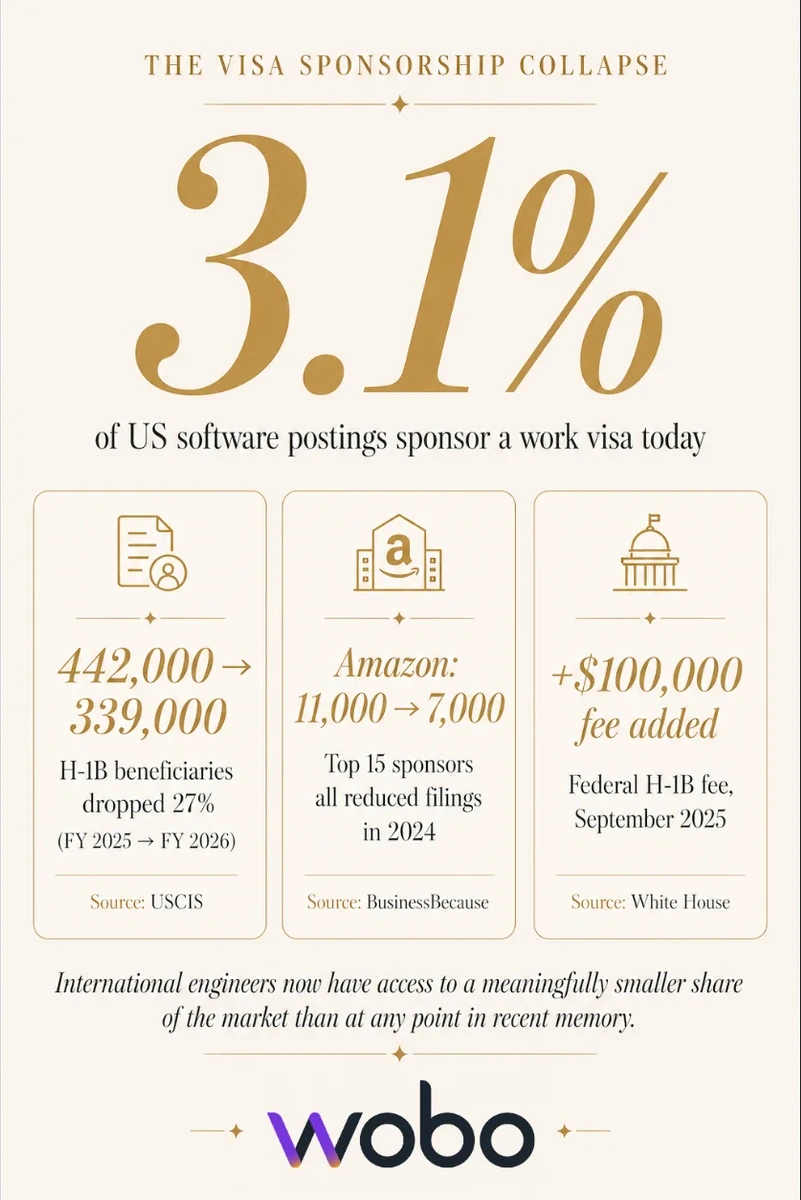
Our data shows that of 63,133 US-based software postings in the last 90 days, only 1,943 (3.1%) indicate willingness to sponsor a work visa. That is roughly 1 in 32 software roles open to international candidates.
The trend is downward across multiple authoritative data sources:
Source | Metric | Data point |
Wobo data (April 2026) | US software postings sponsoring visa | 3.1% |
USCIS[6] | H-1B beneficiaries FY 2025 → FY 2026 | 442,000 → 339,000 (−27%) |
BusinessBecause / USCIS[7] | Amazon H-1B filings 2023 → 2024 | 11,000+ → 7,000 |
White House[8] | New federal H-1B fee, Sept 2025 | +$100,000 |
USCIS[6] reported a 27% drop in H-1B beneficiary registrations between fiscal year 2025 and fiscal year 2026, from approximately 442,000 to 339,000 unique beneficiaries. The top 15 H-1B sponsoring companies all decreased their visa filings in 2024[7], with only Meta increasing. Amazon went from over 11,000 H-1B filings in 2023 to roughly 7,000 in 2024. In September 2025, the federal government added a $100,000 fee to most H-1B applications[8], a structural change that will likely accelerate the decline at all but the largest employers.
The combined picture: sponsorship was already shrinking before the 2025 policy changes. The 2025 changes accelerated the decline. International engineers competing for US software roles now have access to a meaningfully smaller share of the market than at any point in recent memory, and the trajectory is still downward.
The pragmatic move for international candidates is to work backwards from sponsorship: identify the companies and role types that still consistently sponsor (large enterprise, certain defense contractors, certain healthcare companies, large engineering services firms) and target those, rather than starting with the role and hoping sponsorship will appear.
What this means for engineers in 2026
We try to avoid prescriptive career advice in our reports because the diversity of individual situations makes generic recommendations close to useless. With that caveat acknowledged, here is what we think the data implies for engineers planning their next 12 months.
If you are a new graduate or entering software engineering through a non-traditional path
The volume of explicitly junior-tagged roles has not recovered from the 2024 collapse. The most famous employers (Netflix, Anthropic, Spotify, Airbnb, OpenAI) have the worst senior-to-junior ratios in our dataset.
The realistic entry points are:
Large consulting firms (Accenture has the most balanced junior:senior ratio of any large employer at 2.7:1)
Large industrial and healthcare companies (GE HealthCare, GE Vernova)
Some defense contractors with formal early-career programs
A handful of scale-ups (Stripe at 5:1, Cohere at 4:1, Plaid at 4:1) that are still meaningfully more open than the household names
These are not the answers most career advice gives. They are where the doors are still actually open.
If you are mid-career and worried about being squeezed
The mid-level role description has changed. The most-requested skills are moving toward Go, Kubernetes, React, and LLM tooling, and away from Java and pure-frontend specialization.
Generalist engineers with modern stacks and credible LLM literacy are the most valuable hires of 2026, by margin. Specialists in a single layer of the stack (frontend-only, mobile-only) are increasingly being absorbed into fullstack roles.
If you are senior or above
The senior+ share of postings has held remarkably stable around 50% for 18 months, but the bar inside that share has risen.
AI-tooling-fluent senior engineers with proven leverage on small teams are the highest-leverage hires available. Senior engineers who can credibly mentor the few juniors that do still get hired are unusually valuable, because the supply of pipeline-trained junior engineers is shrinking and has been for two years.
If you are searching internationally
US visa sponsorship has collapsed to 3.1% of software postings, and the public H-1B numbers suggest the decline is structural, not temporary. The pragmatic approach is to identify sponsoring employer categories that are stable (large enterprise, certain defense contractors, certain healthcare companies, large engineering services firms) and target those directly.
Industry implications
A few observations for the recruiting and hiring leadership reading this report.
The collective decision to scale back junior hiring is reshaping the senior labor pool. The candidates currently filling senior roles came up through pipelines that are now significantly thinner. In 5 to 7 years, the senior engineer market companies depend on will likely be measurably tighter because the cohort that should have been training in 2024-2026 is doing something else for a living instead. Several of the companies in the senior-only tier of our data are aware of this and are addressing it through internal training programs and apprenticeships. Many are not.
The two-market split described above has a recruiting implication too. Hiring teams operating in the enterprise ecosystem are competing for a labor pool that is older, more expensive, and more concentrated in legacy stacks. Hiring teams operating in the modern ecosystem are competing for a labor pool that is younger, more globally distributed, and increasingly fluent in AI tooling. The same job description does not perform equally in both. We see hiring teams underestimate this.
Closing
The software industry has spent two years telling itself that AI would empower the next generation of engineers. The data we collect across 3 million job postings says the next generation is having a harder time getting hired than at any point in modern memory.
The companies building the tools that promise to make junior engineers obsolete are themselves declining to hire any. The companies integrating those tools into legacy systems are doing the same. The companies still maintaining genuine pipelines for new talent are the ones nobody is writing career advice about: consulting firms, healthcare giants, defense contractors, scaled industrial operators.
If you are an engineer planning your next move, the maps you have been given are wrong. The opportunities are not where you have been told to look. They have not disappeared. They have moved. If you want help finding them, the Wobo platform is built for exactly this — matching engineers to the roles that fit their actual profile, including the ones outside the obvious destinations.
We will publish the next iteration of this report in roughly six months. In the meantime, write us at support@wobo.ai.
🚀 Stop Applying Manually
AI scans the job market 24/7, finds matching roles, and applies with tailored content
Automate My Job Search →★ 4.7/5 on Reviews.io
Sources
- Stanford Digital Economy Lab. Labor market analysis on early-career technology hiring decline post-2023. digitaleconomy.stanford.edu
- SignalFire. State of Talent Report 2025. New graduate hiring at Big Tech firms has fallen over 50% since 2019, with an additional 25% year-over-year decline in 2024. signalfire.com
- Federal Reserve Bank of New York. Labor Market Outcomes of College Graduates by Major. Computer science graduates aged 22-27 face 6.1% unemployment, computer engineering 7.5%, both more than double rates in non-technical fields. newyorkfed.org
- The Washington Post. Abril, Danielle. “Bosses are seeking ‘AI literate’ job candidates. What does that mean?” August 30, 2025. washingtonpost.com
- LinkedIn Economic Graph. Building a Future of Work That Works: January 2026 Labor Market Report. US job postings requiring AI literacy increased 70% year over year. economicgraph.linkedin.com
- U.S. Citizenship and Immigration Services (USCIS). H-1B Electronic Registration Process: FY 2026 Cap Statistics. The number of eligible unique beneficiaries dropped from approximately 442,000 in FY 2025 to 339,000 in FY 2026, a 26.9% reduction. uscis.gov
- BusinessBecause. “H-1B Data Shows Top Companies Sponsoring Fewer Visas In 2024” (analysis of USCIS Fiscal Year 2024 data). All but one of the top 15 H-1B sponsors decreased filings; Amazon went from over 11,000 to roughly 7,000. businessbecause.com
- The White House. “Restriction on Entry of Certain Nonimmigrant Workers.” Presidential Proclamation, September 19, 2025. Adds a $100,000 fee to H-1B specialty occupation petitions. whitehouse.gov
Wobo is an AI job search platform that automates job searching for tens of thousands of users. To see what jobs match your profile, visit wobo.ai.
This report and the underlying data are made available for reference and journalistic citation. If you are quoting from it, we would appreciate a link back to wobo.ai.

Stop Applying Manually
- ✓AI scans the job market for you 24/7
- ✓Applies with tailored content on company sites
- ✓You focus on interviews, we handle applications